Just to remind you about the detail: there was an explosion at the pit which took the lives of 439 miners (boys and men) plus 1 rescue worker. The mine manager and the owners (who had previous form - 81 men had also died there in 1901, just 12 years earlier) were prosecuted and fined a paltry £24. This caused national outrage and newspapers of the time wrote that the life of a miner was worth just one shilling and a penny farthing.
I've learnt recently that my grandmother (Florrie B of blessed memory) went up to Sengenhydd as soon as she'd heard about it. She would have been 12 at the time and must have walked up from Caerphilly. If only I'd known this when she was alive to ask her about it.
Quid me anxius sum? (Alfred E Neuman, Mad Magazine circa 1956). Facio, ita.
Monday, 14 October 2013
Saturday, 12 October 2013
Let's raise a glass, or two, to Jumbo
What comes after Dead Elephant Ale? What else but Double Dead Elephant Ale? Double in the sense of higher alcohol content and a more bitter taste. Will there be a triple dead elephant ale at some stage?
Thursday, 10 October 2013
An elephantine tale - Post Script
A comment on yesterday's post reads: "I don't think they found all the ashes if they fit in a peanut butter jar". A good point and one that I followed up by e-mailing the Athletics Department at Tufts University for clarification. It wasn't long before I received this reply: "Phyllis Byrne, the administrative assistant in the athletics department, dispatched a colleague to the ruins to collect some of Jumbo's ashes in an empty peanut butter jar. Jumbo's spirit lives on in his hybrid container (a Peter Pan Crunchy lid on a Skippy jar), and since 1975, university athletes have rubbed the jar for good luck. And when a new athletics' director is named, there is a ceremonial "passing of the ashes" to the successor".
I was hoping for a photograph but the image I found on the Internet will have to do. And, finally, for UK readers wondering what a Skippy jar is - it's another brand of peanut butter. Given the choice, which would Jumbo prefer? Me? Neither. I can't stand the stuff.
Wednesday, 9 October 2013
Canadian Observations: Part 3 - An elephantine tale
Jumbo (the name comes from the Swahili word “jumbe,” which means chief) was the star attraction of the Barnum and Bailey Circus. He was billed as the largest land animal ever in captivity. Born wild in the Sudan in 1859, Jumbo became the main attraction at the London Zoo for many years due to his tremendous size and mild temperament. However, he started getting bored and was acting up so, in 1882, the Zoo sold him for $10,000 to the circus. Jumbo's sale caused a great uproar throughout England, with Queen Victoria and the Prince of Wales (Their majesties were not amused. Sorry, just couldn't let that one go by!) among many expressing their concern and disappointment. Despite attempts to block the sale, the ever-resourceful Barnum managed to secure his elephant and on Easter Sunday, April 9th, 1882, with bags pached (pached - pachyderm - get it?) Jumbo arrived in New York City to much celebration. In Jumbo's first year with the circus, Barnum earned $1.5 million. But the good times didn't last and, sadly, whilst preparing to board trains in St. Thomas on September 15th, 1885, Jumbo was hit by an oncoming locomotive and killed. According to legend, Jumbo sacrificed his own life to save a baby elephant called Tom Thumb. A touching story but almost definitely not true and a product of Barnum's showmanship. The life-size statue of Jumbo now commemorates the tragedy at the very spot where the accident occurred. Apparently there is also a mural somewhere nearby but we drew the line at looking for that. There was a limit to how much of St Thomas we wanted to see.
To complete the story: what do you do with the two ton corpse of a dead elephant? Employ an expert taxidermist, that's what! Jumbo's skeleton was donated to the American Museum of Natural History in New York. His heart was sold to Cornell University and his hide was stuffed and travelled with the circus for a number of years. Even in
![]() |
| Jumbo stood on display in Barnum Hall at Tufts until fire destroyed the building - and Jumbo - in 1975 |
death he performed and drew the crowds. In 1889, Barnum donated the stuffed Jumbo to Tufts University where it was displayed until destroyed by a fire in 1975. Jumbo's tail, which survived the fire, is kept in the University archives; his ashes, recovered at the time by a forward-thinking caretaker, are kept in a 14-ounce Peter Pan Crunchy Peanut Butter jar in the office of the Tufts athletic director.
A statue of Jumbo was purchased from an amusement park and placed on the Tufts campus after the fire; however this erroneously depicts an Asian elephant rather than an African one (it's in the ears, dear, the ears!). In honour of Barnum's donation of $50,000 and Jumbo's hide, Jumbo became the university's mascot and remains as such today. I think it's a lovely story. So, when you next order a large hot dog or sausage or fly on a Boeing 747, think 'Jumbo' and remember his statue at St Thomas and his remains in a peanut butter jar. Is there any significance in it being the crunchy variety? Maybe someone sampled the ashes and felt that the smooth version would not be appropriate?
![]() |
| And this is what Jumbo looks like today. Sort of. I doubt that his ashes are the colour of crunchy peanut butter but I stand to be corrected. |
Monday, 7 October 2013
A very pleasurable day.......
..............Comprising of a morning pottering about, early afternoon productive shopping session in Tavistock, excellent lunch at Robertson's and a walk along the river at Calstock to Okel Tor Mine.
| The iconic railway viaduct at Calstock |
| If I could build a wall like this, I'd be pleased. |
Sunday, 6 October 2013
The making of a Bodmin Moor legend
As you might expect from such a bleak and mysterious place, Bodmin Moor has more than its fair share of myths and legends - from the strong connections of the bottomless (?!) Dozmary Pool to the stories of King Arthur, the smuggling exploits associated with Jamaica Inn, the ghostly presence of murder victim Charlotte Dymond on the slopes of Roughtor. right up to present day reports of farmers' livestock being hunted down by the Beast of Bodmin Moor.
Practically every village on or near the moor has a tale to tell. Even Upton Cross which we pass through every time we head up onto the moor. Especially Upton Cross! Few places can rival the dramatic story still told around the fires in the houses of the village on dark, winter nights. Dear readers, draw closer if you dare and I'll tell you all about the Head of Fernley Pike. Whoooooooo!
At the centre of the village lies the Victorian school and observant travellers will notice that there is a gap in otherwise completely symmetrical lower railings.
Closer inspection reveals to the intrepid explorer the following plaque:
'Fernley Pike was stuck here. June 1945.' Who could fail to be intrigued by this? Who was Fernley Pike and why is he remembered? Permit me to enlighten you.
Fernley was a pupil at the school and, one day in June 1945, a football bounced over the railings and landed on the pavement outside. Fernley thought that he could reach the ball by reaching through but Fernley was wrong. His head got firmly stuck and, despite the heroic efforts his teachers to free him, the village blacksmith had to be called to cut the railings with a hacksaw. This story has entered the folklore of Upton Cross and Fernley, who is in his 70s and now lives over the border in Devon, is still remembered for it. In 2008 he was invited to present a cheque to the school on behalf of the ex-pupils but this was a subterfuge as he was really asked to come along to unveil the commemorative plaque now affixed to the railings.
And there was more to come! Last year, Sterts Theatre (based in Upton Cross) put on a production called Cornish Phoenix. It was a musical story of life and love on Bodmin Moor, conceived and written by Nick Stimson with the help of local people who contributed ideas and stories at a series of workshops held over the winter. The tale of Fernley Pike was one of those stories and the moment features in the finished play. Fernley was guest of honour at one of the first performances of the play, which he attended with his family. The photograph below shows him chatting to the young actors on the stage set about his moment of fame – or infamy.
Every time we pass Upton Cross school now we shout 'Remember Fernley Pike'. Long may he be remembered. And long may he act as an example of how not to retrieve a football.
| Fernley Pike re-enacts his entry into the history books. |
Every time we pass Upton Cross school now we shout 'Remember Fernley Pike'. Long may he be remembered. And long may he act as an example of how not to retrieve a football.
Saturday, 5 October 2013
In search of something that wasn't there!
To Minions on Bodmin Moor this afternoon with my IWC to see what was going on at a recent archaeological dig which took place whilst we were away. The dig uncovered a causeway linking two of the 4000 year old stone circles at the Hurlers. What we were hoping to see was:
Although it doesn't look like it, the stones are of local quartz and, as such, would have been impressively white in their original state. What we actually saw was:
The dig was over and, after recording what had been revealed, they'd covered it up again. Still, all was not lost as we continued our walk around the Cheesewring and back to the car. It was a very clear day and I reckon we could see for at least 25 miles. Here are a few more images.
![]() |
| And this is what a 25 mile vista looks like. We are looking east towards Dartmoor. We could just about make out our house on the slopes of Kit Hill about 6 miles away. |
Thursday, 3 October 2013
Canadian Observations: Part 2 - Fishy Tales
I came to the conclusion that Canadians love fish: actually it's more than that - they dote on fish. And the welfare standards they set for their piscine inhabitants are nothing short of inspirational. Let me give you just two examples I encountered on our travels.
What do they do with fish which are stressed with modern life? They give them sanctuary, that's what. They fence off areas of tranquil lakes, provide subdued lighting and play ambient music. Everything a fish could need to calm its ruffled fins.
And rather than release them back into the wild too prematurely after they have rediscovered their inner fish, they have a period of rehabilitation in another specialist area. Here, their strength is built up and they learn to interact constructively with other species. Counselling is provided by social worker fish (recognisable by their natty denim dungaree outfits) and case study managers.
What do they do with fish which are stressed with modern life? They give them sanctuary, that's what. They fence off areas of tranquil lakes, provide subdued lighting and play ambient music. Everything a fish could need to calm its ruffled fins.
And rather than release them back into the wild too prematurely after they have rediscovered their inner fish, they have a period of rehabilitation in another specialist area. Here, their strength is built up and they learn to interact constructively with other species. Counselling is provided by social worker fish (recognisable by their natty denim dungaree outfits) and case study managers.
And when they are fully recovered and completely at ease with themselves, they are released back into the wild. There to be caught, filleted and eaten by people like me. Feast your eyes on this plate of home smoked walleye. Does anything taste better than a totally relaxed fish? I think not!
* For those who don't know, a walleye is a fresh water fish indigenous to the northern states of the USA and Canada. It's also known as a pickerel.
** Many thanks to Mary and Frank for the fish (smoked in Frank's home smoker).
Wednesday, 2 October 2013
Canadian observations: Part 1 - Iconography
We've just enjoyed 14 days in Canada with friends. The fact that my blog was suspended during this period is a testament to how busy we were and how much we packed into our time there. So, instead of my customary 'real time' travelogue, I'm going to give a few (vaguely accurate) posts on some items that caught my fancy or amused me. I thought I'd start off with some Canadian icons.
1. Tim Hortons
1. Tim Hortons
More, a lot more, than just a fast-food outlet, Tim Hortons (sadly always without an apostrophe) is an object of national veneration. Indeed, if such a thing were possible, I'm sure it would be a candidate for Canadian sainthood. Tim Horton was a hockey player who started his eponymous chain of doughnut shops in the late 1960s. Sadly he died in a car crash not that long after but his widow has ensured that his name lives on. Curiously, at least to the European mind, you can buy 'Tim Bits' at each shop. No, these do not refer to some strange relics of the Body of the Departed Tim but to the holes of the doughnuts, which are sold separately in Canada. What are the doughnuts like? No idea as fried dough covered in sugar is not my thing but the cinnamon and raisin bagels are good. As is the coffee apparently. Oh yes, they have clean toilets and free Wi-Fi. The Blessed Tim would be pleased.
2. Poutine
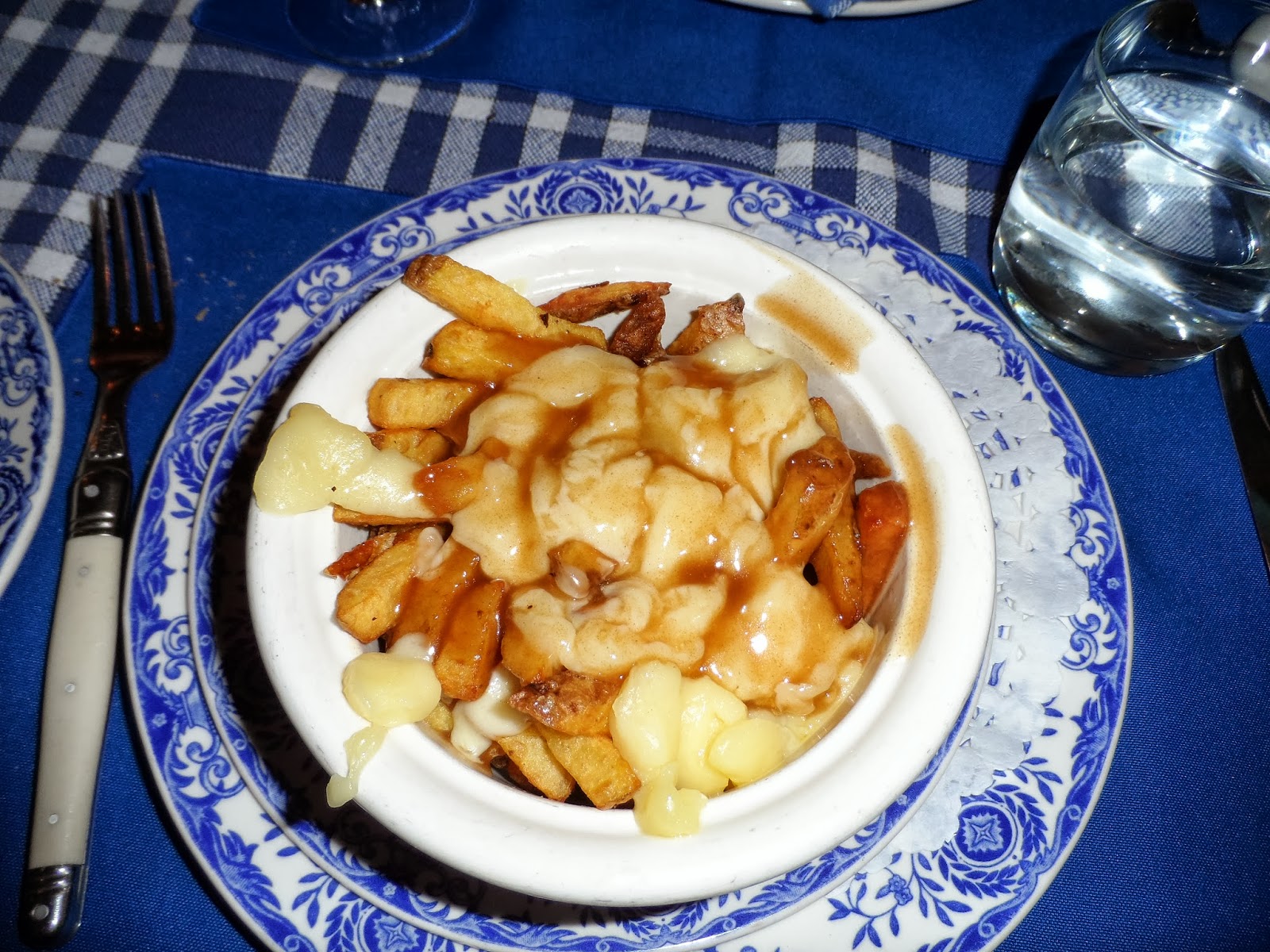
Whilst on the subject of fine-dining, I just could not ignore the joys of that local delicacy, poutine. How can I describe it? Chips, smothered in gravy and cheese curds is pretty accurate. How does it taste? Just as you would expect chips smothered in gravy and cheese curds to taste. How do you feel after eating it? Just as you would expect after eating a pile of chips smothered in gravy and cheese curds. How does it look? Just as you would expect chips smothered in gravy and cheese curds to look. If you don't believe me, here's a plateful to tempt your tastebuds.
It is served everywhere. Everywhere we go, they throw in a ladle or two of poutine into the bargain. "Postcards? Sure, over there, and here" - gloop - "have some poutine with them". "Tickets to the theatre? No problem and here" - gloop - "take some poutine for the interval".
3. Canadian Loonies
No, not some sort of mental instability (you know, the kind that motivates people to eat at Tim Hortons or wallow in bowlfuls of poutine) but the one-dollar coin. So called because of the depiction of a waterfowl - the loon - on one side. And don't you dare think that the figure on the obverse is in good company. To take your mind off this possibility, I'll let you know that when the two-dollar coin was introduced, it was named, with admirable Canadian logic, the 'twoonie'.
Tuesday, 17 September 2013
In praise of Aunty Charlotte
![]() |
| Angelina Weld Grimke |
One of my Poem-a-Day e-mails a few days ago introduced me to one entitled 'To Keep the Memory of Charlotte Forten Grimke' by Angelina Weld Grimke. Who were these women? And why did one eulogise the other? If you read the poem at the end of this post perhaps you'll agree that eulogy is the right way of describing it. Briefly, here's the story of two quite remarkable women and it takes us into an area that we don't hear much of in our history lessons in the UK.
![]() |
| Charlotte Forten Grimk |
Her niece, Angelina, lived with her aunty Charlotte during her teenage years, while her father served as the American consul to the Dominican Republic. She was born on February 27th 1880 in Boston. After graduating from the Boston Normal School of Gymnastics (now Wellesley College) in 1902, Angelina embarked on a career teaching English in Washington, D.C. that would last until 1926. It is during her teaching career that she begins to write. Her poetry, short stories and essays were published in The Crisis, Alain Locke’s The New Negro, in Countee Cullen’s Caroling Dusk and in Robert Kerlin’s Negro Poets and Their Poems. She is best known for her play Rachel, a three act drama that was performed by an all black cast in March of 1916. Published in 1920, the play was produced as a vehicle for the NAACP (National Association for the Advancement of Coloured
People. Founded in 1909, the NAACP is the oldest and
largest civil rights organization in the USA) to rally support against the film The Birth of Nation. In the production program of the play the NAACP qualifies Rachel as unprecedented, “This is the first attempt to use that stage for race propaganda in order to enlighten the American people relating to the lamentable condition of ten millions of colored citizens in this free republic.”
After her father died, Angelina moved to New York and never published again. Dying in 1958, she is regarded as a forerunner of the cultural awakening of black art and expression.
At a distance, it's difficult for someone in the UK to fully appreciate the difficulties Charlotte and Angelina faced and the determination they must have shown in pursuing their aims. I think it's right that we keep the memories of both of them, albeit briefly.
To Keep the Memory of Charlotte Forten Grimke
by Angelina Weld Grimke
Still are there wonders of the dark and day;
The muted shrillings of shy things at night,
So small beneath the stars and moon;
The peace, dream-frail, but perfect while the light
Lies softly on the leaves at noon.
These are, and these will be
Until Eternity;
But she who loved them well has gone away.
Each dawn, while yet the east is veiléd grey,
The birds about her window wake and sing;
And far away each day some lark
I know is singing where the grasses swing;
Some robin calls and calls at dark.
These are, and these will be
Until Eternity;
But she who loved them well has gone away.
The wild flowers that she loved down green ways stray;
Her roses lift their wistful buds at dawn,
But not for eyes that loved them best;
Only her little pansies are all gone,
Some lying softly on her breast.
And flowers will bud and be
Until Eternity;
But she who loved them well has gone away.
Where has she gone? And who is there to say?
But this we know: her gentle spirit moves
And is where beauty never wanes,
Perchance by other streams, mid other groves;
And to us here, ah! she remains
A lovely memory,
Until Eternity;
She came, she loved, and then she went away.
Sunday, 15 September 2013
I leave these shores with considerable trepidation..............
...............at what mischief this lot will get up to in my absence. Perhaps they'll be gone when I come back? Perhaps it's all a nasty dream? Perhaps I need a holiday?
(If you are interested, the links will take you to some interesting comments on their respective performances. I particularly like the one at the end for Hapless Nick Clegg - it's well worth three minutes of your time to view).
| David Cameron - A Prime Minister who can't lead. |
| George Osborne - a Chancellor who can't count. |
| Michael Gove - an Education Secretary who's semi-literate. |
| Iain Duncan-Smith – a head of the Department of Work and Pensions who’s unemployable. |
| William Hague – a Foreign Secretary who can’t read a map. |
| Owen Paterson – an Environment Secretary whose big policy is killing large numbers of animals. |
| Philip Hammond – a Defence Secretary who sulks when Parliament won’t allow him to attack. |
| Theresa May – a Home Secretary who always seems to be completely out-to-lunch. |
| Jeremy Hunt – a Health Secretary who makes everybody sick. |
| Chris Grayling – a Justice Secretary who specialises in making trials unfair. |
| Maria Miller – a Culture Secretary who is an utter philistine. |
| Eric Pickles – a Communities Secretary who makes everyone want to steer well clear of him. |
| Edward Davey – an Energy Secretary of stultifying inertia. |
| Nick Clegg – a Deputy Prime Minister who… um… does… er… well, he’s… well-well what I’m trying to say is… no, I mean… well I mean, what he’s there to do is… to… ermmmmm… |
Friday, 13 September 2013
Service with a smile: continued (again).
A recent trip to Jersey gave us the opportunity to partake of the delights of Coffee Republic. To be accurate, my IWC had the coffee and I had a rather nondescript cup of Earl Grey (such sophistication for one from Trethomas). I've had a pop at Costa Coffee and Starbucks in the past and, I'm afraid, now it's the turn of Coffee Republic. Lousy coffee by all accounts in a mug with an intriguing slogan. The beans were 'lovingly brewed', allegedly. This got me thinking about how would we know the amount of affection that went into producing each mugful. Maybe something along the following lines happens in the brewery/roastery...............?

Subscribe to:
Posts (Atom)