Saturday, 20 May 2017

Sunshine and Monuments on Bodmin Moor

A walk with our monthly group a little closer to home this week, just ten miles away in the centre of Bodmin Moor. The weather gods were kind to us.
We started and ended in the Hurlers car park at Minions. It was a 6.8 mile circular route taking in Craddock and Twelve Men's Moors, plus a couple of tors and some stretches on the old mineral railway. The track is the green one in the inset above, which also shows the many walks we've done in this general area. We are starting to know it quite well and we never get bored with the scenery. It's always different.
A solitary engine house on the way to Treggarick Tor. It was surrounded by lots of evidence of the mining activities that took place there in the mid 1800s, with some features that looked like they pre-dated this period. 
On the side of Tregarrick Tor looking northwards with Brown Willy and Rough Tor in the far distance. They'd be about 20 miles away, as the crow flies.

Clouds over Tregarrick Tor. It was not a day for clear blue skies and the cloud formations were with us all the way around.
Ooh, look! A dip in the ground. Yes, it is but a rather intriguing dip. It's actually a cursus: sort of like a trench or embankment but wider. This is Neolithic in origin, is around 5 meters wide and about 2 kilometers long. What was its function? Processional? Ceremonial? No-one knows for this one but it can't be a coincidence that it seems aligned with the high point of Caradon Hill at one end and towards Rough Tor at the other.
Just one of the many Neolithic/Bronze Age hut circles that are on this part of the moor. It's a good time of year to see them as the bracken has not yet grown up to obscure some of the features. At other times it can be quite difficult to discern the various artifacts and sometimes impossible to rediscover something that you know is there and have visited several times already.
What are we looking at here? In the middle left you can make out the outline of a settlement boundary. In the foreground is a large flat stone surrounded by an enclosure of stones. This predates the settlement so the settlement builders were aware of it but did not 'rob' it to use the stones in their own building. This suggests that the flat stone, whatever its purpose was, was of some significance and was respected.
A lump of amorphous jelly lying by the wayside. What is it? At this time of year, it's unlikely to be regurgitated frog spawn, possibly by a heron. Slime mould? It seems too tall for this. Suggestions on a postcard, please.
 
A nice example of a stone wall. Not too difficult to find the raw material up here as it's lying all around.
A mill grindstone that was abandoned for some reason. High on the moor, you can imagine the worker beavering away at this in all weathers. Presumably there would have been a wooden structure providing some protection from the rain and wind? I hope whoever it was got paid for their labour up to this point.
A memorial to Garnet Hoskin. Let's remember him and recognise the effort it must have taken to get this heavy monument to its isolated final resting place. It was certainly only accessible by foot. A labour of love or a final act of awkwardness on Garnet's part? 
 
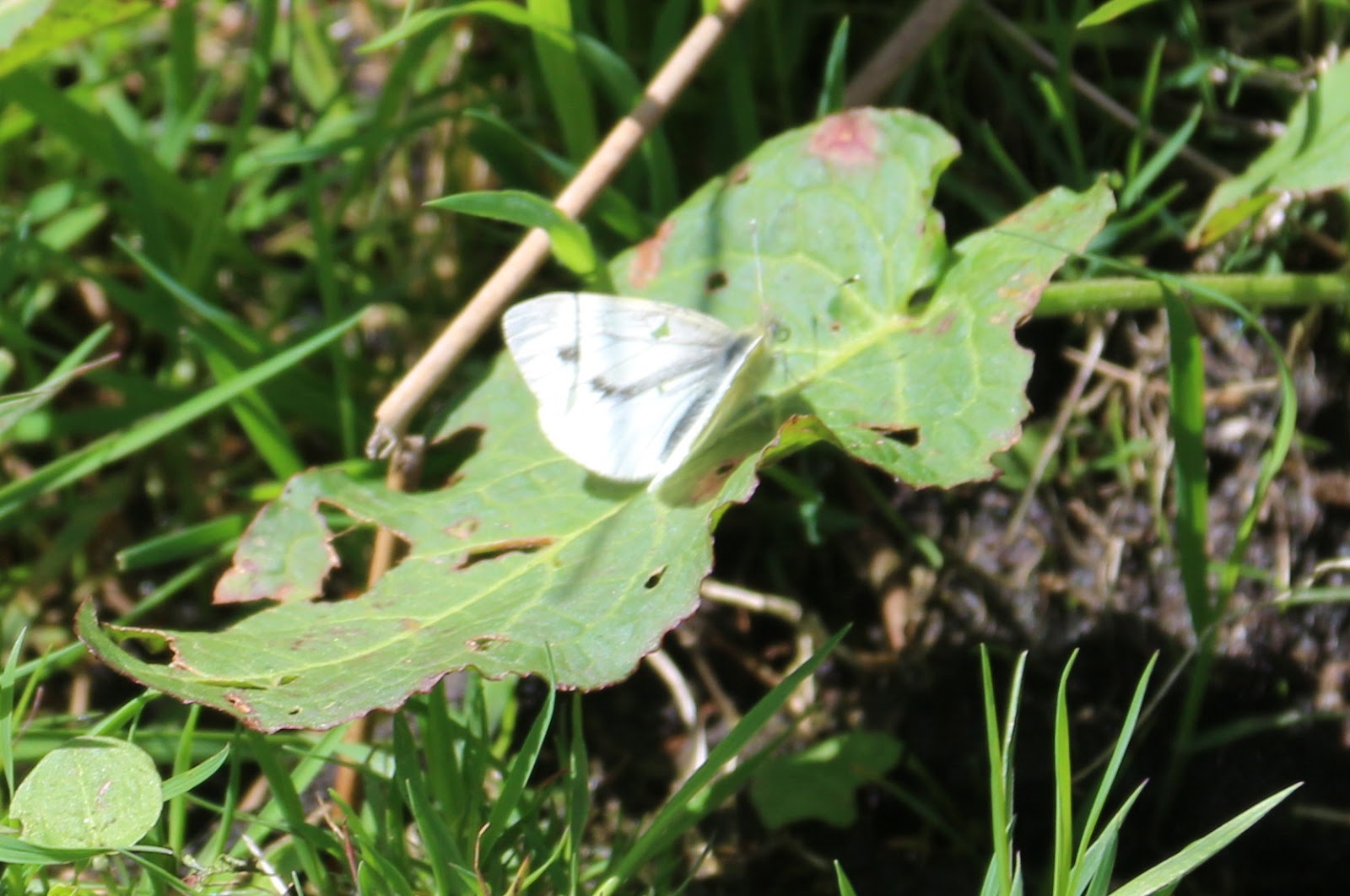
A Small White butterfly, the only type flying around as we walked. This one is a male and he gave me a hard time trying to get him in focus.
Lousewort (Pedicularis sylvatica). But the name doesn't refer to a herbal cure for lice but the belief that the damp places in which it grows, cause the cattle to be infested with lice and liver flukes. It's an interesting little plant with attractive fern like leaves and described as being hemi-parasitic. This means it lacks a fully developed root system and forms connections with another plant, from which it obtains some or all of its water and minerals. But it does have chlorophyll and produces its own food by photosynthesis as per normal.
Walking up the side of Twelve Men's Moor, you soon notice that the area is littered with hut circles. You can make out 5 or 6 in this photograph. In days gone by, this was a very populated place.
Looking north-ish towards Sharp Tor and a nicely patterned sky. Also patterned are the sides of Sharp Tor, patterned with the furrows of mediaeval field systems. These are more visible when the sun is low enough to cast shadows across them.

The jumble of granite waste tumbling down from the Cheesewring Quarry.
Just Larch.


Sunday, 14 May 2017

A Sunday Homily

I’ve always been suspicious of politicians, and others, who wear their religion on their sleeves and who cite it as proof of their goodness. In my opinion, if you’re a Christian, you really shouldn’t need to tell people that you are. If others see, through your actions, that you’re a good human being who understands the importance of compassion, of humanity, of empathy and the centrality of love, then the discovery that you are a believer should come as absolutely no surprise. Your deeds would echo your faith, rather than your deeds betraying your faith.

As we know from what she says, the most prominent self-declared Christian politician in the UK today is Theresa May (OK, I know Tim Farron is as well but he doesn't have the same profile as TM). Many times during this campaign she has said things along the lines of "her Christian faith helps guide her in every decision she makes". Mmm, is that so? Let's have a look at how a person who is guided by her faith votes to help others in parliament. She has:

* Voted for every military action and bombing campaign in the last 4 parliaments. 
* Voted for all benefit cuts against the disabled. 
* Voted for all benefit cuts against the sick such as those receiving on going hospital treatment for illnesses such as cancers and MS.. 
* Voted for the removal of 3rd child benefit. 
* Voted for the removal of benefits for the 16-21 age group. 
* Voted for the bedroom tax which has hurt some of the poorest working families in Britain and especially those with young disabled children. 
* Voted for the mass removal of disability vehicles. 
* Voted for NHS pay freezes. 
* Voted against energy caps to help the poor who were being forced into fuel poverty. 
* Voted against building 100,000 affordable homes for low income workers. 
* Voted against curbing payday lenders who exploite the most vulnerable. 
* Voted against implementing a series of proposals intended to reduce tax avoidance and evasion by huge corporations to help better fund the NHS. 
* Voted against creating more jobs for young people funded by bank bonuses and fines. 
* Would vote to reintroduce fox hunting, a so called sport which she says she is very fond of. 
I'll admit that my theology is somewhat flakey but I'm not too sure that Jesus would be very proud of Mother Theresa and her take on Christian compassion. Compassion means you put the needs of the weak and the vulnerable before the needs of the strong and the rich. Don’t know about you, but it strikes me that there's little about Mrs May's political deeds that’s Christian.

So this Sunday, let's join together and reflect on the gap between the words and the deeds of our political leader who lays claim to Christian beliefs. Today's lesson is to beware of those who feel the need to display their faith like an advertising hoarding. It’s actions, not words, which count, and her actions are the opposite of all the things that her faith claims to stand for and to have taught her. The real religion of Mrs May, and the party she represents, is hypocrisy, greed and a materialistic selfishness. Pharisees rather than Christians. Here endeth the homily.


Saturday, 13 May 2017

A walk around Pentire Head, near New Polzeath

Typical - we have some great weather for a few days but it changes somewhat for the worse when we go for our Thursday walk. Nothing too drastic but enough to dampen our expectations of clear views along the coast. We were heading down west to walk around Pentire Head, just to the east of Polzeath. By way of orientation, we were west of Doc Martin Country, east of Poldark Country and smack in the middle of David Cameron's Holiday Country. But we didn't see any of them.
The route was a straightforward circular one of around 4.5 miles with a few ups and downs. As we were walking around a peninsular, there was a very high ration of sea to land.
Our starting point in the National Trust car park and looking down onto New Polzeath, with Polzeath beach in the distance.
This gives a good flavour of the views we had. It's a good time of year for flowers on the coastal footpath and for the entire walk the sides of the path were swathed in colours. Lots of yellow from gorse, but alos pink from Thrift, white from Bladder Campion etc.
Looking up the coast westwards towards Port Isaac (or Port Wen to Doc Martin fans). I was surprised to see the foxgloves so far advanced down here as, in our garden, ours haven't even got to the bud stage yet.
The cliffs that were obscured by foxgloves. Note the sea: calm and dead flat. I can't remember the last time I'd seen it like this and it lead for a walk that was uncharacteristically devoid of wave noises.
The Moule, the island off Pentire Head. As a pre-Brexit preemptive strike, someone has claimed it for Cornwall by planting a  a St Piran's flag on its highest point. I wonder what the gulls thought of the move, especially the short-sighted Brexiteer Gulls.
Lots of Red Valerian around. The floral heads are a collection of interesting elongated tubules that only yield their nectar to the long proboscis of a foraging butterfly. Bees stand no chance of getting at it.
Lots of lovely lichen covered stone walls.
Swathes and swathes of Thrift festooning banks, walls and anywhere else it can grow.
And where the Thrift didn't grow, Bladder Campion did. Another interesting flower. The 'bladder' is formed from the sepals and remains on the plant long after the flowers have gone. It aids seed dispersal by being shaken by the wind and distributing the fine seeds.

Pink Thrift and yellow and orange Bird's Foot Trefoil.
Every now and again we'd come across a gossamer-like nest in blackthorn bushes. They were the communal 'homes' on the caterpillars of the Lackey Moth. Their hairs are irritant or urticaceous, if you'd like a more scientific word.
Quite a few male Orange Tip butterflies were flying around, either looking for food or a mate.  Best of luck to them with the latter as the female of the species is rather shy, doesn't fly around much and keeps well hidden in the undergrowth.
Nearing the end of the walk and we get a good view of the beach at Polzeath, one of the premier surfing beaches and one beloved of David Cameron. Not many surfers in evidence today but that's not surprising given the state of the surf and the tide.

Thursday, 11 May 2017

Mull 2017: Some grave matters

Whenever we are away, local graveyards, cemeteries and war memorials act as magnets to me. Quite often they are a window onto the social history of wherever we are and sometimes reveal interesting and poignant stories. I'm not sure how I should label this mild obsession of mine: it's certainly not 'necrophilia' (a rather morbid derangement). How about 'taphophilia' (“taph” from the Greek for tomb and “philia” meaning an inordinate fondness)? Nah, too clinical and not really what I do. I like to walk their paths, smell their flowers, see their statuary and read their epitaphs. Perhaps, because my interest has so many different facets, there is no single word or phrase for it. I’m all right with that. And now to what Mull and Iona had to offer in this regard.

In the small walled graveyard at Fionphort, I came across this headstone. It reads: Erected by D. McPherson, Appin. In memory of his beloved son, John, mate of SS Farho (lm). Wrecked on Tory Island. 22nd August 1874. Aged 35 years. His body was washed ashore here, a distance of 200 miles, 19 days later.
A little research reveals that SS Fairholm struck a rock in fog and sank off Tory Island on the north coast of Ireland. The full story is given in the newspaper cutting shown below. What was particularly poignant to me was realising that the Appin in the inscription is actually a small village on the mainland opposite Tobermory. With slightly different currents and/or wind directions, John's body might have returned home.
Taken from the Glasgow Herald and gives more detail of the events surrounding the sinking of SS Fairholm.

Another one from Fionphort and it mentions what happened to two sons of Duncan and Margaret Mae Gillivray MacKechnie, of the village.
Willaim MacKechnie, who is buried here, was a deck hand on HMS Lavatera and seems to have been 'lost at sea'. Swept overboard, perhaps? Lavatera was a small steam drifter (fishing vessel) built in 1913, she measured just 84 tons and originally fished out of Banff. In March 1915 she was taken over by the Navy, armed with a 3 pounder gun, and was employed as a patrol vessel. She was returned to her owners in 1920.
Their other son, Archibald, was killed on July 15th 1917, when his ship, HMS Redbreast, was torpedoed by U-boat 38 in the Aegean Sea. His body was never recovered and this headstone commemorates his memory. HMS Redbreast was an interesting ship in that it was one of the so-called Q-ships (also known as Q-boats, decoy vessels, Special Service Ships or Mystery Ships). These were heavily armed merchant ships with concealed weaponry and were designed to lure submarines into making surface attacks, giving the Q-ship a chance to open fire and sink them. The ethos of every Q-ship has been described as 'to be a wolf in sheep's clothing'. Whatever the ethos, it clearly didn't work for Redbreast. And the Q? This refers to the vessels' home port of Queenstown in Ireland.            

Just to the south of the landing stage on Iona is this granite memorial at Martyr’s Bay or Port nam Mairtear. It is not in memory of the 68 monks killed here by Vikings in 806AD, but to the men lost in the First and Second World Wars. It's a beautiful place with stunning views over to Mull and to Erraid, once the summer home of Robert Louis Stevenson.
Never one to miss reading a war memorial, I was intrigued to see this: "Bimbashi Colin MacDonald. Frontier Batt. Sudan DFC. FCS. Aged 29 years". Bimbashi? Never heard of it but Google tells me that it is a rank equivalent to Major, originating from the days of the Ottoman Empire and retained in the Egypt Service. A little more reading suggests that DFC. FCS. are not the initials of awards but are shorthand for Defence Force.
The Commonwealth War Grave Commission's website gives a little more information but doesn't give a clue as to why Colin MacDonald was serving in a Sudanese regiment.
A little more rooting around and I come across this entry in a Year Book for Edinburgh University. Colin MacDonald had joined the Sudan Political Service and enlisted in the Sudan Defence Force from there. It is likely that he was killed in an engagement with Italian forces.

The simple granite grave of John Smith, erstwhile leader of the Labour Party and one of the great 'what if's' of British politics. What if he had lived longer? What if he had formed a government? Who knows? His epitaph reads 'an honest man'. It could very well turn out to be fitting for the present incumbent of that same position.
I liked the simplicity of this pink granite headstone. 'Here lies all that could die of Bruce Kenrick'. And does the memory of him linger on? It certainly should as he seemed quite a force. Amongst his many achievements was founding Shelter. Google his name and you'll find out a lot there about him.
The elaborate marble tomb of the 8th Duke and Duchess of Argyle placed in Iona Abbey.
I couldn't but help contrast the simplicity of this marker for an unknown Merchant Navy seaman with the Argyle tomb. It is just one of six similar found in the graveyard next to Iona Abbey, all with different dates.

Friday, 5 May 2017

Mull April 2017: Some birds

Visits to the Scottish Islands always give the chance of seeing some birds that we don't get in the |West Country. The Mull trip was no exception and we came away with a reasonable list of sightings. And here's some of the evidence but before getting to them, a confession.

One day I'm going to write a blog entitled 'Things that can go wrong when using a digital camera'. You name it, I've probably done it and this holiday was no exception.
Cock-up #1 (CU1): Forgetting to switch from manual to auto focus when needed.
Cock-up #2 (CU2): Forgetting to switch the image stabilising on when I'm using a zoom lens.
Cock-up #3 (CU3): Forgetting to switch to sports setting when trying to photograph birds in motion.
Cock-up #4 (CU4): Forgetting to take the right lens with me when I KNOW I'll need my longest lens.
You'll see examples of potentially good photographs blighted by ineptitude and one or other of the above. But that's life and I did see the birds in the feather: that's the important thing.
A Curlew to the left, which we see in Cornwall, and a Whimbrell to the right, which we don't as they are restricted to the north-west of Scotland. They are fairly similar but the distinguishing feature is the beak. That of the Whimbrell is somewhat thicker and less downward curved (CU2).
The larger picture is of a Black Guillimot, with pretty much the same distribution as the Whimbrell, and the inset is of a 'common' Guillimot, which we do see down west. The bright red legs of the Black Guillimot are a useful diagnostic feature (CU1 and CU2 -  a double whammy).
A Great Northern Diver, widely distributed but not common. I'm not that good at identifying Divers but the speckled back of the Great Northern gives it away. I'm always open to correction by those who know better (CU2).
Wheatear, one of our earliest migrants. A busy bird, always on the move and never stopping anywhere too long. More often than not you only see it from the back, which is useful as its white rump is a clear feature (CU2, CU4 with a touch of CU3 as well).
I mentioned previously that we went Sea Eagle;White Tailed Eagle spotting at an RSPB hide in Glen Tiororan. Did we see any? Sort of. The fixed telescopes at the hide enabled us to spot a bird on the nest but, as it was about 3/4 mile away, it was impossible to get a decent photograph. The above is as as good as I got: it could have been better but this black flying arrow kept getting in the way. Some purists are somewhat sniffy about this type of organised viewing but we enjoyed it. It got us out into the countryside and we learnt a lot about the habits of the birds from the resident RSPB warden. We also saw at first hand how our RSPB membership subscription was being spent (CU4).
But when we were returning from our boat trip, we did motor past a Sea Eagle's nest quite near the shore. One of the birds conveniently sat on a tree stump for a while until it flapped off to escape from some irritating crows (CU4).
The huge nest was in a nearby tree, with the other bird of the pair sitting on their eggs (CU4).
Sea Eagle in flight, with the white tail and yellow beak clearly visible (CU3).
A composite of shots of the bird as it tried to escape from the marauding crows. These are big birds, the largest in the UK by far, with an eight foot wing span. Camera settings were OK for this set but the sun was in the wrong place.
On the island of Lungha we were fortunate to be able to get close to a few shags on a cliff top. They didn't seem to mind us eating our sandwiches a few yards from them. Here is one showing off the 'courting' tuft of feathers very nicely.
We had a great view of the courtship behaviour of the birds, with foot drumming, beak displays, throat clicking and general 'look at me, I'm great' posturing. The females looked impassive as the males preened and ponced about but isn't that always the way?
No trip to the islands would be complete without Puffins and we saw lots of them. It's always a delight to see them up close and they never seem to be perturbed by the presence of people gawking at them.
Puffins coexist quite happily with rabbits. They don't share the same burrows but they do live side by side without any problems. I wish we could have lingered longer on Lungha.


Wednesday, 3 May 2017

Nos nouveaux porcs sont arrivés!

We are now formally back in the business of pig raising. Eleven weaners were picked up from near Falmouth today and are installed in their new quarters. This was not the time to point out to one of them that they were destined to be the main attraction at our barbecue on August Bank Holiday Monday.
Comfortable and pretty relaxed after their 45 mile drive up the A30.
With a little persuasion, we finally got them out of the trailer into their field. It's amazing what a few handfuls of food will do.
I'll give them 2 weeks before they've rooted out most of this grass.