A relaxing walk - 3 churches, 1 holy well, 3 coves, 1 pub, 1 cafe, coastal footpath, mud and sun. Who could ask for more.
The route from Church Cove, took us inland to Grade and Cadgewith and then back along the coastal footpath. About 5.5 miles. Reasonably energetic , with the first half being made more 'interesting' because of the mud.
Just up the lane from Winch House is The Mariners. Built in the 17th Century, it was originally three cottages. In the early-mid 1800s the middle cottage obtained a license to become a public house and was known as a ‘kiddlewink’, a nickname that came from the fact that the pub was only licensed to sell Ale and not spirits but smuggled spirits were kept in a jug or kettle on the bar and a customer would look at it and wink and say ‘a drop of your special’. Fact or fiction? Who cares. It's a great story.
Church #1: St Wynwallow. We skirted past this today and did not repeat our visit of yesterday.
Every now and again some gymnastics were called for to get over muddy patches. In other places, it was a case of wading through to the occasional comment of "couldn't you have chosen a route along lanes?".
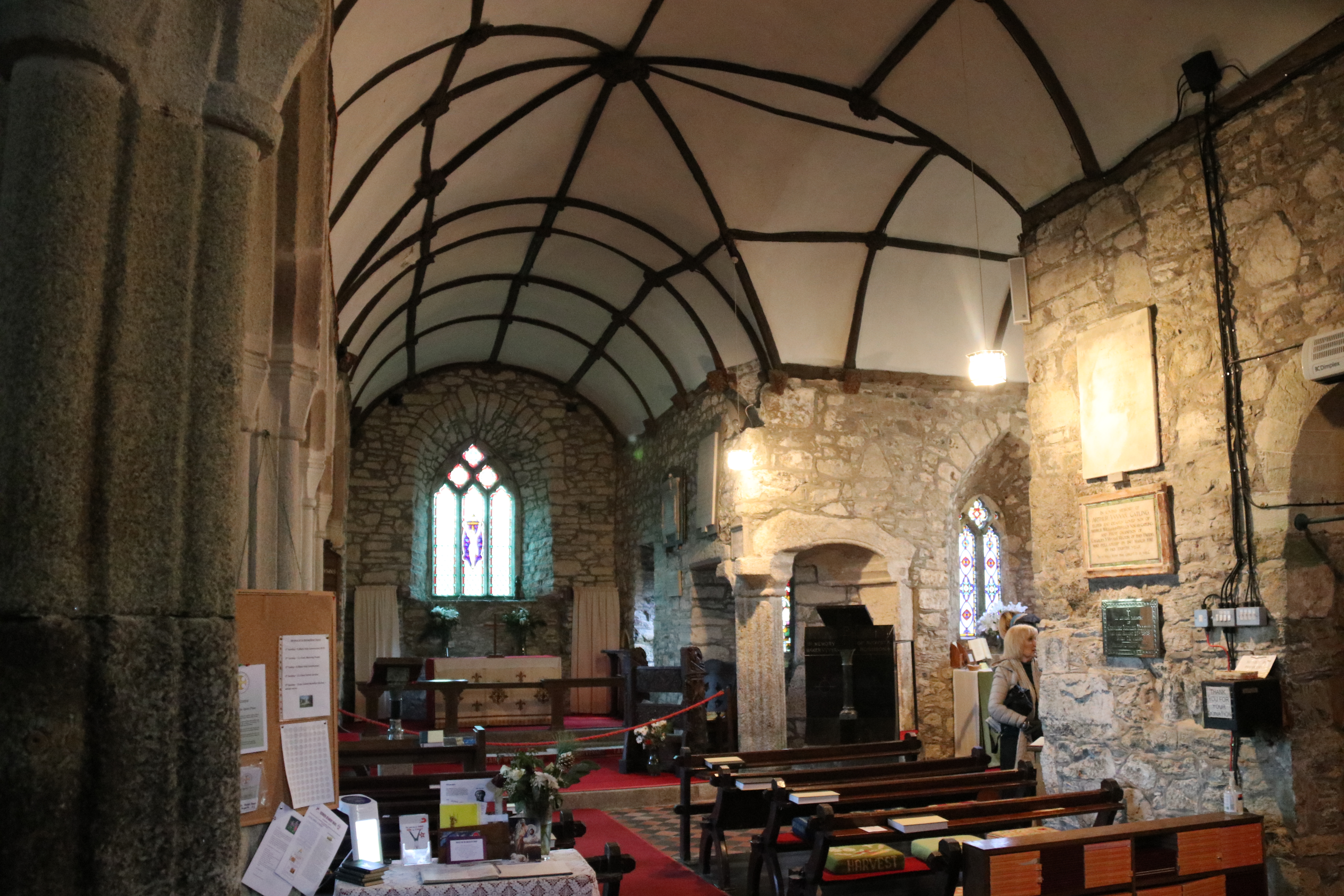
Church #2: the Church of St Grada and the Holy Cross at Grade. Not quite the most southerly church in the UK but almost. Not only historic but also rather interesting, slightly mysterious and quite difficult to find. It is remote with no direct access. A rough lane takes you there and, for that reason, it is only open during Spring and Summer. Well, that and the fact that there is no electricity or heating so it's deemed too cold to hold services over that period, But it is open for visitors all the time. Saint Grada (Grade, Grace) is another obscure but unique Cornish saint. She is accepted to be local, female and a maiden; that’s all we’ve got. The full dedication is to St Grada and the Holy Cross, and the original dedication was simply to the Holy Cross since an early parishioner brought back a piece of the “True Cross” from an early pilgrimage to Jerusalem (more on this next). When, and indeed why, the dedication changed to St Grada is not recorded but records suggest the early 13th Century, not long after its construction.
The tower is 13th C and the body of the church was a century older but needed an extensive 19th Century rebuild.
Coming back to the 'holy cross' dedication. A sixteenth century version of a legend tells how Sir Roger Wallysborough of Cornwall made a pilgrimage to the Holy Sepulchre in Jerusalem where he stole a piece of the Holy Cross - apparently he hide it in his thigh!. On his return, his ship was wrecked off Cornwall and he was cast ashore. During his ordeal he vowed to give a piece of the relic to the church of the parish where he landed safely - guess where that was. Grade is the only church dedicated to the holy cross on the coast, and in 1553 mention is made of a silver box “of the Holy Cross” amongst the parish possessions. If it was ever there, it's been long stolen and/or lost. I should point out that there are other versions of this story that add in a few fantastical elements, such as doves acting as prescient messengers and Sir Roger dying in a nearby field.
Following my usual practice when I come across an interesting military grave, I tried to find what I could about J P Newman. It turns out that his name was Jack Paul but, for some reason, he served under the alias of 'Newman'. His next of kin was his father, H Paul, of Norwich. Jack's service record shows that he worked on airships and a little more research shows that there was an airship base, RNAS Mullion, not that far away at Cury. I didn't know that airships were used to track and attack German submarines in WW1. The base was dismantled in 1919 and very little of it remains now. I couldn't find out the cause of death for Jack Paul but I'm assuming that he died in an accident at the base.
A rather sad headstone: "In loving memory of SUSIE beloved child of N & E BOULDEN who died Oct. 15th 1896, aged 3 years". I can't find out anything else about her, except for the fact that the Boulden family have been present in the graveyard for generations. When I come across headstones like this, I often wonder who was the last person to think about them and remember them. At least, I've remembered Susie and given her some substance for a while. And you will as you read this.
A very pleasant church to visit and one with a very peaceful atmosphere. It is small but not the smallest we'll come across on the walk.
Some of the staned glass on the south wall.
The obligatory piece of serpentine, a rather fine pulpit.
Three ways of getting into the graveyard - a wooden stile, a steeped granite version (probably the original entry point) and a gate. Take your pick. We did and used the wooden stile.
A holy well - St Ruan’s Well - and water for baptisms at St Grada used to be fetched from this well. Think of the many people who, through the centuries, have come to pray here. And here's a little more of the fantastic: Oral tradition cites St Ruan as being a werewolf who was invulnerable to wolves and credits him with driving them from Cornwall.
Church #3. The smallest church we've come across: St Mary’s Church, Cadgwith. It is not very old and was originally built as Holy Cross Roman Catholic Church. It became St Mary’s in the Anglican diocese of Truro in 1926. It was originally constructed of wood before being clad in corrugated iron when bought by the Diocese of Truro; just when it turned a lovely shade of blue is not recorded.
It’s original construction was in 1895 when the fishermen of Cadgwith were having difficulty finding brides. A consignment of brides was procured in the Republic of Ireland but they were all Catholic and before they settled in Cadgwith the Methodist fishermen had to build their new wives a Catholic church. Within a generation the Catholic congregation had shrunk and in order to maintain the church the Diocese of Truro took it over. Rather unique, eh?
It is still well used with regular services. Small but perfectly formed!
I know you've been looking out for it and here's the serpentine feature.
A pleasant surprise. I thought it was a Stonechat or a Chaffinch but it turns out to be a Bullfinch. Something I have not seen for a long, long while.
Just a seed-head in monochrome. I like it.
Cove #1: Working fishing boats at Cadgwith Cove. Refreshments at the Cadgwith Inn - recommended.
THV (Trinity House Vessel) Galatea is a lighthouse tender operated by Trinity House, the body responsible for the operation of lighthouses and marine navigation aids around the coasts of England, Wales and the Channel Islands. Trinity House, itself, was founded in 1514, during the reign of Henry VIII.
What a shame! I missed this by a couple of weeks. If I had been here on Christmas Day, I might have been the first in the water. And pigs might fly.
Lobster pots at Cadgwith Cove.
The Devil’s Frying Pan on the way. This 200 feet deep hole was once a cave, the roof having collapsed leaving a bar of rock and an archway through which the waves pound.
Looking westwards towards Church Cove.
Cove #2: Church Cove now.
Church Cove then. About 100 years ago. Hasn't changed much, has it?
Cove #3: Light levels dropping at Poldhu Cove. The beach cafe is recommended.
Another day being entertained on the Lizard. And the first day for ages and ages without any rain. A day enjoyed with old (or should I say 'long time') friends, Glynis and Mike.
Something to look at over my bowl of breakfast cereal. Rose, the Lizard Lifeboat Station's Tamar class all-weather lifeboat out on exercise from nearby Kilcobben Cove. Rose which was placed in service on 16th July 2011 was funded by a large anonymous donation from a charitable trust founded by a generous benefactor called Rose.
An immature Stonechat. As the year progresses, it will gain its adult plumage and be much brighter.
Looking towards the lighthouse on Lizard Point.
And a few moments later, a rainbow appears. A little diffuse, but still a rainbow.
Saint Wynwallow/Wynwalloe, Landewednack, just outside of Lizard Village. The most southerly church in mainland Britain, at the very tip of the Lizard peninsula. Established in the 6th Century by Gwenole, a monk from the Landevennac Abbey in Brittany, after which the village is named. Dedicated to St Winwalloe as is the church at Gunwalloe Church Cove. What we see today dates from the 15th Century. The tower is a delight of patchwork, featuring alternate blocks of granite and the local serpentine rock.
So, this site has seen many changes over the years, ranging from pre-Christian times when Christianity was not the major religion, to Christian times when it was and now to, arguably, Post-Christian times when, again, Christianity is not the major religion. And that is the big challenge that the Church faces - what role does it have in Post-Christian times? I'm not sure that 'it' knows. And I certainly don't.
Stained glass in Chancel South dating from 1869: Christ raising the dead. It looks a lot brighter in situ and much more modern than the date suggests.
In 1549 the Act of Uniformity introduced the Book of Common Prayer in the English language during services, stirring the Prayer Book Rebellion (a popular revolt in Cornwall and Devon against these changes). With the quick suppression of the uprising, the Cornish language fell into decline. In the latter 1670s, Reverend Francis Robinson preached: "Qy A Wra Aga Clewes Kewsel D’aga Tasow Agan Honen An Gwy Threson Mur A Dhew" (‘We do hear them speak in our tongues the wonderful works of God’). It would be the final sermon delivered in native Cornish and very fitting that it was about the power of speech.
The font is 15th Century and is inscribed with 'Dn. Rich Bolham me fecit' which translates from Latin as ‘Master Richard Bolham had me made’. Richard Bolham served as rector of St Wynwallow’s from the early 15th Century. The serpentine supports cannot be contemporary with the bowl. And they are not. A little more research says that they date from the 19th Century.
No self-respecting Lizard church would be complete without a substantial piece of serpentine.
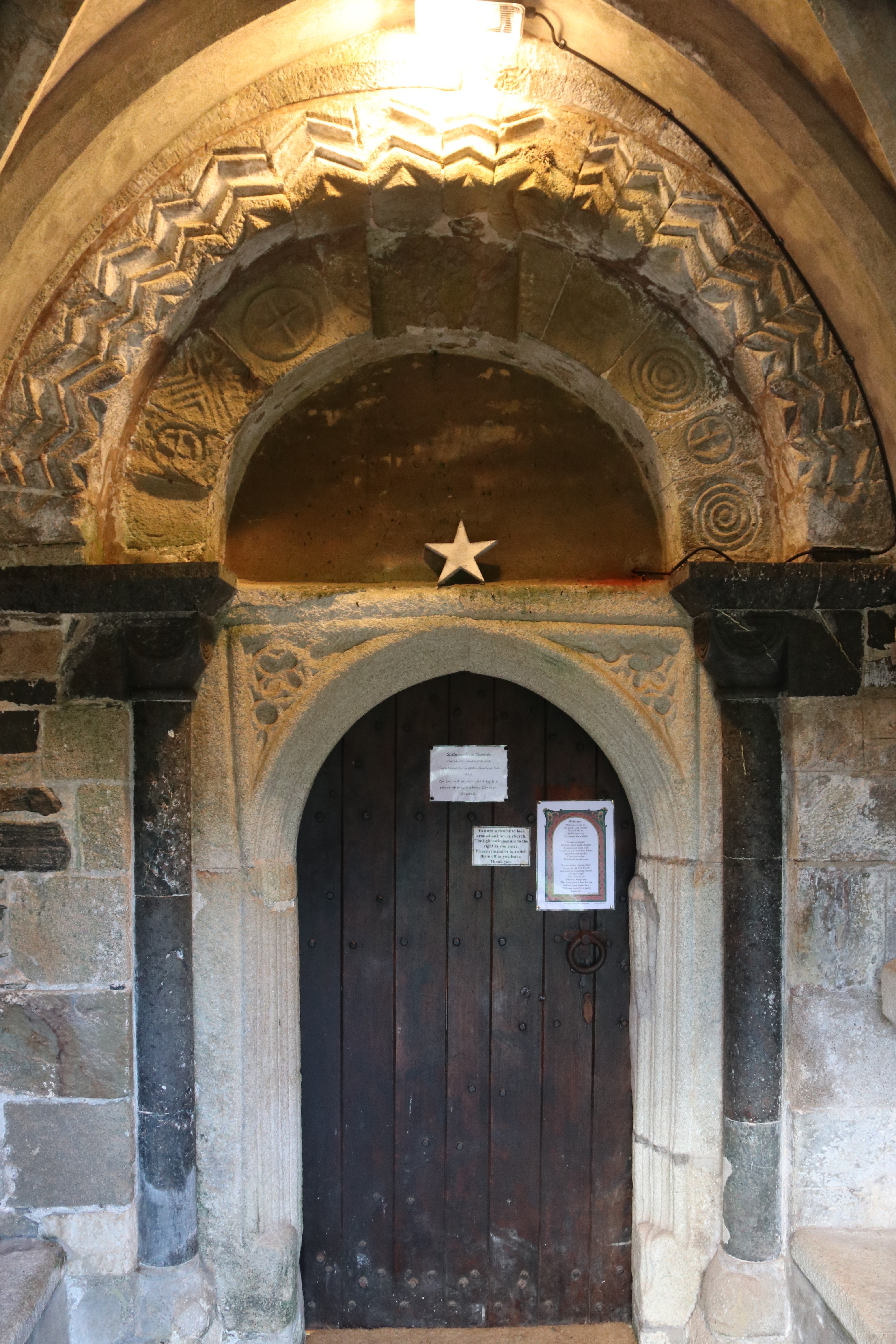
The oldest part of church is the twelfth century Norman doorway , decorated with typical Norman zig-zag carving. But it's a little more complicated than that as a 13th Century doorway has been set inside the earlier Norman opening. The perpendicular polished serpentine columns are 19th Century. The Norman tympanum (the semi-circular bit on the top of the door) has a very nicely decorated inner course. Its centre voussoir is missing and it is thought that there once was a figure that projected into the arch. The star is a poor substitute.
The last we came, these headstones were completely covered by the natural skin of lichen. Since then, someone has cleared enough away to enable the inscriptions to be read.
Every headstone in a graveyard tells a story, mostly only known to family members and then probably only remembered for a generation or two. Not so, those graves maintained by the Commonwealth War Graves Commission. There is always something of interest to discover - always tragic because of the context but some have an added dimension, just like this one for Radio Office Robert Frederick Hampshire of the Merchant Navy. He served on the SS Gairsoppa and was just 18 when he died at some point between 16th February and 7th March 1941. What's the story hinted at by his inscription? Here it is: At 00.08 hours on 17 Feb 1941 the unescorted Gairsoppa (Master Gerald Hyland) was hit on the starboard side just behind the bridge in #2 hold by one G7a torpedo from U-101 about 300 miles southwest of Galway Bay, Ireland. The ship had been in convoy SL-64 which was slowed down by bad weather and running low on coal, she was detached alone to Galway on 15 February. At 18.00 hours on 16 February, the U-boat spotted the ship but had troubles to hit the target due to heavy seas and missed with a spread of two torpedoes at 23.28 hours and one G7e torpedo at 23.32 hours. The Gairsoppa caught fire and settled slowly by the bow after being hit in the third attack, but Mengersen decided to give up further attacks when a coup de grâce missed at 00.20 hours, assuming correctly that the burning freighter will sink anyway in the heavy seas. The survivors managed to abandon ship in three lifeboats before she sank within 20 minutes. However, two of the boats were never seen again and its occupants presumably perished in the cold and bad weather. The boat in charge of the second officer set sail with eight Europeans and 23 Lascars aboard, but after seven days most had died of exposure and only four Europeans and two Lascars were still alive when the boat reached land on 1 March. Sadly, it capsized in the swell and surf of Caerthillian Cove on The Lizard, Cornwall and all occupants drowned except the second officer, who was rescued unconscious by a coastguard. The bodies of two Europeans and the two unidentified Lascars were recovered and buried in the Landewednack Churchyard. The master, 82 crew members and two gunners were lost. The cargo being carried by the Gairsoppa comprised of 2600 tons of pig iron, 1765 tons of tea, 2369 tons of general cargo and 200 tons of silver ingots and coins. Some 50 tons of the silver bullion has been recovered in an operation claimed to be the heaviest and deepest recovery of precious metals from a shipwreck ever made.
An unknown sailor from the Gairsoppa. His CWGC entry says that he was of Indian nationality.
And back to Winch House for refreshments!
Church Cove as it was somewhere between 1896 and 1920.
Down to the Lizard for a week at Church Cove. Looking forward to getting out and about in this glorious part of Cornwall, which is just 90 minutes from home. And, at this time of the year, there are few tourists around to make the place busy.
Church Cove from the lounge of our rental property.
Our home for the next week - the Winch House. This once housed the winch that pulled boats up and down the steep, steep, steep slipway. It dates from the mid-19th century and has been very comfortably converted. If it was any closer to the sea, it would be in it.
Breakfast at the Polpeor Cafe at Lizard Point, the southernmost cafe at the southernmost point in the UK. Proudly Cornish as well!
The RNLI decided to close the lifeboat station at Polpeor Cove in 1961because of its operating limitations - it was insufficiently protected to allow safe launches in all conditions. Kilcobben Cove has since been the location for The Lizard Lifeboat station.
A wayside bench with a fishy theme - on the Coastal footpath just above Carleon Cove. Perhaps celebrating the local pilchard fishing traditions or possibly as a memorial to a fisherman who had passed away?
The history detailed on the sign is interesting enough but what I found more interesting was the way it seemed to attract so many small snails. Why? Food? Good place to copulate?
LSCL - Lizard Serpentine Company Limited - features at the top of an old storehouse. Serpentine is not the name of a single mineral. Instead it is a name used for a large group of minerals that fit this generalized formula: (X)2-3(Y)2O5(OH)4. Interesting stuff, eh? The most obvious physical properties of serpentine are its green color, patterned appearance, and slippery feel. These remind the observer of a snake and that is where the name "serpentine" was derived. It's easily shaped and polished and that's what makes it valuable.
The details are legible so I won't repeat what's written. The incorporation of serpentine mantelpieces and pedestals into Osbourne House, and the associated patronage of Queen Victoria and Prince Albert, lead to great interest in serpentine products. So much so, that this site had a factory, showroom, warehouse and offices. Stone came from local quarries by cart and then the finished serpentine stoneware was ferried in flat-bottomed barges to schooners offshore. But demand fell and the company was wound up in 1893.
The site is now owned by the National Trust and gives walkers of the coastal footpath an unexpected encounter with a post-industrial landscape. I know it came as a great surprise to ourselves when we first came across it. We had no idea that it was there.
The Coast Path crosses the Poltesco River in Carleon Cove by this impressive footbridge, designed to reflect the curved lines of a boat. Knowing that, I can now say "of course it does".
The church at Ruan Minor was at first probably a parochial chapelry to Ruan Major, but during the bishopric of Bishop Bronescombe (in fact in 1277) the bishop’s register records the presentation of a rector (William de Carnavald) to “Ecclesia de Sancto Rumono parvo”, so that Ruan Minor was a separate parish from that time. And it seems probable that the church building itself dates from the 13th century, since there is no definite evidence of anything earlier. Originally consisting simply of chancel and nave, in about the mid-15th century a north aisle was added, and at the same time the single stage west tower constructed of serpentine and granite ashlar. The church also underwent a “restoration” in 1879 when the chancel was extended and its roof line raised, and the south porch was added.
St Ruan or St Rumon was probably an Irish missionary bishop of the 6th Century, but the nomenclature may also refer to Ruman or Roman, and hence an entirely different saint! So, unknown he may be and merely one of the host of Celtic saints with which Cornwall abounds!
The small size of the church gives it a very welcoming ‘cottagey’ feel.
This impressive lectern, made of polished serpentine, was presented to the church in 1893 by the then rector John Mallock, in memory of his mother, Maria - or so the inscription says. Apparently, it may well be one of the last artefacts of the Poltesco Serpentine Works which were within the parish of Ruan Minor.
The colours of the eastern window were rather washed out but the red-painted reredos gave a nice splash of contrasting colour.
A detail from a window given in 1926 by Elizabeth Randle in memory of her parents, and her brother and sister. It depicts Saint Luke with 2 shadowy figures behind (the siblings?). It is modern and is an interesting design with very rich colours. I like it.
The font, which may be pre-Norman, has a symmetrical chevron decoration around the bowl. Its wooden cover is modern and decorated with 4 carved wooden bottle nose dolphins. It was donated in memory of an admiral whose name I did not record.
And then off to Kynance Cove as the light levels are dropping.
And with the sun setting in the West, we head back to Winch House.
A new day. A new year. A new resolution - try and stay positive, even in the face of overwhelming odds!
Let's accept that 2024 is not going to be an easy one for many of us in the UK. Importantly, neither should we forget what is going on elsewhere in the world: we are not alone in facing huge issues - in fact, some of ours pale into insignificance when we think of Ukraine, Gaza. etc etc. Notwithstanding all the doom and gloom, there will be many good things about 2024 that we should not lose sight of. We should take pleasure and comfort where we can. Here are a few from me: add your own as you will.
* The sun will rise and set every day. * Most people will eat, laugh and love more than they are hungry, cry and hate. * The world around us will continue to provide immense pleasure to those who take time to experience it. * Many people will practice, and others receive, unsolicited random acts of kindness. * Communities and organisations will continue to work together and make the lives of many immeasurably better. * Most of us will continue to relish the companionship and support of our network of family and friends. * Children will be born and received into the arms of loving mothers. * Healthcare professionals will successfully treat millions of us for a wide variety of illnesses and diseases. * Other public service professionals and employees will continue to keep us safe and contribute to our good standard standard of living.
Each of us can accomplish something worthwhile in 2024: let's remember the Boy Scout motto of doing a good deed every day! Here endeth today's sermon.
And let's end on a cheery note with one of my favourite songs.