Saturday, 6 January 2024

Church Cove January 2024: Part 2

 Another day being entertained on the Lizard. And the first day for ages and ages without any rain. A day enjoyed with old (or should I say 'long time') friends, Glynis and Mike.

Something to look at over my bowl of breakfast cereal. Rose, the Lizard Lifeboat Station's Tamar class all-weather lifeboat out on exercise from nearby Kilcobben Cove. Rose which was placed in service on 16th July 2011 was funded by a large anonymous donation from a charitable trust founded by a generous benefactor called Rose.

An immature Stonechat. As the year progresses, it will gain its adult plumage and be much brighter.
Looking towards the lighthouse on Lizard Point.
And a few moments later, a rainbow appears. A little diffuse, but still a rainbow.
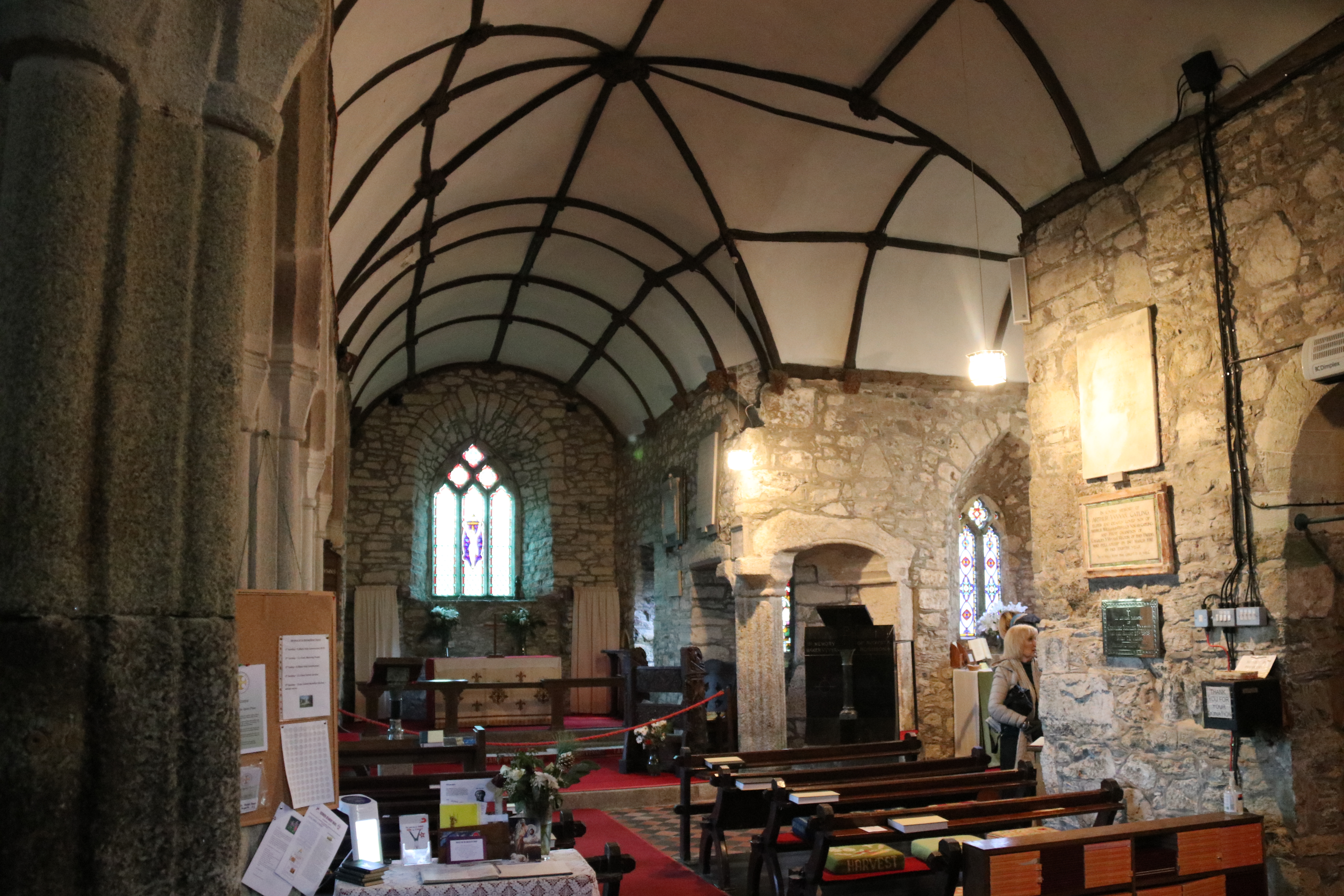
Saint Wynwallow/Wynwalloe, Landewednack, just outside of Lizard Village. The most southerly church in mainland Britain, at the very tip of the Lizard peninsula. Established in the 6th Century by Gwenole, a monk from the Landevennac Abbey in Brittany, after which the village is named. Dedicated to St Winwalloe as is the church at Gunwalloe Church Cove. What we see today dates from the 15th Century. The tower is a delight of patchwork, featuring alternate blocks of granite and the local serpentine rock. So, this site has seen many changes over the years, ranging from pre-Christian times when Christianity was not the major religion, to Christian times when it was and now to, arguably, Post-Christian times when, again, Christianity is not the major religion. And that is the big challenge that the Church faces - what role does it have in Post-Christian times? I'm not sure that 'it' knows. And I certainly don't.

Stained glass in Chancel South dating from 1869: Christ raising the dead. It looks a lot brighter in situ and much more modern than the date suggests.

In 1549 the Act of Uniformity introduced the Book of Common Prayer in the English language during services, stirring the Prayer Book Rebellion (a popular revolt in Cornwall and Devon against these changes). With the quick suppression of the uprising, the Cornish language fell into decline. In the latter 1670s, Reverend Francis Robinson preached: "Qy A Wra Aga Clewes Kewsel D’aga Tasow Agan Honen An Gwy Threson Mur A Dhew" (‘We do hear them speak in our tongues the wonderful works of God’). It would be the final sermon delivered in native Cornish and very fitting that it was about the power of speech.

The font is 15th Century and is inscribed with 'Dn. Rich Bolham me fecit' which translates from Latin as ‘Master Richard Bolham had me made’. Richard Bolham served as rector of St Wynwallow’s from the early 15th Century. The serpentine supports cannot be contemporary with the bowl. And they are not. A little more research says that they date from the 19th Century.

No self-respecting Lizard church would be complete without a substantial piece of serpentine.
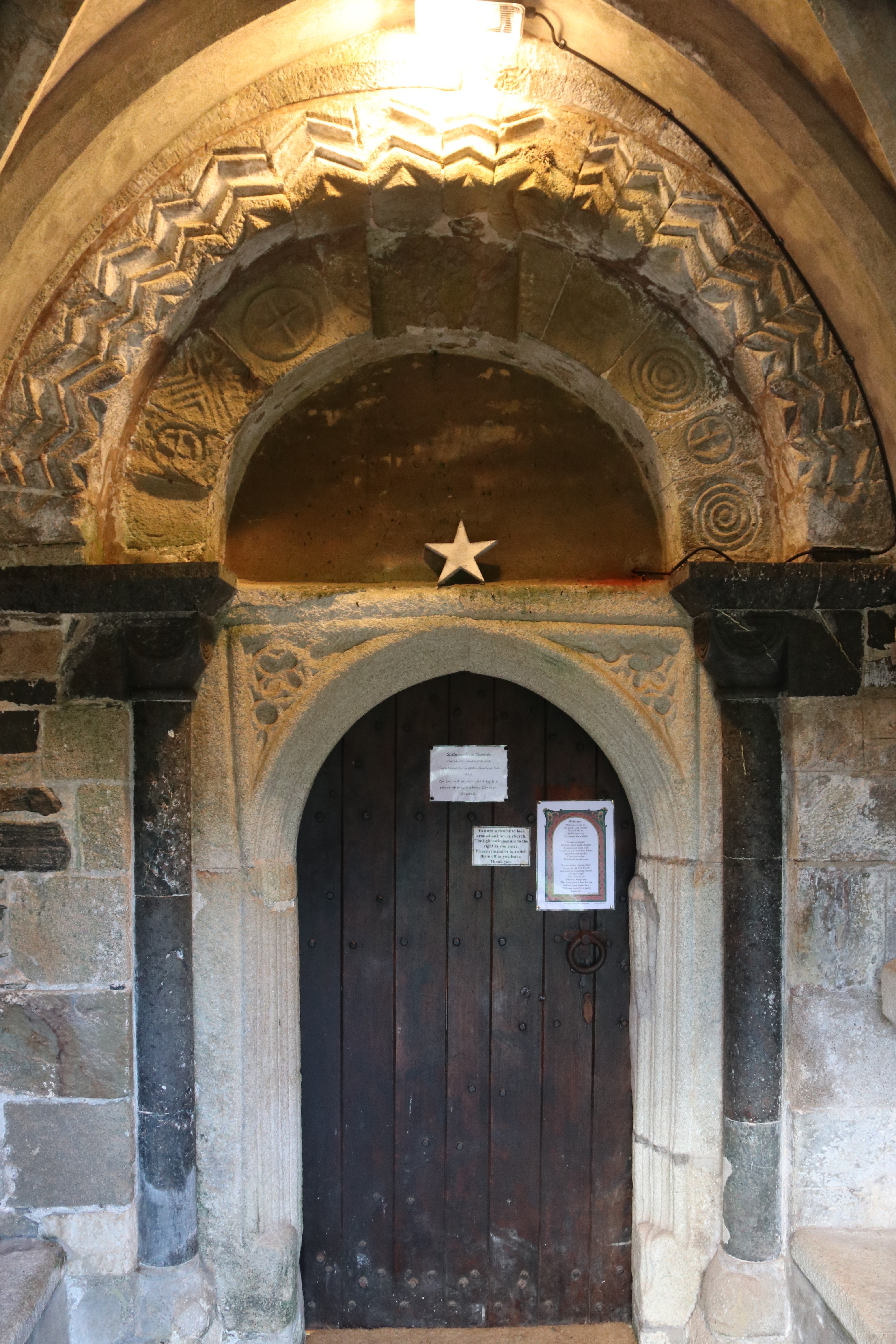
The oldest part of church is the twelfth century Norman doorway , decorated with typical Norman zig-zag carving. But it's a little more complicated than that as a 13th Century doorway has been set inside the earlier Norman opening. The perpendicular polished serpentine columns are 19th Century. The Norman tympanum (the semi-circular bit on the top of the door) has a very nicely decorated inner course. Its centre voussoir is missing and it is thought that there once was a figure that projected into the arch. The star is a poor substitute.

The last we came, these headstones were completely covered by the natural skin of lichen. Since then, someone has cleared enough away to enable the inscriptions to be read. 
Every headstone in a graveyard tells a story, mostly only known to family members and then probably only remembered for a generation or two. Not so, those graves maintained by the Commonwealth War Graves Commission. There is always something of interest to discover - always tragic because of the context but some have an added dimension, just like this one for Radio Office Robert Frederick Hampshire of the Merchant Navy. He served on the SS Gairsoppa and was just 18 when he died at some point between 16th February and 7th March 1941. What's the story hinted at by his inscription? Here it is:
At 00.08 hours on 17 Feb 1941 the unescorted Gairsoppa (Master Gerald Hyland) was hit on the starboard side just behind the bridge in #2 hold by one G7a torpedo from U-101 about 300 miles southwest of Galway Bay, Ireland. The ship had been in convoy SL-64 which was slowed down by bad weather and running low on coal, she was detached alone to Galway on 15 February. At 18.00 hours on 16 February, the U-boat spotted the ship but had troubles to hit the target due to heavy seas and missed with a spread of two torpedoes at 23.28 hours and one G7e torpedo at 23.32 hours. The Gairsoppa caught fire and settled slowly by the bow after being hit in the third attack, but Mengersen decided to give up further attacks when a coup de grĂ¢ce missed at 00.20 hours, assuming correctly that the burning freighter will sink anyway in the heavy seas. The survivors managed to abandon ship in three lifeboats before she sank within 20 minutes. However, two of the boats were never seen again and its occupants presumably perished in the cold and bad weather. The boat in charge of the second officer set sail with eight Europeans and 23 Lascars aboard, but after seven days most had died of exposure and only four Europeans and two Lascars were still alive when the boat reached land on 1 March. Sadly, it capsized in the swell and surf of Caerthillian Cove on The Lizard, Cornwall and all occupants drowned except the second officer, who was rescued unconscious by a coastguard. The bodies of two Europeans and the two unidentified Lascars were recovered and buried in the Landewednack Churchyard. The master, 82 crew members and two gunners were lost.
The cargo being carried by the Gairsoppa comprised of 2600 tons of pig iron, 1765 tons of tea, 2369 tons of general cargo and 200 tons of silver ingots and coins. Some 50 tons of the silver bullion has been recovered in an operation claimed to be the heaviest and deepest recovery of precious metals from a shipwreck ever made.

An unknown sailor from the Gairsoppa. His CWGC entry says that he was of Indian nationality.

And back to Winch House for refreshments!
Church Cove as it was somewhere between 1896 and 1920.

Friday, 5 January 2024

Church Cove January 2024: Part 1

Down to the Lizard for a week at Church Cove. Looking forward to getting out and about in this glorious part of Cornwall, which is just 90 minutes from home. And, at this time of the year, there are few tourists around to make the place busy.

Church Cove from the lounge of our rental property.
Our home for the next week - the Winch House. This once housed the winch that pulled boats up and down the steep, steep, steep slipway. It dates from the mid-19th century and has been very comfortably converted. If it was any closer to the sea, it would be in it.
Breakfast at the Polpeor Cafe at Lizard Point, the southernmost cafe at the southernmost point in the UK. Proudly Cornish as well!
The RNLI decided to close the lifeboat station at Polpeor Cove in 1961because of its operating limitations - it was insufficiently protected to allow safe launches in all conditions. Kilcobben Cove has since been the location for The Lizard Lifeboat station.
A wayside bench with a fishy theme - on the Coastal footpath just above Carleon Cove. Perhaps celebrating the local pilchard fishing traditions or possibly as a memorial to a fisherman who had passed away?
The history detailed on the sign is interesting enough but what I found more interesting was the way it seemed to attract so many small snails. Why? Food? Good place to copulate?
LSCL - Lizard Serpentine Company Limited - features at the top of an old storehouse.
Serpentine is not the name of a single mineral. Instead it is a name used for a large group of minerals that fit this generalized formula: (X)2-3(Y)2O5(OH)4. Interesting stuff, eh? The most obvious physical properties of serpentine are its green color, patterned appearance, and slippery feel. These remind the observer of a snake and that is where the name "serpentine" was derived. It's easily shaped and polished and that's what makes it valuable.
The details are legible so I won't repeat what's written. The incorporation of serpentine mantelpieces and pedestals into Osbourne House, and the associated patronage of Queen Victoria and Prince Albert, lead to great interest in serpentine products. So much so, that this site had a factory, showroom, warehouse and offices. Stone came from local quarries by cart and then the finished serpentine stoneware was ferried in flat-bottomed barges to schooners offshore. But demand fell and the company was wound up in 1893.
The site is now owned by the National Trust and gives walkers of the coastal footpath an unexpected encounter with a post-industrial landscape. I know it came as a great surprise to ourselves when we first came across it. We had no idea that it was there.
The Coast Path crosses the Poltesco River in Carleon Cove by this impressive footbridge, designed to reflect the curved lines of a boat. Knowing that, I can now say "of course it does".
The church at Ruan Minor was at first probably a parochial chapelry to Ruan Major, but during the bishopric of Bishop Bronescombe (in fact in 1277) the bishop’s register records the presentation of a rector (William de Carnavald) to “Ecclesia de Sancto Rumono parvo”, so that Ruan Minor was a separate parish from that time. And it seems probable that the church building itself dates from the 13th century, since there is no definite evidence of anything earlier. Originally consisting simply of chancel and nave, in about the mid-15th century a north aisle was added, and at the same time the single stage west tower constructed of serpentine and granite ashlar. The church also underwent a “restoration” in 1879 when the chancel was extended and its roof line raised, and the south porch was added.
St Ruan or St Rumon was probably an Irish missionary bishop of the 6th Century, but the nomenclature may also refer to Ruman or Roman, and hence an entirely different saint! So, unknown he may be and merely one of the host of Celtic saints with which Cornwall abounds!
The small size of the church gives it a very welcoming ‘cottagey’ feel. 
This impressive lectern, made of polished serpentine, was presented to the church in 1893 by the then rector John Mallock, in memory of his mother, Maria - or so the inscription says. Apparently, it may well be one of the last artefacts of the Poltesco Serpentine Works which were within the parish of Ruan Minor.
The colours of the eastern window were rather washed out but the red-painted reredos gave a nice splash of contrasting colour.
A detail from a window given in 1926 by Elizabeth Randle in memory of her parents, and her brother and sister. It depicts Saint Luke with 2 shadowy figures behind (the siblings?). It is modern and is an interesting design with very rich colours. I like it.
 The font, which may be pre-Norman, has a symmetrical chevron decoration around the bowl. Its wooden cover is modern and decorated with 4 carved wooden bottle nose dolphins. It was donated in memory of an admiral whose name I did not record.

And then off to Kynance Cove as the light levels are dropping.
And with the sun setting in the West, we head back to Winch House.

Monday, 1 January 2024

Happy New Year - 2024


A new day. A new year. A new resolution - try and stay positive, even in the face of overwhelming odds!

Let's accept that 2024 is not going to be an easy one for many of us in the UK. Importantly, neither should we forget what is going on elsewhere in the world: we are not alone in facing huge issues - in fact, some of ours pale into insignificance when we think of Ukraine, Gaza. etc etc. Notwithstanding all the doom and gloom, there will be many good things about 2024 that we should not lose sight of. We should take pleasure and comfort where we can. Here are a few from me: add your own as you will.

* The sun will rise and set every day.
* Most people will eat, laugh and love more than they are hungry, cry and hate.
* The world around us will continue to provide immense pleasure to those who take time to experience it.
* Many people will practice, and others receive, unsolicited random acts of kindness.
* Communities and organisations will continue to work together and make the lives of many immeasurably better.
* Most of us will continue to relish the companionship and support of our network of family and friends.
* Children will be born and received into the arms of loving mothers.
* Healthcare professionals will successfully treat millions of us for a wide variety of illnesses and diseases.
* Other public service professionals and employees will continue to keep us safe and contribute to our good standard standard of living.

Each of us can accomplish something worthwhile in 2024: let's remember the Boy Scout motto of doing a good deed every day! Here endeth today's sermon.

And let's end on a cheery note with one of my favourite songs.

Sunday, 31 December 2023

We live in a land........................

 
My last post of 2023 and I wish I could bring the year to a close on a cheery note. But I can't. The world has been a shitshow in 2023 and to be honest, I can't really see it getting much better in 2024. So many places of despair around the world. I'm just going to comment on how I see the UK at the moment, and that's depressing enough. I'll confess to going into 2024 with my normal optimism rather dented.

We live in a land which has gone insane. 
We live in Tory Britain. 

We live in a land where it’s the poor who are condemned, not poverty.

We live in a land where it’s considered normal that working people don’t earn enough to feed their families and have to resort to foodbanks while the richest who profit from their labour get ever richer. 

We live in a land that will not admit to the damage that Brexit has done in so many ways - the venom injected by Brexit is still poisoning public discourse.

We live in a land where the refusal of the EU to bend over backwards for us is condemned as threats and bullying. 

We live in a land that has lost its moral compass and is adrift in the modern world.

We live in a land where all these cruel insanities and many, many more are defended by otherwise rational people because, because.... I don't know why. Haven't the last few years been bad enough to convince people not to put their trust in such a duplicitous bunch?

I am genuinely afraid for the future and genuinely depressed about what’s in store for us. How many bright futures will be sacrificed on the altar of an inept Tory government that’s strong and stable only in its greed and inhumanity?

We live in a land where people who campaign peacefully and democratically for a world are decried in the same breath as terrorists who bomb and kill. 

We live in a land where those who do the decrying are British nationalists who glorify military might and who have a fringe of violent extremism of their own.

We live in a land which demands unity but which offers no compromise or concessions to those who have a different opinion. 

We live in a land where the past is exalted and lauded because the future offers nothing to welcome. 

We live in a land where there are no checks or balances, no written constitution, because strength and stability is said to come from a Prime Minister who can do as he pleases and whose power is unconstrained and unconfined. A Prime Minister whose grasp on reality is increasingly tenuous. A Prime Minister who refuses to be held to account, who speaks in soundbites and never answers questions. 

We live in a land which has gone insane. We live in Tory Britain. 

We live in a land which heaps wealth upon the rich and hoards power for the powerful. 

We live in a land where the inept, mediocre, cronies and neophytes are awarded formal state honours for political opportunism.

We live in a land still in thrall to the Ruritanian fantasy of the Monarchy.

We live in a land where the king remains the only person in the world who still wears a double-breasted suit.

We live in a land where the space for democracy is diminishing and decaying. 

We live in a land where the media doesn’t challenge but cheer leads for the right wing zealots.

We live in a land whose government is strong only in its avarice and stable only in its vindictiveness. 

We live in a land which has gone insane. We live in Tory Britain. 

We could live in a land which has potential. We could live in a land which can offer a future to its people. We could live in a land where hope can flourish. We live in a land where increasingly the scales are falling from the eyes of the deceived and the downtrodden. We live in a land where we are learning that the way out of the insanity is to defeat the Tories. We live in a land which can be better than this. Let’s live in a better land. Let’s defeat the Tories. Make that your resolution for 2024. And a Happy New Year to you all!

Friday, 29 December 2023

Anyone fancy a cold water dip?


Much to my delight, the Caerphilly Local History Facebook page recently posted a photograph of the open-air swimming baths at the Morgan Jones Park. These were built in the mid-1930s after the opening of the Park in 1934. Funded by the Special Areas Commission ("designed to facilitate the economic development and social improvement of certain areas which have been specially affected by industrial depression"), these were part of a group of twelve such swimming baths paid for in this way in the valleys. Now long demolished sadly but the memories remain intact. 

In my day, mid 1950s to early 1960s, it was a magnet for many (most? all?) children in the area during the summer months when they were open. OK, so they were bitterly cold and crowded but they were the place to be in the long, hot summer holidays. "I'm going up the baths", I'd say and, after joining the motley crew that comprised our gang, off we'd go with our towels and knitted swimming trunks (yes, really, home knitted swimming trunks). Bedwas and Machen UDC blue bus from Bedwas Square to the Tanyard in Caerphilly (known locally as Lavender Corner because of the awful smell and where my great grandfather, Jacob Batt, had worked as a 'flesher'. Although, from what I've learnt of the occupation, 'deflesher' is probably more accurate), cross over to the Pic (short for Piccadilly) and then up Nantgarw Road to the Park and the watery heaven that was the baths. Depending on how much money we could scrounge from our parents, we'd have enough for the entry (low coppers in old money) and maybe a frozen Jubbly and a bag of chips afterwards. Facilities were rather crude by today's standards - just the pool and rudimentary changing cubicles with wire baskets for your clothes.

On our way home, we'd quite often sneak into Caerphilly Castle and explore the towers, ramparts and moat. This was pre-Cadw and there were numerous breaches in the walls that we could get through. I can't remember any custodians being around because we were never chased away or told not to venture into parts we shouldn't. And there were many of them which are nowadays out-of-bounds, which is a shame because what's left is a pretty sterile castle-experience that you can get anywhere. 

I've come across this photograph which gives the route we walked, from the blue spot in the top left to the baths in the bottom left. I'd put the photograph at slightly later than the mid 50s as, before then, the moat to the right of the castle was the site of allotments with a footpath leading diagonally across it from the Twyn. It was from this side that we got into the castle. A breach at the base of the famous leaning tower was a favourite spot.

Thinking of the baths brings to mind the tragedy in 1961 when a friend, Edward Combstock, drowned there on June 29th. He was just 16 and was a year ahead of me in school. From what I recall, he had hit his head on the diving board and entered the water unconscious. Our gang went to his funeral in Bedwas. Here’s to the memory of Edward, a lovely boy.

Wednesday, 27 December 2023

In the gloaming

It's still the Festive Season and it is all Christmas Trees, Reindeer, and Kiss Me Quick Under The Mistletoe. Now call me an old misery if you will, but some of these activities have always seemed to me to be best suited to spreading a host of infectious diseases. But I could be in a minority of one on this view. Anyway, a lazy and wet post-Boxing Day afternoon has given me the opportunity to look at our collection of old postcards and I've come across something that drove me into the arms of Mrs Google and diverted me for a while. 


It's a postcard which dates back to 1906 and which was published by the Cynicus Publishing Company of Tayport, Fife. As you can see, we have an acrobatic embrace along with a line from the Victorian song "In The Gloaming". Written by Annie Fortescue Harrison and Meta Caroline Orred, the song is a typical bit of Victorian melodrama about doing the right thing and setting a lover free.

"Think not bitterly of me
Though I passed away in silence
Left you lonely, set you free
For my heart was tossed with longing
What had been could never be
It was best to leave you thus, dear,
Best for you, and best for me."

Mrs Google tells me that it is supposed to be semi-autobiographical because Annie (a lowly daughter of a Conservative MP!) fell in love with the 4th Marquis of Downshire, but gave him up because she was from a lower class and wrote music instead. Some time later, the Marquis heard the song at a concert and realised it was about himself and sought her out, proposed to her and they were married in 1877. It seems to me to be a little too much like the stuff a celebrity publicist would come out with and, if like me, you are suspicious of a happy ending, you will be better concentrating on the artist who drew and published the postcard.


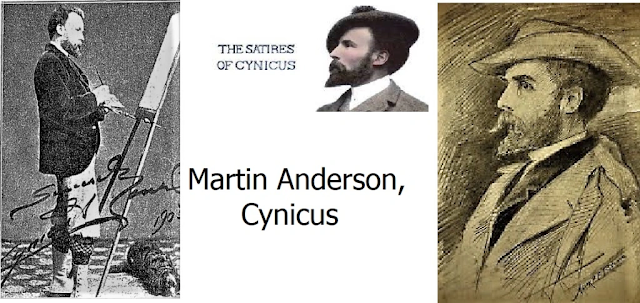
"Cynicus" was the name used by the Victorian artist Martin Anderson who gained fame during the picture postcard craze of the first decade of the twentieth century. Unlike many other postcard artists who produced their drawings for established publishers, Anderson set up his own publishing company - The Cynicus Publishing Company - and for a brief time achieved both fame and fortune. Alas, the success was as short lived as the postcard craze and by 1911 the business faced financial ruin. Poor Anderson lived for the next two decades in poverty and was eventually laid to rest in an unmarked paupers' grave.

Now that's the kind of story we want for Christmas. Bah Humbug!

Sunday, 24 December 2023

Mystery Women of Vancouver

Most old photographs are enigmatic, usually providing far more questions than answers. As an example, who are these two ladies, where were they out walking, and when? If you are lucky, you might find a caption scrawled on the back of the photo, but even these can be less than illuminating. On this particular photograph all it says is "This was taken in December on the street". Why, oh why, can't people put more information on the back of photographs. I've got so many unknowns like this.

Colourising the image enhances it somewhat but still raises questions.
The photograph comes from a file which I’ve labelled "unknown family photographs and odds & sods". I do not recognise this rather stern pair of ladies, but the photograph must have been passed to me through my family as I’ve got very few random images from other sources. I think it comes from ‘my’ side of the family rather than Mrs P’s. This being the case, the place could be Brighton,  Bristol or South Wales. The lady on the right is not my maternal grandmother but there are some similarities. However, there is a "foreign" feel about the location - the names of the shops, the size of the billboards, the pricing of the goods. I tried searching for some of the shop names, but it wasn't until I got a match for "Millar and Coe" that things became interesting. I found online a 1930s photograph of a street of shops in which there is a Millar & Coe almost next door to a shop called Cordell. Not in Brighton, Bristol or South Wales but in Vancouver in Canada.
Some of my questions are now answered - the place is the city of Vancouver - a place, to the best of my knowledge, nobody in the family has ever visited - and, from the style of dress, I’d say the time is the 1930s. And, given that it's labelled as being in December, I'll assume that the ladies are doing a bit of Xmas shopping. I am, however, still left with the mystery as to who these two ladies of Vancouver are. Ah, the joys of family history. Maybe I’ll uncover a link one day - not out of the question as it took me 10+ years to accurately attribute a couple of other photographs in the same file. My working hypothesis is that the answer may lie with my grandmother’s extended and largely unknown tree of step-siblings from Bristol. 

Friday, 22 December 2023

Knowledge and Competence

Yesterday the Tory Health Secretary Victoria Atkins launched a bitter and ignorant attack on Junior Doctors, diminishing their medical experience by describing them as "doctors in training" as if they're not properly qualified doctors. The reality, of course, is that Junior Doctor is the term for a fully qualified doctor who is doing a 2 year clinical foundation, or has not specialised yet, meaning they're supervised by consultants in their area of practice. If Victoria Atkins was really concerned about medically unqualified people within the NHS, perhaps she should look at the Tory Department of Health, including herself and her junior ministers.

Victoria Atkins, herself, worked as a barrister before becoming a career politician. She has no medical qualifications.

Junior health minister, Helen Whatley, did a couple of years of management consultancy and then a stint at the Internet dinosaur AOL before becoming a career politician. She claims to have volunteered at NHS hospitals in her youth, but has no medical qualifications.

Junior health minister, Andrew Stephenson, was an insurance broker before becoming a career politician. He has no medical qualifications.

Junior health minister, Andrea Leadsom, was a debt trader for Barclays Bank and then an investment banker before getting on the Tory career politician gravy train. She has no medical qualifications.

Junior health minister Nick Markham was a businessman with his fingers in a lot of pies. One of his most notable ventures was his chairmanship of Inview Technologies which went bust in 2020 costing investors over £20 million. He was parachuted into the unelected House of Lords so he could be made a junior health minister without the bother of even getting elected. He has no medical qualifications.

Of the six Tory politicians who run the Department of Health, only one has any real NHS experience. Maria Caulfield worked as an NHS nurse for a couple of decades before turning to politics.

In light of the alarming dearth of medical training and experience within the Tory-run department of health, it's a bit damned rich for Victoria Atkins to try to diminish the expertise of trained and qualified NHS doctors, isn't it? But since when has any Tory adminstration bothered with knowledge and competence as criteria for high office? Certainly not this one. Liz Truss, anyone?

Wednesday, 20 December 2023

School trips with a difference

Would you believe that we regularly played in and out of these wagons?

I was born and grew up in a Welsh mining village, in the Rhymney Valley, just a couple of miles from Caerphilly. Our local pit was the Bedwas Navigation Colliery, that had the reputation of yielding good quality steam coal for the maritime sector - the clue is in the name 'navigation'. It seemed that every village around us had had a pit at one time and each village had provided hundreds of men and boys to help hew the coal from the ground. Coal brought prosperity, albeit at a pretty low level, to our village, but at a cost. At one end of the spectrum were the fatalities, not that many but there were regular accidents. At the other end, I remember that miners were covered in little blue scars, like tattoos. If you got even the smallest cut down a pit, the dust got in straight away and turned it blue forever - and there was nothing you could do about it. The dust got in to your lungs too but these are part of a story for another day.


The primary school I attended, between 1952 and 1959, was Bedwas Junior Mixed. It was a typical mining village school, with most of the pupils' fathers (most mothers stayed at home in those days) having some connection with the pit, either directly as colliers or indirectly as supplying some service to the pit. Our school outings were very limited, in stark contrast with what my grandchildren have experienced. We had an annual trip, by steam train, to Bristol Zoo, and the occasional charabanc outing to St Fagans, nowadays the St Fagans National Museum of History, at Cardiff. And we also had, for two or three years, a unique day-trip - a visit to our local pit!


Who in their right mind would take young children down a working coal mine now? It would never be allowed in today's litigious and safety-conscious times. And in retrospect, it was a pretty mad thing to do. But, within the context of the zeitgeist, it was a little like a 'take your child to work day'.


We walked the mile or so up to the pit in crocodile file and, after some 'pop' and a biscuit in the pit canteen, we were taken to the pit head under the winding gear. There we were all crammed in the cage and snuggled up against each other. The man in charge of the ascent and descent was Len the Pen and he was a neighbour of ours in Bryn Fedw. I think he said something like "are you ready for the ride?" and then we gasped as the floor fell away. Len let the cage drop a while and put the brakes on. It was dark and he said that we were stuck. Much screaming at this point and then we dropped again. I thought the cable had snapped but the brakes came on again as we got near to the bottom of the shaft - Mr Google tells me that the shaft was around 2000ft deep, and it felt like it. When we reached the bottom, everyone outside, and Len the Pen, were doubled up with laughter. They obviously enjoyed playing this trick on innocent children. It must have livened up an otherwise dull day down the mine.


We didn't venture far from the cage and I can still smell the dank, foetid odour, the likes of which I haven't encountered before or since - a very distinct combination of strange gases. Lights were switched out for a short while and we were shown how miner's lamps were used. At one point, in the distance we heard a long, wailing siren, followed by a bellowing, full-throated roar. Shot blasting at the coal face! It could have been my dad doing that as he was a shot firer for a while. And then it was back in the cage and up to the surface and more 'pop' and biscuits.


If I wanted to be dramatic, I could say that, sometimes, even now, I wake up with my head throbbing and my ears ringing, as if my skull has been tightly clamped in a vice all night. I haven't been to the doctor's about it. It wouldn't do any good. It isn't depression, or stress. It isn't a migraine, or a hangover. It's nothing physical at all. But that’s not true. It's just a memory - a memory from childhood. It is just a memory of a dank, smelly, sweaty, claustrophobic place. I hated the foul, festering hell-hole the moment I set foot down there. I could say that I decided that day that I'd never end up down the pit like my grandfather, dad and others. I could say that I decided that day I'd never set foot in a pit again as long as I lived. I could say that I decided that day I wanted something better. 


But that would be completely wrong. There was never any chance that I would end up down the pit. My parents would never have allowed that, and they often told me in no uncertain terms. And for that, I am eternally grateful.

Looking up to the pit from the bottom of our street - Bryn Fedw. The tips are likely to be reclaimed in the relatively near future. Recovered coal will be recovered and sent to steel furnaces and cement works, with the remaining landscaped back to its’original topography’ - and who can remember what that looked like? Well before my time but I presume that plans exist somewhere.