Showing posts with label Cotehele. Show all posts

Saturday, 29 April 2023

An evening stroll around Cotehele

 A pleasantly sunny evening and an excellent time for an 'after closing' stroll around the top gardens of Cotehele House. With no-one else around, you can almost imagine that this is your own fiefdom. Well, that's a bit of a stretch but we live close enough to visit regularly and regard it as an extension of our own, much more modest, garden. A few photographs as a record.

The lawn to the left was a carpet of daffodils a couple of weeks ago.
One door leads to another..............
Wisteria flowering in the courtyard.
The fruit trees are just coming into blossom. Give it a couple of weeks and it's going to be spectacular.
Apple blossom.....
.....and more blossom.
This sculpture depicts honey bees filling their cells with pollen. And if you look closely enough, within the cells themselves, created from timber and bamboo, you might be lucky and see a variety of real-life bees.
I'd like one in our garden but we'll have to make do with real ones.
Some impressive white bark on a very large Eucalyptus tree.
The top pond in splendid isolation.
Upon reflection............
.........we'll go through this door to the next part of the garden.
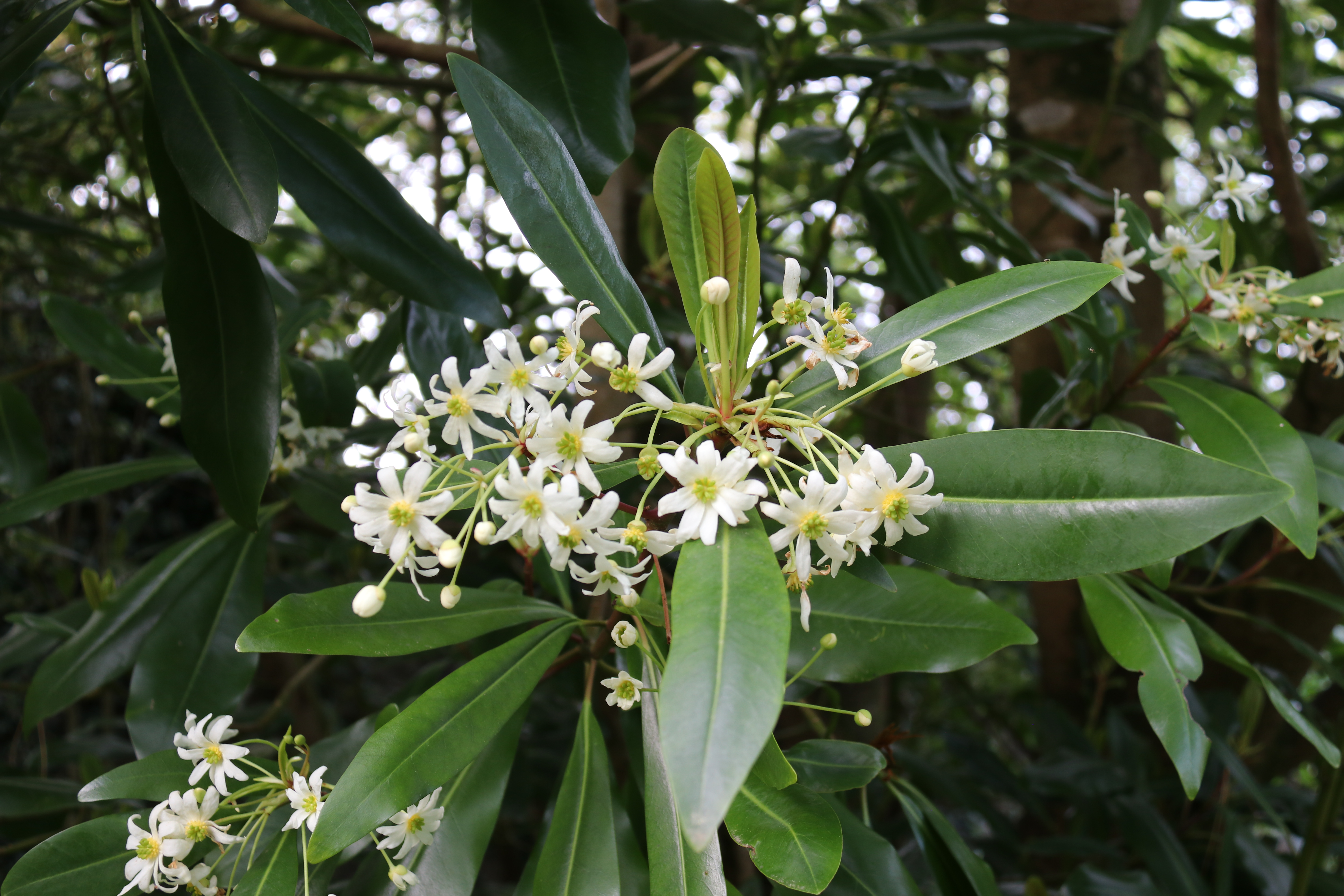
The rather lovely and fragrant flower of Winter's Bark (Drymis winteri), a native of Argentina/Chile. It's named after a contemporary of  Sir Francis Drake, John Wynter. He discovered, or more accurately learnt from indigenous people in South America, that the bark was a preventative and curative for scurvy.
The back of the house with a rather limp flag on the tower.
The flower borders are just about getting into their stride. It's amazing what an army of gardeners can achieve.
My tulips never look like this.
Looking over the borders, down the Wooded Valley towards the viaduct at Calstock.

Wednesday, 23 March 2022

Hosts of golden daffodils

What better theme for a post than daffodils? It's that time of year when they are everywhere and Cornwall is at its best. A veritable symphony in yellow. Enjoy.

We'll start in our garden. I did start counting how many we've got but gave up when I reached 6.

An excellent showing of our Tete-a-tete's this year.
And then it was off for a circular walk around the Cotehele Estate, with a coffee stop half way around! Our route takes us up the Danescombe Valley which was once an important area for growing daffodils commercially. Those days are long gone but the residual daffodils haven't. The woodland is full of blooms and, because they are mixed varieties, the display lasts for several weeks. And after that? Bluebells!
I'm not very good at identifying daffodil varieties but I know what I like. And I like this trio.
If daffodils can have an expression, I thought this one looked rather sad.
Yet more daffodils in the Danscombe. About 1/2 mile of them.
Another unknown (to me) variety.
Cotehele Tower with the daffodils on the meadow putting on an excellent show.
Amongst the daffodils are some Snake's Head Fritillaries. A rather subtle flower against the rather in-your-face yellow of the daffodil.

Daffodils in the Old Orchard are just about coming into bloom. Plenty of buds to come.
The 'famous' Archway of Daffodils. An idea pinched from the garland?
Same thing, slightly different view.

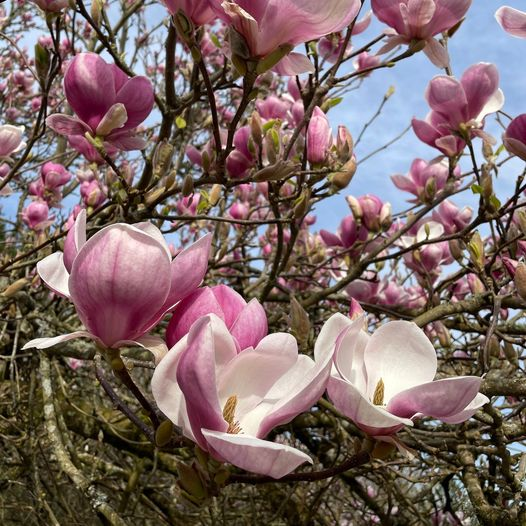
And it's not just daffodils that are looking good at Cotehele at the moment. What about this fantastic magnolia blooming in the Terrace gardens?


Saturday, 16 October 2021

Regular Walks: Cotehele Quay and Danescombe Valley Circular

 A regular follower of the walks I describe has asked for more details of some of our more local routes. We quite often walk from Cotehele Quay and we consider ourselves lucky to have a number of variants that we can take depending on time available, mood, weather etc. Here's a 3.5 miler we did recently. With a refreshment stop at Cotehele Barn, it took around 2 hours.

We started at the quay car park, headed along the river track, up the Danescoombe Valley and then back to Cotehele through the woods on the 'top level' track.
We leave the car park and turn right along the river track to Calstock.  Possibly one of my least interesting photographs ever.
The area of low lying meadow just passed the car park is destined to become flooded wetlands as part of flood prevention measures. The embankment was broached a couple of weeks ago and it will be interesting to see how the wildlife evolves. I'm going to be involved in surveying the birdlife on a regular basis. At the moment, low tide just produces mud but give it a while and the waders will come as the flora and fauna stabilises to the new conditions.

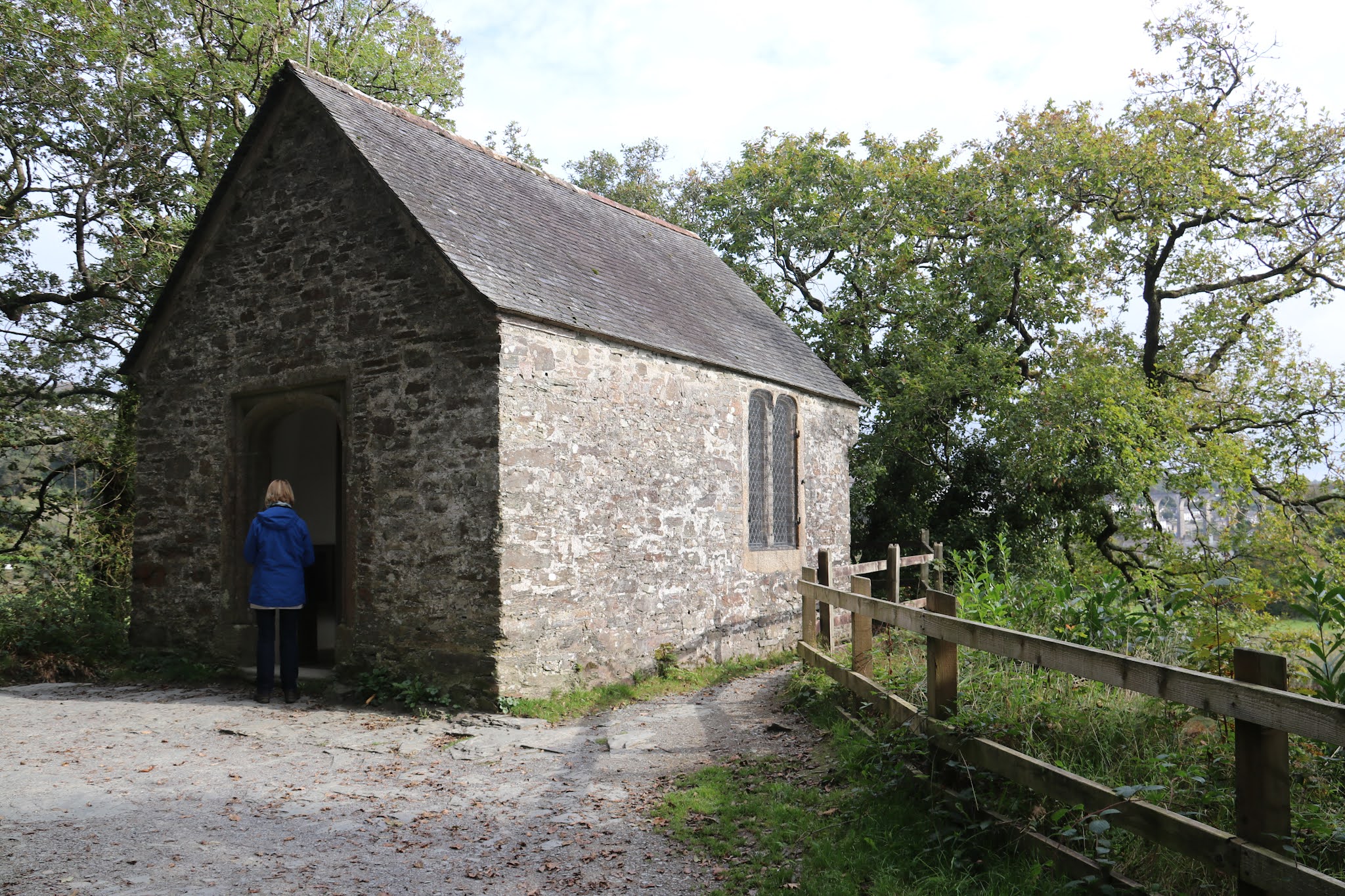
The first building we come to is The 'Chapel in the Woods', or, more properly, the Chapel of SS George and Thomas Becket, which was erected by Sir Richard Edgecumbe, the builder of Cotehele House. The story behind these bald facts is quite intriguing. In 1483 Sir Richard joined a rebellion against King Richard III. The rebellion was quashed, and the king's men under Sir Henry Trenowth of Bodrugan pursued Edgecumbe through the woods. He must have thought the end was near, but, thinking quickly, Sir Richard threw his hat upon the waters of the river that runs through the woods, and hid in the trees. His enemies saw the floating hat and assumed that Sir Richard had been drowned while trying to cross the water. They left, and Sir Richard was able to complete his escape and make his way to safety in Brittany. A few years later, Henry Tudor defeated Richard III at the Battle of Bosworth and took the throne as Henry VII. Sir Richard was able to return from exile and reclaim his estate at Cotehele. He wanted to give thanks for his escape so, sometime between 1485 and 1490 he built this small single-cell chapel at the spot where he had cast his hat into the river. The chapel measures only 6.3m by 4.6m and is built of coursed slate and stone rubble.

And then on to the look-out point taking in the view over the Tamar to the viaduct at Calstock. The word 'iconic' comes to mind. After taking it all in, continue on the track (up and down) and turn left when some houses are met.
A few yards up the track and you come to he old saw mill at the bottom of the Danescoombe Valley. Built in 1878, it was relatively short-lived and had gone out of use by the turn of the 20th century. It took its power from the stream that runs down the valley and, as it is at the bottom of the valley, it the lowest of the water-powered sites in the valley. A leat was taken off about 300 foot upstream leading to a cistern 30 foot above the mill. Water from this was piped to the turbine in the saw pit, but no evidence of this remains.
Head up the track for a while longer and you come across a group of houses associated with the 'local' mine, variously known as Wheal Calstock, the Danescoombe Valley Mine or Cotehele Consols. The first house was built in the early 19th-century as the mine office and the next housed a Cornish beam engine and was later reused as a blacksmith's shop on the ground floor, with a miner's dry (changing room) on the floor above. Both are available to rent from the National Trust.
A little further on and you pass the house called Mispickel, named after the arsenic containing ore that was mined here. The house itself comprises of two converted mine buildings and comes with its own adit and entrance to a silver mine.
Even further on, you come to a cluster of buildings associated with the Danescombe Mine, a former copper and arsenic mine, which was worked on and off throughout the 19th century. Its beginnings are obscure, but it was working before 1837 when it was restarted under leases granted by Lord Ashburton and the Earl of Mount Edgcumbe. This company was wound up in 1842. The buildings were leased off the National Trust in the 1990s by the Landmark Trust and extensively restored to form a unique holiday let.
The Engine House as it was before restoration. If you want to find out more take a look at the Landmark Trust website (here).
All along the path as it heads up there are the remains of various mining artefacts. This might have been a shaft. It's probably a good idea not to venture too far from the path and wander into the woods. Who knows what hole you might fall down?
Continue up the path until a lane is reached and then take the track immediately on the left. And this takes you to..........
.........Cotehele House, by a back entrance. A quick refreshment stop in the Barn Restaurant and it's time to head back to the starting point at the Quay.
There are a number of options at this point and one that we like is the one that goes through this tunnel and .......
.....into the Valley Garden, which drops down almost to the Chapel. We are just coming up to one of the best times of year for this stretch, when the autumnal colours are a joy to behold.

Sunday, 30 May 2021

Reflections at Cotehele

 Out for an evening walk around the Cotehele Estate. After a while, a theme emerged for the photographs I was taking - reflections. Which sort of fits in with the food for the soul that Cotehele provides.

We arrived just before a high tide, one of the highest that coincides with the full moon. The river was remarkably still, the tide was still coming in but very slowly at this point
From the reflection of the yacht's mast, you can see how still the water was
In the 19th century, as local industries boomed, Cotehele Quay would have been busy with vessels loading and unloading cargo. Crowded paddle steamers travelled upriver from Plymouth to see the orchards in blossom and small boats carried market-gardening produce for sale at Devonport Market. But that was yesterday. Today all is quiet.
A lone Mallard duck
The peace and tranquillity were shattered with the arrival of one man and his nautical dog.
The pond in the Upper Garden at Cotehele
The pond in the Himalayan Glade at Cotehele
A collection of boats and yachts at their moorings by the boatyard in Calstock