Showing posts with label Stoke Climsland War Memorial. Show all posts

Wednesday, 12 December 2018

On this day in 1918, Private John Leslie Neale died

The formal ending of WW1 died not bring peace to all of those who had fought. Many men lived with the aftermath and died of wounds and illness long after hostilities had ceased. Two men named on the Stoke Climsland war memorial were amongst these.
John Leslie Neale, commonly known as Leslie, was the eldest child and only son of John Henry and Eliza Coumbe Neale. He had two sisters, Blanche and Ena. His father was a farmer and Leslie was born at their farm near Lewannick in 1898. He was baptised there (Newton Farm between Congon’s Shop and South Petherwin) under the auspices of the Launceston Bible Christian Circuit on 10th March 1898. Sometime after 1901, the family moved to Crockett farm, from where Leslie and his sisters went to the village school in Stoke Climsland.
Leslie with his sisters, Blanche and Ena. Blanche is on their horse, Tommy, whilst Leslie holds their dog, Shep

Leslie with his father and elder sister, Blanche. Both of these family photographs were taken on the farm at Crockett, near Stoke Climsland

Leslie, flanked by two of his friends
We don’t know exactly when Leslie enlisted but his regimental number and War Gratuity payment both suggest that it was in mid-1917. This being the case he probably spent some time with the 1st/5th Devons in Egypt and might have fought in the following campaigns: Third Battle Of Gaza (6th November 1917; Capture Of Junction Station (13th November); Battle Of Nabi Samweil (20th November); Tell ‘Asur (11th March 1918); Berukin (9th April). The latter was, perhaps, their most successful action whilst in Egypt, capturing the town at a cost of 88 casualties.

In May 1918 the 1st/5th Devons were ordered to France where they fought on the Marne and elsewhere in many engagements: Battle Of Tardenois (20th July); Battle Of The Scarpe (26th August); Battle Of The Drocourt-Queant Line (2nd September); Battle Of Havrincourt (12th September); Battle Of The Canal Du Nord (27th September) and during the Final Advance In Picardy, the Battle Of The Selle (17th October); the Capture Of Solesmes (20th October) and the Battle Of The Sambre (4th November). The Armistice found the 1st/5th Devons behind the line at Monplaisir after 30 months’ fighting in Palestine and France which had cost the lives of 342 of their comrades and won the two battalions ten battle honours.

At some point, Leslie was either wounded or developed an illness and he died on 12th December 1918, a month after the cessation of hostilities. He is buried in Plot S.IV.D.6 in the St. Sever Cemetery Extension in Rouen. During the war, Commonwealth camps and hospitals were stationed on the southern outskirts of the city. A base supply depot and the 3rd Echelon of General Headquarters were also established there. Almost all of the hospitals at Rouen remained there for practically the whole of the war. They included eight general, five stationary, one British Red Cross and one labour hospital, and No. 2 Convalescent Depot. A number of the dead from these hospitals were buried in other cemeteries, but the great majority were taken to the city cemetery of St. Sever. In September 1916, it was found necessary to begin an extension, where the last burial took place in April 1920. Leslie would have been a patient of one of these hospitals and was buried in the Extension.

Detail from Leslie Neale's death certificate

Leslie Neale’s Headstone with the inscription
A Devoted Son and Brother
Leslie’s effects of £38 16s 5p were given to his father.

The formal record of Leslie Neale's effects

Sunday, 4 November 2018

On this day in 1918, Wifred Arthur Cornish died


Private 67960
Wilfred Arthur Cornish
1st Battalion, Auckland Regiment
New Zealand Expeditionary Force
Died 4th November 1918
Age 37
Wilfred Arthur Cornish has the dubious distinction of being the last local man to be killed in action in WW1. He was born on 15th September 1881, the third of the six sons of William and Anne (Annie) Cornish. William was the long serving headmaster of the Luckett Board School and it was in the School House at Luckett that Wilfred lived for all of his life in the UK. His brother, John Adams Cornish, was killed in France in July 1916 and at least two of his brothers also served during the war.

Wilfred joined the Royal Navy when he was 19, enlisting at Devonport on 14th September 1900 and signing on for a 12 year engagement. His entry level was Ship Stewart Assistant (SSA) and his first postings were at a number of shore establishments around Devonport. Throughout his naval career his location alternated regularly between shore establishments and ships. His progress up the ranks culminated in his promotion to Ship’s Stewart (SS) on 9th January 1908, only for him to be demoted to SSA on 31st July 1908 for ‘returning from leave drunk’. He remained at this level until his term of engagement expired on 23rd September 1912.

SS Rotorua
Wilfred emigrated to New Zealand in 1913, leaving Plymouth as a Third Class passenger on the New Zealand Shipping Company’s vessel, SS Rotorua, on 5th July 1913. He had given his occupation as a farmer but, once in New Zealand, he gained employment as a wharf labourer or ‘watersider’ for the United Steamship Company. The Police Court News section of the New Zealand Herald of 6th June 1917 reports that ‘the previous offender Wilfred Arthur Cornish was fined 10s for drunkenness’. Wilfred did not declare this incident when he later applied to join the army.

Report from the New Zealand Herald (June 6th 1917)
On 6th August 1914, shortly after the outbreak of war, Britain accepted New Zealand’s offer of an expeditionary force of approximately 8000 men. When countrywide recruiting for the New Zealand Expeditionary Force’s (NZEF) ‘Main Body’ began on 8th August 1914, the response was overwhelming. In September 1915 Wilfred did try to join the army but was not accepted, being deemed medically unfit due to ‘flat feet (left)’. He was more successful with his second attempt in September 1917 but then only with the rating of C1 ‘likely to become fit for active service after special training’. The special training needed was never specified.
SS Balmoral Castle
He was assigned to the 3rd Reserve Battalion and then travelled to Europe on the SS Balmoral Castle, leaving Wellington on the 24th April 1918, disembarking in London on 21st June. On the same day, he was entered Sling Camp, near Bulford on Salisbury Plain, and remained there until 30th September when his battalion left for France, docking at Etaples on 3rd October. He eventually joined his unit in the field, D Company of the 1st Battalion of the Auckland Regiment, on 8th October 1918. Wilfred’s Company was soon in action and engaged the enemy in and around the town of Le Quesnoy. The Battalion War Diary for 4th November notes: ‘A miserable night but the morning broke fair and fine. At 5.45 a.m. we moved forward, 15 minutes after zero hour........ when crossing the Ruesnes - Le Quesnoy road, an enemy plane came over and immediately after this artillery opened up and heavily shelled the line of advance, but very few casualities were caused’. As there was no other incidents mentioned that day, it is reasonable to conclude that Wilfred killed during this barrage, just 17 days after he landed in the country.

He is buried in Plot I.C.3 in the Ruesnes Communal Cemetery, just to the east of Cambrai and close to the border with Belgium. There are now 84 soldiers who died in November 1918 commemorated there, nine of whom were part of the NZEF.
Wilfred Cornish's headstone in the Ruesnes Communal Cemetery
From correspondence included in Wilfred’s Service Record, it seems that there was some question over monies owing to him by the NZEF. His mother queried the fact that she had not received any War Gratuity. The explanation given was that as Wilfred had made an allotment to his mother of 3s per day from 21st April until his death, this had accounted for all the money owing to him. As a separate event, his father was granted probate of Wilfred’s estate of £60 by the Bodmin Registry Office on 15th December 1919.
 

Wednesday, 31 October 2018

On this day in 1918, Sergeant Henry James Hartnell died.

Sergeant 557
Henry James Hartnell MM
18th Battalion, Lancashire Fusiliers
Died 31st October 1918
Aged 30
Henry James Hartnell was born in Crediton in 1888, one of the three sons of John and Elizabeth. John was a travelling signalman on the railways. Both John and Elizabeth died when they were young, barely 40: John in 1894 and Elizabeth in 1898. Because of the death of his parents, Henry was living in an orphanage in Warminster in 1901, whereas his brother, Stanley George, was following in his father’s footsteps and was working as a signal lad in Exeter. We have no information on the fate of his eldest brother, William.

Henry’s military records have not survived but the 1911 census shows him at the Lancashire Fusiliers’ depot in Bury, serving as a drummer. We know little of his service, but it is unlikely that he entered the France and Flanders theatre of war much before 1916, as his Medal Roll shows no entitlement to an award for earlier service there.
Badge of the Lancashire Fusiliers
His regiment, the 18th Battalion, Lancashire Fusiliers, also known as the 2nd South-East Lancashires, was originally formed as a Bantam Regiment, composed of healthy men between 4 ft 10ins (140cm) and 5ft 3ins (160cm) tall. They were named Bantams after the small aggressive fowl which became their emblem. Height notwithstanding, the 18ths was heavily involved in many actions in 1918, including the First Battle of Bapaume, the Battle of Ypres and the Battle of Courtrai, leading up to the Battle of Tieghem, which was an integral part of the final advance in Flanders.

 
On the 31st October, an attack was led by 104th Brigade, with the 19th Durham Light Infantry on the right, 17th Lancashire Fusiliers in the centre and 18th Lancashire Fusiliers on the left. The entry for the day in the Battalion War Diary reads: ‘The Battalion attacked for the 8th time since September 28th and gained the objectives by 11am. A heavy barrage assisted the attack and opposition was slight. About 125 prisoners and a quantity of war material was taken including ........3 message dogs’. For the 18th, the action resulted in the loss of 48 men killed, 221 wounded and 49 missing in action. Henry was one of those killed and was buried where he fell initially but his body was subsequently exhumed for reburial in Plot V.D.3 at the Vichte Military Cemetery, about 30 miles east of Ypres. This cemetery was started in October 1918, by the burial officers of the 9th and 31st Divisions, and the remainder formed after the Armistice when graves were brought in from the neighbouring battlefields. Vichte now contains 236 Commonwealth burials from WW1, 60 of them unidentified. Henry would have been one of the later additions. CWGC records show that he was exhumed and reburied on 9th September 1920, with the macabre footnote that his body was formally identified from a standard army name tag recovered at the time of exhumation.
Henry Hartnell's headstone in the Vichte Military Cemetery
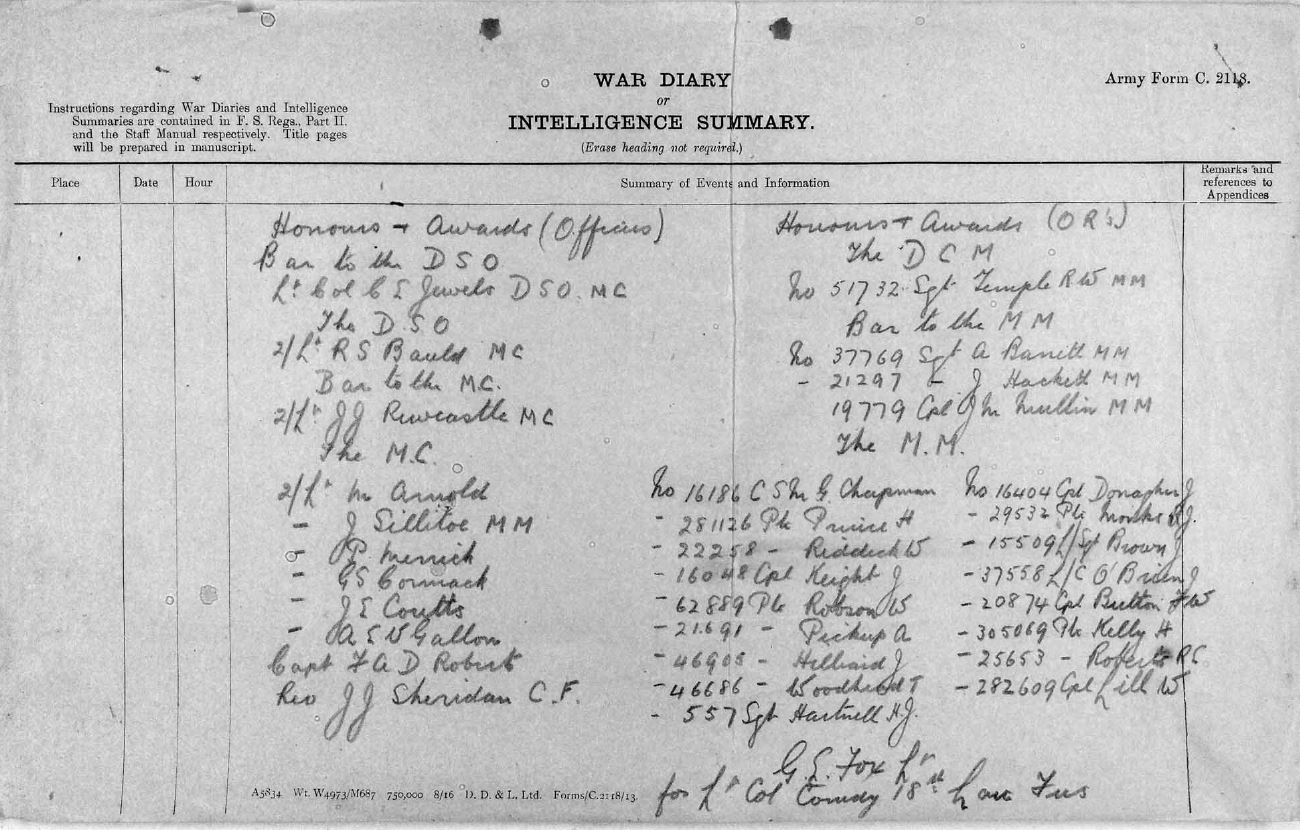
At the end of October 1918, Henry was awarded the Military Medal for bravery posthumously. This is given for acts of gallantry and devotion to duty under fire or for individual or associated acts of bravery which were insufficient to merit the Distinguished Conduct Medal. It was the Other Ranks’ equivalent to the Military Cross (M.C.), which was awarded to Commissioned Officers. There is no mention of the reasons why Henry deserved this award but it was officially gazetted in the London Gazette in June 1919.
Extract from the War Diary of the Lancashire Fusiliers detailing the award of the Military Medal to Henry Hartnell
It is unlikely that Henry ever visited Stoke Climsland. His connection with the Parish is somewhat indirect and took a lot of research to establish. It can only come through his brother, Stanley George, who had become the traffic manager for the Plymouth, Devonport and South Western Junction Railway. Stanley was based at the station in Kelly Bray and lived locally.

Henry's brother, Stanley George Hartnell

List of the effects left by Henry Hartnell

Sunday, 28 October 2018

On this day in 1918, Saddler Ernest Henry Rowland died.

Saddler 966507
Ernest Henry Rowland
 53rd Brigade
Royal Field Artillery
Died 28th October 1918
Age 29
Ernest Henry Rowland was born in Treskinnick Cross village, near Poundstock in 1889, one of the six surviving children of Richard and Elizabeth. Richard was an agricultural labourer and the family seemed to have moved with his work. In 1901 he was employed as a horseman in Dinnacoomb, Jacobstow and in 1911, he was living at Old Mill in Stoke Climsland and employed again as a farm labourer. At this time, Ernest was staying at Dannett farm near Quethiock and working as a waggoner for Joseph Wenmoth.
The marriage certificate of Ernest Rowland and Lily Wills in 1916
We know that Ernest enlisted into the army in Callington but do not know exactly when. But it must have been before 1916 as, when he was married on 15th January 1916 at the Registry Office in Launceston, his profession is given as ‘Saddler, Territorial Royal Field Artillery’ and his address as Barrack Lane, Exeter. He was married to Lily Wills from Luckett, whose brother, Edward John Wills, sadly died in a Prison of War camp in Germany on 24th October 1918, just four days before her husband. At this point, Ernest’s Service Number was 2269 but this changed to 966507 when all Territorial Service Numbers were reassigned to 6 digit format on 1st March 1917.

At some subsequent point, Ernest joined the 53rd Brigade of the Royal Field Artillery (RFA) and travelled to the Middle East, probably disembarking in Alexandria. His Brigade would have been formed of three battalions, responsible for medium calibre guns and howitzers deployed close the front line. The armaments were reasonably mobile and, as they were horse-drawn, the skills of Edward and other saddlers were very much needed. The 53rd Brigade was involved, as part of the 3rd (Lahore) Division in activities against the Ottoman Empire Eight Army, culminating in the Battle of Tabsor in modern-day Palestine on 19th and 20th September 1918, an engagement that effectively neutralised the enemy threat. During this battle, the 3rd (Lahore), together with the 7th (Meerut) and 75th Divisions attacked the entrenched Ottoman positions defending the Tabsor defences. These defences were located in the middle section of the front line, assigned to the XXI Corps. On their left the Battle of Tulkarm was being fought, with the Battle of Arara fought on their right. Together with the cavalry phase, these battles make up the Battle of Sharon, which, with the Battle of Nablus, fought by the XX Corps and Chaytor’s Force, have become known as the Battle of Megiddo. Megiddo developed into a major set piece offensive, when large formations of the Allied Egyptian Expeditionary Force, attacked and responded to the reactions of three Ottoman armies, each time following a predetermined plan. The offensive resulted in defeat for Ottoman forces in Palestine, Syria and the Transjordan.

After this action, the 53rd Brigade was involved in general clean up operations around Jiljulieh in Gaza and the unit’s war diary does not mention any activity with the enemy.
War debris in the aftermath of the Battle of Tabsor
What caused Ernest’s death a month after the last reporting of any fighting was not wounds received but pneumonia, as his death certificate records. Another victim of a virulent epidemic that killed millions towards the end of the conflict and beyond. He is buried in the Gaza Military Cemetery, just outside of Gaza City, where many men from various Casualty Clearing Stations and General and Stationary hospitals are also buried. It contains 3,217 Commonwealth burials from WW1, 781 of them unidentified.
The Gaza Military Cemetery at the end of WW1 and before the work of the CWGC
 
Ernest Rowland's headstone in the Gaza Military Cemetery

Ernest’s outstanding wages of £13 14s 3p and War Gratuity of £18 10s were sent to his widow, Lily, after the war.
Details of the personal effects left to Lily Wills


Wednesday, 24 October 2018

On this day in 1918, Private Edward John Wills died.

Private 240646
Edward John Wills
 1st/5th Battalion
Duke of Cornwall’s Light Infantry
Died 24th October 1918
Aged 25
Edward John Wills, often known as John, was born in Stoke Climsland, in 1894, the only son of John and Betsy Anne Wills. He was baptised in the local church on the 6th May of that year. He seems to have had at least thirteen sisters. John was a copper miner and he and his family lived in Treovis Mill and Broadgate. John died in early 1901 and the census for that year records his widow living as a pauper with her son and six daughters at Treovis Mill. She remarried in 1909 to Francis Dawe, who was a general labourer, and lived at Luckett House, Luckett. We can assume that Edward John attended Luckett school and left to work as a general labourer, as he is listed in the 1911 census as having general work in fruit gardens.

Details of Edward’s military service are sparse. He seems to have had two service numbers, an early one of 2965 and the later one of 240646. This was not an unusual occurrence when a soldier changed regiments: whether or not this was the case with Edward is not known. He did enlist into the 1st/5th Battalion, Duke of Cornwall’s Light Infantry at Bodmin but we do not know when or where he entered service overseas. We do know, however, that he was at the Front when his battalion became embroiled in the Battle of Estaires, an engagement in the Battle of the Lys (7th-29th April). This was part of the German Spring Offensive, originally planned with the objective of capturing Ypres and forcing the Allied Forces back to the Channel Ports and out of the war. Extracts from the History of the DCLI will put the involvement of Edward’s battalion into context: ‘Orders were received to take up a line east of Merville.......But the whole of the draft were youths without any experience of real warfare and the change practically from the barrack-square to the firing-line against a well-trained, war-bitten enemy was a terrible
experience. Nevertheless these youngsters did very well, playing their part nobly in holding up the advance of the enemy and helping to rob him of victory’.
The 1/5th had put up a splendid fight over 11th-13th April but their losses were very heavy. No less than sixteen officers and 467 other ranks were killed, wounded or missing. Edward was one of the latter, not missing but wounded and captured by the Germans.
Limburg Prisoner of War camp
After the war, the belligerent countries involved provided lists of prisoners to the International Committee of the Red Cross, which created an index card for each prisoner and detainee. Edward Wills is one of these and his record card tells us what happened to him after his capture. He was taken at Merville on 12th April 1918 and had sustained a wound to the thigh. From the battle zone, he was transported to the Prisoner of War Camp at Limburg. Sometime thereafter he was transferred to the hospital at Munster Camp (Munsterlager) where he died of pneumonia on 24th October 1918. It is likely that he was buried, initially, somewhere close to the hospital. His final resting place is the Commonwealth War Graves area in the Hamburg Cemetery, closer to the city of Hamburg.
Edward Wills' headstone in the Hamburg Cemetery
During the First World War, Hamburg Cemetery was used for the burial of over 300 Allied servicemen who died as prisoners of war. In 1923, it was decided that the graves of Commonwealth servicemen who had died all over Germany should be brought together into four permanent cemeteries. Hamburg was one of those chosen, and bodies were brought into the cemetery from 120 burial grounds, including 130 from the Munster POW camp cemetery. Edward would have been amongst those transferred and reinterred in 1923. He is buried in Plot IV. C7.

International Red Cross Committee entry for Edward Wills detailing his POW status, where captured etc.
International Red Cross Committee entry for Edward Wills detailing his death

Listing of the monies due to Edward Wills' family


Edward Wills' War Medal that was sold in Plymouth a few years ago.


Monday, 22 October 2018

On this day in 1918, Private Horace Johns Griffin died.

Private 318066
Horace Johns Griffin
Army Service Corps
Died 22nd October 1918
Aged 19
Horace Johns Griffin was born in 1899 at Downgate, Stoke Climsland, the eldest child of Frederick and Laura (nee Johns) Griffin. He had two sisters, Ida and Hettie, and one brother, Frederick. Horace was a pupil at Stoke Climsland School. His father had been a grocer and draper in Chillaton at the time of the 1901 census and the family subsequently moved to Lower Downgate. Frederick died in 1908 and his wife then ran the grocery shop and post office next to the chapel there. In the 1911 census, Laura is listed as grocer and employer. Two live-in grocery assistants also feature in the census return for the household. If you look closely, there are residual traces of the shop’s sign still visible on the outside of the house.
The Griffins' shop in Lower Downgate taken in 1908. Is that one of his sisters in the photograph? If so, which one? The sign can still be made out on the front of the present house. The chapel is now closed and converted into a home. The area is pretty much the same today.

Horace’s Service Record is available and shows that he enlisted, at the age of 17 years 11 months, with the Royal Army Service Corps (regimental no. 318066) as a Private on 7th January 1917 for the duration of the war. His pre-war occupation was given as an apprentice engine fitter and he was sent to serve at the Motor Transport depots at Grove Park and Battersea. He was admitted to hospital in Battersea on 17th March 1918 with chronic bronchitis, the condition being ‘considerably aggravated by exposure. Rales (small clicking, bubbling or rattling sounds in the lungs) all over chest, especially right side where musical signs predominate. Has been losing flesh. Cough troublesome in the morning. Very debilitated’. He was subsequently deemed to be ‘no longer physically fit for war service’ on 1st October and was discharged on October 11th 1918. He died 11 days later in Downgate. His death certificate records the cause of death as pleurisy and chronic meningitis. He was buried at the Methodist Chapel in Venterdon, together with his parents Frederick and Laura, the latter dying in 1955.
The Griffins' family grave and headstone in the graveyard at Venterdon Methodist Chapel. I did try to give it a clean but did not try too hard as I was very conscious of not disturbing the lichen and algae growing there.
The barely discernible 'entry' for Horace Griffin

Horace’s illness and time in hospital are fully documented in his Service Record and it seems that, at some stage, he was classified as a Chelsea Pensioner. This may suggest that he might have spent some time in hospital there.
For a while, it was the custom of families to produce memento mori which were given to friends and relatives of the deceased. This is the one for Horace Griffin

Detail from Horace Griffin's death certificate. I presume he died in the shop in Lower Downgate


Thursday, 18 October 2018

On this day in 1918, Second Lieutentant Alfred James Wills died.


Second Lieutenant 87209
Alfred James Wills
182nd Royal Garrison Artillery
Died 18th October 1918
Age 23
Alfred James Wills was born on 3rd August 1895 at Middlewood in North Hill, one of the three sons and three daughters of James and Jessie Wills. He was baptised at St Torney’s church in North Hill on 2nd September 1895. His father was a bootmaker and the family moved from North Hill to South Petherwin and then to Venterdon, from where Alfred attended Stoke Climsland School. In the 1911 census, he seems to be working with his father as an apprentice bootmaker but this must ahve changed as his given occupation when he joined the army was farm hand/ horseman. In early 1918, before his posting abroad, Alfred married Ethel Annie Jones, also from North Hill, in Launceston Registry Office. Their time together was very short because, within a few months, Alfred was killed. His widow lived until 1990.
Alfred's headstone in the Highland Cemetery at Le Cateau
Alfred’s full Service Record survives and the salient points of Alfred’s military career can be summarised as follows. He was attested (technically enlisted) on 9th December 1915 and posted to the Army Reserve same date. This was a "Derby Scheme" enlistment and was quite normal. Effectively it meant that he had enlisted but his services are not immediately required. He was subsequently mobilised (called-up) on 29th May 1916 and posted to the Royal Garrison Artillery (RGA) depot in Bury St Edmunds. He was appointed as a bombardier on 28th September 1916 and posted to a reinforcements depot on 10th November 1916, making him available for overseas service. He joined the No 423 Siege Battery on 5th May 1917 and applied for a commission and posted to a cadet school in Aldershot in the same month.

After his officer training, on 20th January 1918, he was given a commission in the RGA and embarked for France (Folkestone to Le Havre) on 30th March 1918, where he joined the 182nd Siege Battery on 20th April 1918. The battery was equipped with 6 Ordnance BL 6 inch 26cwt howitzers - the qualifier "26cwt" refers to the weight of the barrel and breech together. These guns needed 10 crew and could fire a 40kg shell a distance of 10km. One source gives that guns of this type fired 22.4 million rounds during the Western Front campaign.


6 inch 26cwt Howitzer of the type used by the 182nd Siege Battery
Alfred’s unit was involved in the Battle of the Selle which started in thick mist at 5:20 a.m. on 17th October 1918. Behind a creeping barrage, the infantry and tanks moved forward on a ten mile long front, south of Le Cateau. Despite tenacious enemy resistance and much uncut wire, the River Selle was crossed during the first day and by nightfall Le Cateau had been captured. The fighting continued into the next day and it is likely that Alfred was killed at this time during enemy counter barrage fire. On the same day two other 182 men (Gunners J Waugh and W Harrison) also died. All three bodies were exhumed in 1920 from a grave location at the entrance to a sugar factory near Inchy, nearly three miles from Le Cateau, and reinterred together at the nearby Highland Cemetery in Le Cateau, a small town in Northern France about 19 kilometres south-east of Cambrai, quite close to the border with BelgiumAll three were identified by their clothes and identifying cross. The inscription on Alfred’s headstone, ‘A loving son, true and kind. A beautiful memory left behind. They will be done’, was chosen by his father, James. The charge levied for these 60 words was 19s 6p.

Alfred’s residual wage and War Gratuity amounted to £81 18s 10p but there is no record of who received these monies.

The official record of the effects left by Alfred Wills
 

Tuesday, 25 September 2018

On this day, 22nd December 1915, Private Percy Jenkin was killed

 Percy Jenkin was the first of the three sons of James and Mary Jenkin/Jenkins who were killed in the war. He was born in 1893 in Lower Downgate and was baptised at his parents' house on 19th October 1893 as part of the Callington Methodist Circuit. The family moved to nearby Kelly Bray quite soon thereafter. By the time of the 1911 census, Percy was working as a live-in waggoner at Manaton Farm in South Hill, about two miles from Kelly Bray.

Entry in the 1911 Census for Manaton Farm, South Hill.

Percy’s military career began when he enlisted in the Duke of Cornwall’s Light Infantry at Launceston on 5th December 1914. Initially he joined the 9th Battalion at Falmouth but had transferred to the 7th by the time he had landed in Boulogne on 27th October 1915. From there, his battalion moved to the front line around Armentieres where preparations for the Battle of the Somme were underway.

Within a matter of two months Percy was killed on 22nd December and a poignant newspaper report dated 15th January 1916 tells us: "It is understood that Private Jenkin had been in the trenches for nearly six weeks and had obtained leave to go on a journey of one mile to procure and despatch a Xmas greeting card for a little friend of his at Golberdon. The card, accompanied by a letter to the child’s parents, intimating that he was in good health, was dated on the day of his death. So it is assumed that on his return to the trenches he was killed. Private Jenkin will be greatly missed and his genial disposition won him high esteem and many friends".

The report of Percy Jenkin's death that appeared in the Cornwall and Devon Post of 15th January 1916.
An enlargement and enhancement of the photograph of Percy Jenkin from the above article.
Percy lies buried in Plot K7 at the Y Farm Military Cemetery at Bois-Grenier, a village just to the south of Armentieres.
Percy's headstone at the Military Cemetery.
 As well as being commemorated on both the memorials in Stoke Climsland, Percy is also remembered on the Golberdon Memorial. He had been connected with the Wesleyan Church there and its Sunday School. As the newspaper reported "his general disposition won him high esteem and many friends".
Golberdon War Memorial.
 Percy had left his effects to his brother and sole legatee, Alfred. He received the sum of £5 14s 10p (worth approximately £500 at today's rate) on 25th February 1916, comprised of £2 4s 10p cash and £3 10s War Gratuity. The War Gratuity was introduced in December 1918 as a payment to be made to those men who had served in WW1 for a period of 6 months or more home service or for any length of service if a man had served overseas. It was calculated based on the actual length of service.
Form recording the dispersal of Percy's effects.