Monday, 23 March 2015

An overlooked deed of WW1 bravery

Apropos of my earlier blog on the misuse of the word 'hero', I've been irritated this week by a well known supermarket beginning with T applying the term to those brave souls who risk all in passing your goods across the barcode scanner and taking your cash. They go over the top for your tenner! And then, as if to rub salt into my wounds, I was assailed over the weekend by a coffee shop asking me to let their barista heroes prepare me a cappuccino.  

Let's go back to first principles and remind ourselves of what the dictionary tells us. Bear this definition in mind as I tell you a true tale.

HERO: A person distinguished by courage and admired for brave deeds. A person who has noble qualities and has performed selfless acts. Regarded as a model or an ideal for others due to heroic action.


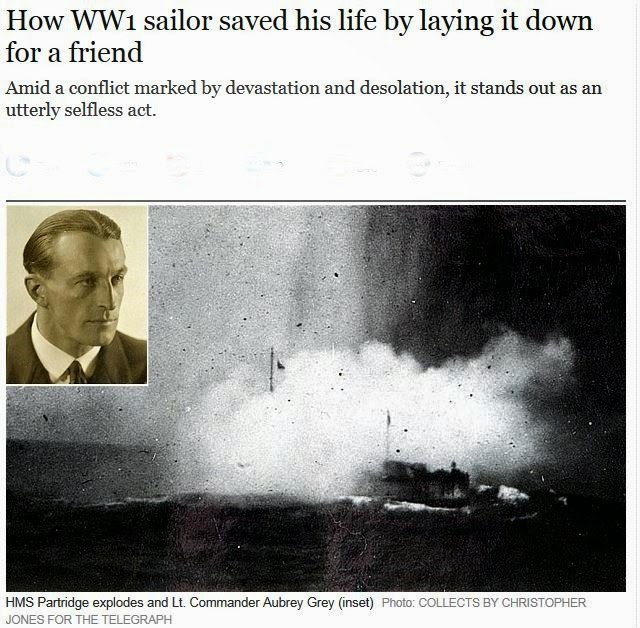
Regular readers will be aware that I'm commemorating those named on our local WW1 memorial on the centenary of their deaths. One such will be Lancelot Walters who was killed when his ship, HMS Partridge, was sunk on December 12th 1917. As well as his name appearing on our two war memorials, he is also commemorated on a separate, and easily missed, plaque, just to the right of the altar in the church. The wording on the plaque is rather intriguing and reads: ‘.......who lost his life in action on Dec 12th 1917 in the North Sea in spite of a gallant attempt to save him by Sub Lieut Aubrey Egerton Grey R.N.’ What was the story behind these few words? Who was Aubrey Grey and what did he do to merit such praise?


After enough research to make me feel rather pleased with myself, I managed to piece together the following. In late 1917 HMS Partridge was one of a number of ships, based at Lerwick in the Shetland Islands, being used to escort convoys to and from Norway. On 11th December 1917 the destroyer left port in the company of the destroyer HMS Pellew and four armed trawlers, escorting a convoy of six merchant ships. At 11.45 am on 12th December the convoy was south west of Bjorne Fjord when enemy ships were sighted to the north. The convoy was ordered to scatter and the Partridge and the Pellew prepared to engage the enemy in the form of four destroyers. The Partridge was quickly hit, and with her main steam-pipe severed, was rendered helpless and a sitting target. After being struck by another torpedo her Captain gave orders for her to be abandoned. Despite this order, Lieutenants Grey and Walters were determined to continue the fight. Manning a torpedo tube they fired one which hit an enemy destroyer but failed to explode. Soon afterwards Grey was wounded in the thigh. The two Lieutenants then made for a boat but this capsized casting both into the water. Grey, although wounded, then performed an unselfish act of bravery. He swam to help Walters who was exhausted, and although badly wounded himself in the leg, swam with him for more than a quarter of a mile and placed him on the only vacant place on a raft. Seeing that his own added weight would endanger the raft, he then swam away and was eventually picked up by a German destroyer in a very exhausted state. Remember that this was December in the North Sea: there was a heavy sea running at the time and the weather was intensely cold. For this gallant act of life saving, Lieutenant Grey was awarded the Royal Humane Society’s Silver Medal and was subsequently awarded the Society’s Stanhope Gold Medal in 1919 for his action.
HMS Partridge in a pre-WW1 photograph
A photograph, from an enemy ship, of HMS Partridge taken shortly after she was hit.
A press clipping of the award of the RHS's medal.
 
After another piece of self-satisfying research, I managed to contact Lieutenant Grey’s son, Aubrey, who says his father spent the remainder of the war in a POW in Kiel but rejoined the navy as soon as he could thereafter. He also added a fascinating addendum to the episode. In 1936 during the Coronation of Edward VIII, there was a review of ships of all nations anchored in the Solent and Spithead. His father was asked to a dinner to entertain the captains of some twenty foreign ships. One of them was a Captain Ruge, who told Grey that he had sunk HMS Partridge! They became friends (Ruge was not a Nazi sympathiser) and exchanged letters before and after WW2. The younger Aubrey was not aware of the plaque and although he is now in his mid 80s, he was able to visit the church recently and see for himself the dedication to his father. It was quite a moving experience for all of us present.
The younger Aubrey Grey at the plaque commemorating his father's bravery.
As a footnote to the above, Aubrey Grey junior sent the story of his father to the Daily Torygraph in response to a request for unknown WW1 exploits. They published it and, far be it that I should accuse the author of plagiarism, it is strange that many phrases I'd used elsewhere appeared in the Torygraph's piece. Putting that personal niggle to one side, since Aubrey Grey's act became apparent to me I've put him firmly in the pantheon of heroes, even if he probably couldn't prepare a decent cup of coffee or pack my grocery bags properly.  

Sunday, 22 March 2015

Hiding in plain sight.

The borders of the United Kingdom have been locked down to prevent ISIS terrorists returning from Syria. But does this concern the jihadists? Apparently not if this lorry we spotted the other day is anything to go by. I suspected they were well organised but this is a step further than I had imagined.

Thursday, 19 March 2015

Alliterative leisure: Luxulyan, leats and launders

A just-over 6 mile walk with one of our groups took us to the Luxulyan Valley further west in Cornwall, near St Blazey. We've passed by many times but have never taken the short detour off the main road and walked the area. What a little gem! On the face of it, just a wooded valley but one with a long history of industrial development. What's there now to be seen is mainly down to the efforts and vision of one man, Joseph Treffry.  His interest in the valley began when he needed to find a way of getting the ore from a mine he owned onto ships at Par Harbour, which he had built. His answer was to link the harbour to a canal at the bottom of an inclined plane he had constructed. The inclined plane was operated by a large water wheel and this needed a supply of, mmm, guess what?, water. This, coupled with the need of the same (lots of it) for nearby mines, quarries and clay-pits, lead to the development of a complex system of leats and launders, culminating in the construction of the unique dual purpose Treffry Viaduct. And all of this started around 1820. My sort of walk - lots of industrial archaeology, out in the open air and good (but not intrusive) company.
For those who like to know the location, here's a map of our walk. Basically it was up one side of the valley to Luxulyan village and then back down the other side to our starting point. The profile shows this quite nicely but doesn't show the mud or give the sound of rushing water that was ever present.
The bottom of the inclined plane, showing the granite blocks upon which the rails were bolted. Unusually, many of the 'shoes' for the rails were still in place. At 1 in 7 it's quite a steep gradient and rises about 400 ft over just under a mile.
Water and greenery wherever we went.
Here we are looking down on the Fowey Consols Leat, one of the earliest of Treffry's engineering projects. It runs for about three miles in total and was built to carry water to Treffry's Fowey Consols copper mine. The original course of the leat ran more middle right than bottom right, the tree marks its old route. It now disappears into a tunnel, built in the 1940's, but before that it went around a rocky outcrop in a cantilevered wooden launder. It must have been an impressive sight and an equally impressive feat of engineering.
Lots of rather misshapen sessile oak trees all along the valley walk, probably due to their growing towards the light (positive phototropism to the botanists amongst us).
And this is the water chute that feeds the power source that hauled wagons up the incline, the Carmears Wheel. Ah, it must be overshot, I hear you say?  And you would be right. The water comes via the Carmears Leat which, in part, is carried across the valley by the Treffry Viaduct. Once it had driven the wheel, the water drained into the Fowey Consols Leat and was subsequently used elsewhere. Obviously, the water is not running at the moment due to essential repair work on the Viaduct.
The original wheel was some 30 foot in diameter and , through a series of cogs in a nearby winding shed, the motion of the wheel was transferred to haul the wagons.  What remains is the central shaft of a later wheel, around 40 foot in diameter, that was later used to power a china stone grinding mill.
Looking a little like a discarded bicycle, the cogs and wheels for the grinding mill can still be seen next to the wheelpit, which is to the left. The powder produced by the grinding mill was mixed with water to produce a slurry and this was piped down the hill, by gravity, to be further processed by settling and drying. This part was in operation until the early 1960s.
When Joseph Treffry started his enterprises, he faced a pretty basic problem: his mine, quarries and water sources were on one side of the very steep valley and where he wanted his water wheel and the incline to be was on the other side of the valley. I like to think he put on his top hat, rubbed his chin, kicked his cat and then said "I'll build a bridge. Wait a minute, I can do better than that..!". And he did, he came up with a dual purpose structure - a combined viaduct and aquaduct. The viaduct carried the horse-drawn tramway delivering the ore/clay to the top of the incline and the aquaduct, situated directly under the granite slabs of the tramway, carried the water of the Carmears Leat to the water wheel. At each end of the retaining balustrade there are curved walls ending in an elegant pillar, adding to a structure that is aesthetically pleasing as well as functional.
The viaduct from below. Each granite block was quarried and shaped locally. From a distance it blends into the landscape from whence it came. Close up the skill of the craftsmen is obvious.
It's still a little early for many flowers. There were a few primroses, celandines and wood anemones but lots of this Spring Euphorbia. And, yes, I do know that most of the colour comes from the lime green bracts rather than the actual flower.
 

Tuesday, 17 March 2015

Reprise: Humpty Dumpty's Guide to Defending the Indefensible

There are lies, damned lies and Tory euphemisms. The Chairman of the Posh Dave's mob, the chancer Grant Shaps, has been caught lying or, as he describes it, 'being over-firm'. I was going to have a nice rant about this when I remembered that I'd already done something similar way back (on 4th April 2012 to be exact). Although it's a little dated in parts, it's still worth another airing.
 
**************************************

Humpty Dumpty's Guide to Defending the Indefensible

I know it’s hard to believe but sometimes governments and politicians do stupid, even bad, things. When they do, their colleagues, government officials and sympathisers inevitably try to defend their conduct, even when those
actions are clearly wrong and/or obviously counterproductive. There’s a word for this and it’s called being an "apologist," although people who do this rarely apologise for much of anything. After all, a sincere apology means an admittance of guilt and few politicians would ever want us to think that they are less than infallible.

All of us need to be able to spot the rhetorical ploys that governments, politicians and their acolytes use to justify their own misconduct. To help you through the labyrinthine lexicology of ‘apologist-speak’ I have compiled ‘Humpty Dumpty’s Guide to Defending the Indefensible’. There is an obvious connection to recent events in the UK (think ‘Jerry Can’ Maude) but such practices are commonplace in many, many countries and, indeed, widely practiced by non-politicians as well. So, ladies and gentlemen, here is what to look out for when the whitewash and bull***t need to be applied. Select which approach is likely to most successful to the task in hand, be it local (store petrol at home, James Murdoch’s defence or just about anything that our government sets out to do)) or international (Iraq, Afghanistan).

1. We didn't do it! (Denials usually don't work, but it's worth a try).
2. We know you think we did it but we aren't admitting anything.
3. Actually, maybe we did do something but not what we are accused of doing.
4. Ok, we did it but it wasn't that bad ("waterboarding isn't really torture, you know. It’s just a little uncomfortable").
5. Well, maybe it was pretty bad but it was justified or necessary. (“We only torture terrorists, or suspected terrorists, or people who might know a terrorist or people who look like terrorists")
6. What we did was really quite restrained, when you consider how powerful we really are. We could have done something even worse.
7. Besides, what we did was technically legal under some interpretations of international law (or at least as our lawyers interpret the law as it applies to us.)
8. Don't forget: the other side is much worse. In fact, they're evil. Really, really evil. As evil as evil can be.
9. Anyway, they started it.
10. And remember: we are the good guys. We are not morally equivalent to the bad guys no matter what we did. Only morally suspect, misguided critics could fail to see this fundamental distinction between Them and Us.
11. The results may have been imperfect, but our intentions were noble. (Invading Iraq and Afghanistan may have resulted in tens of thousands of dead and wounded and millions of refugees, but we meant well).
12. We have to do things like this to maintain our credibility. You don't want to encourage those other bad guys, do you?
13. Especially because the only language the other side understands is force.
14. In fact, it was imperative to teach them a lesson – again.
15. If we hadn't done this to them they would undoubtedly have done something even worse to us. Well, maybe not. But who could take that chance?
16. In fact, no responsible government could have acted otherwise in the face of such provocation.
17. Plus, we had no choice. What we did may have been awful but all other policy options had failed and/or nothing else would have worked.
18. It's a tough world out there and Serious People understand that sometimes you have to do these things. Only ignorant idealists, terrorist sympathisers, craven appeasers and/or treasonous socialists would question our actions.
19. In fact, whatever we did will be worth it eventually, and someday you’ll thank us for it.
20. We are the victims of a double-standard. Other people/countries do the same things (or worse) and nobody complains about them.

I don’t claim that the list is exhaustive but it’s a good start. Bear it in mind when next you watch the news and have fun spotting the tactic being deployed. I listened to an interview with Tory Dave earlier on and recognised the oft-used ‘we have to make difficult decisions’ variant of #17. Putting Tory Dave to one side (if only!), there are some masterful Humpty Dumptyists at work the world over and personal integrity is no bar to the Apologist. They really do think we are stupid. In fact, an alternative title for this blog could be ‘DNP’s Guide to Having Your Intelligence Insulted’ but that’s a story for another day……!

Saturday, 14 March 2015

16th March 1915: On this day Thomas Hancock died


The War Memorial in the centre of Stoke Climsland bears the names of thirty seven men who died in World War One. I've been researching the backgrounds of each of them for quite a while and, one day, one day (will that day ever come?), all the information will find its way into a book of some form. As a cyber-tribute to them (my cyber monumentum mortuorum, if you like), I'm going to commemorate each one in my blog on the 100th anniversary of their deaths (which means I've got to keep blogging until 2019). The details I'll be able to give will vary with the success of my researches: in most cases I have only the name as the starting point. I'll apologise in advance for any errors of fact and I would love to hear from anyone who is able to correct me. It is important to be as accurate as possible.
 
The first man from the Parish to die was 3/4261 Private Thomas Hancock of the 1st Battalion, Duke of Cornwall’s Light Infantry. His regimental number suggests that he was a pre-war reservist, probably a member of the 3rd (Reserve) Batallion, formerly known as the "Royal Cornwall Rangers, Duke of Cornwall’s Own Rifles". As such, he would have been called up for active duty very early after the outbreak of war.

Thomas’s parents, William and Mary Anne, were living at Treburyse Farm Cottages, just outside of Launceston, when he was born in April 1877. William was a farm labourer and the family seems to have moved from farm to farm until they settled in Venterdon in the late 1890s. At the time of the 1911 census, Thomas was a fruit grower and still living with his parents in Venterdon.

I'm not certain when Thomas embarked for France but I do know that his battalion was heavily engaged in activities in Northern France when he died on 16th March 1915 of wounds sustained in an earlier action. At the time, his battalion was involved in The Battle of Neuve Chapelle which began on 10th March and the subsequent action at St Eloi on 14th/15th March. Neuve Chapelle was significant as it was the first large scale organised attack undertaken by the British army during the war and it followed the miserable winter operations of 1914-15. During the action British losses were 544 officers and 11,108 other ranks killed, wounded and missing. German losses are estimated at a similar figure of 12,000, which included 1,687 prisoners. In retrospect, although not a defeat, the Battle of Neuve Chappelle was not a great success. More than anything it revealed inadequacies in the strategy adopted - the artillery bombardment was too light to suppress the enemy defences; there were too few good artillery observation points; the reserves were too few to follow up success quickly; command communications took too long and the means of communicating were too vulnerable.

Thomas Hancock is buried in Boulogne Eastern Cemetery, which is well away from any battle activity, suggesting that when he died he was in one of the many military hospitals that had been established around the port.

A pox on them all - correction.

An e-mail from a friend corrects the Latin in my last post. As he was a house-master at Eton (he taught David Cameron and Justin Wellby, amongst others), I am delighted to stand corrected! You learn something new every day.
 
"I’ve been having further thoughts! Monumentum mortuis would certainly mean literally a monument to the dead but I don’t think the Romans of the day would ever have said it – and in point of fact I don’t think it’s what you really mean: you are not going to give this monument to the dead so that it becomes their possession. What you want is a memorial of their existence, and I think the Romans would have said monumentum mortuorum – literally a memorial of the dead".

Wednesday, 11 March 2015

A pox on them all - or rather not

Regular readers of my blog will have endured the occasional lapse into necrophilia as we've wandered around graveyards, churchyards and other monumenta mortuis. In my humble opinion (Humble? Humble? You? Do I hear someone say?), some of the great features of English churches and cathedrals are the often beautifully sculpted memorial plaques that line their walls. Sometimes these mural monuments refer to a person interred nearby, but often they commemorate someone who is buried elsewhere. I love them for the small glimpses they provide of otherwise forgotten or unknown lives. Reading about them gives them renewed life, if only momentarily.
 
One such we came across in Lichfield Cathedral, just inside the visitor's entrance: a memorial to Lady Mary Wortley Montague. She is buried in London, I assume, as that is where she died, but it is in Litchfield that she is remembered.
 
Just in case you can't make it out, even after you've clicked on the above image to enlarge it, here is the full inscription.

Sacred to the Memory
of
The Right Honorable
Lady MARY WORTLEY MONTAGUE
Who happily introduced from Turkey
into this country
The Salutary Art
Of inoculating the Small-Pox.
Convinc'd of its Efficacy
She first tried it with Success
On her own Children
And then recommended the practice of it
To her fellow-Citizens.
Then by her Example and Advice
We have soften'd the Virulence
And escaped the danger of this malignant Disease.
To perpetuate the Memory of such Benevolence,
And express her Gratitude
For the benefit She herself has receiv'd
From the alleviating Art,
This Monument is erected
by
HENRIETTA INGE
Relict of THEODORE WILLIAM INGE, Esq.r.
And Daughter of Sir JOHN WROTTESLEY Baronet
In the Year of OUR LORD MDCCLXXXIX

I didn't know anything about Lady Mary Wortley Montagu but it wasn't difficult to establish some facts. I learned that she lived from 1689-1762, how she accompanied her husband to Turkey when he served there as ambassador and how she learned from the Turks about inoculating for smallpox. I gleaned a little about her efforts (half a century before Edward Jenner*) to educate the English about inoculation and I read that she was a famous letter writer and a subject of Alexander Pope's satirical pen. It sounds as if she was quite a woman.

 But I could find nothing about the commissioner of the memorial, Henrietta Inge, other than what the inscription tells us. Her husband was a son of the Inge family which held the manor in Thorpe Constantine, Staffordshire, and she came from one of the great families of that county, the Wrottesleys. But what personal experience led her to express such extravagant gratitude for 'the benefit she herself has receiv'd from the alleviating Art?' Logic says that if wasn't Henrietta herself then it must have been someone close to her (a child, husband, parent, dear friend?) who had been spared the scourges of smallpox due to an inoculation à la Lady Mary. We'll never know but at least we have given a little thought to Henrietta Inge and her kind gesture towards the memory of Lady Mary.

* And for those who are wondering: Edward Jenner's discovery was not inoculation, but vaccination, using the related cowpox virus instead of smallpox to produce immunity. Inoculation meant that an incision was made in a healthy patient and a small amount of live smallpox (in the form of pus from an infected person) was introduced into the wound to build up immunity. Which would you prefer? Me? I'm a Jenner man. Coincidentally, one of our friends is a direct descendant of Edward Jenner but that's a story for BJ to tell.

A weekend in Staffordshire: March 2015

A few images from a great weekend in the Potteries with very good friends (many thanks, S & D).
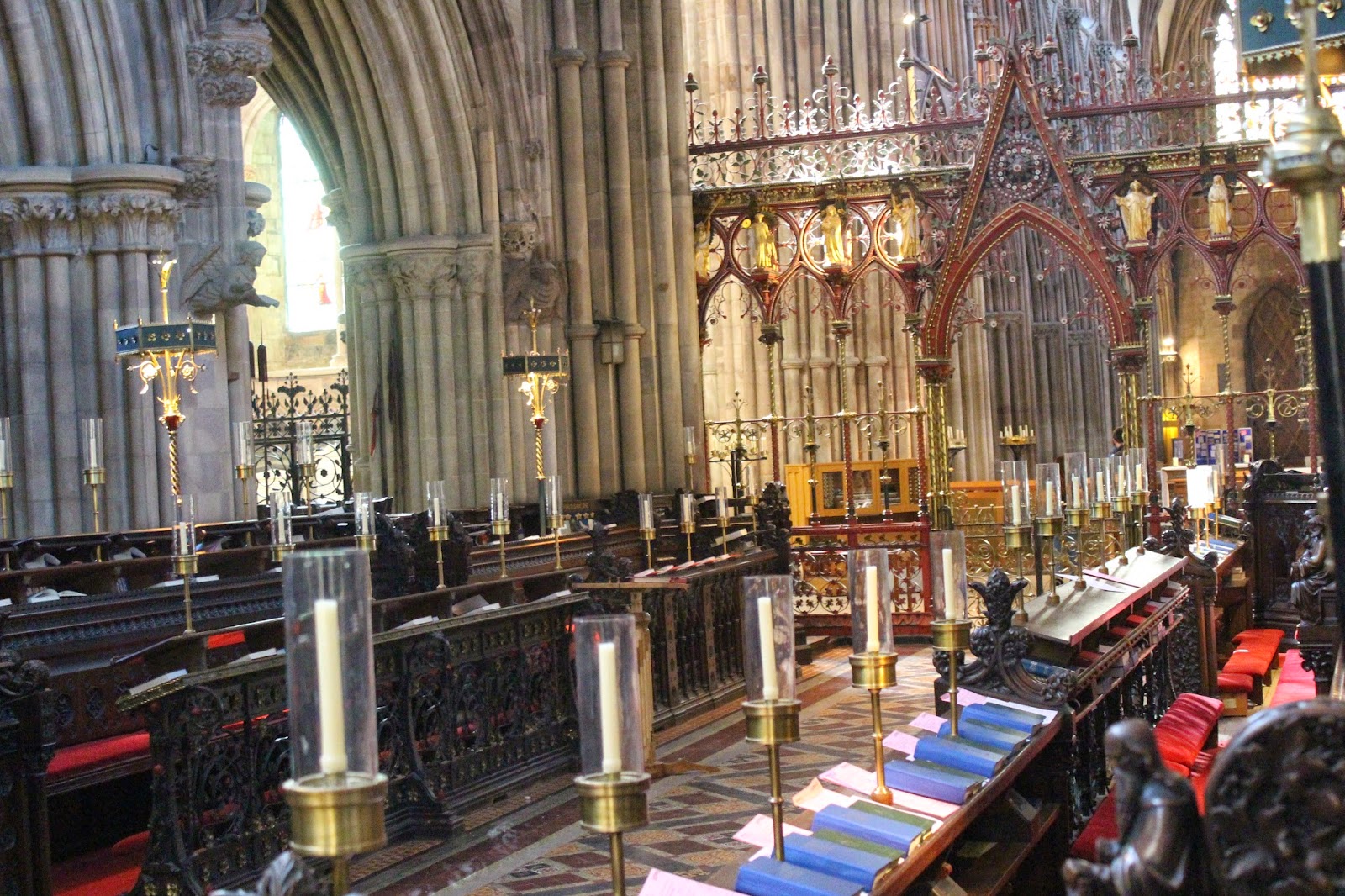
Litchfield Cathedral (or, to give the formal title, the Cathedral Church of the Blessed Virgin Mary and St Chad) was new to us and it's always good to tick another one off the list. Building started just before 1100 and continued in phases through the twelfth century. The original wooden Saxon church was replaced by a Norman cathedral made from stone, and this was in turn replaced by the present Gothic structure begun in 1195 and completed in the 1330s. It is unique amongst English cathedrals in having three spires.
Looking up the nave towards the altar. Apparently the ceiling trusses were originally masonry but were replaced by wood when it was realised that the weight was a problem. Perhaps this was done when the cathedral was restored by Sir George Gilbert Scott in Victorian times?
This crossing screen was designed by Scott and is made of iron, brass and copper. A wonderful example of High-Victorianism. Not to everybody's taste perhaps but I do like a bit of High-Victorianism.
The Choir. A notice said that there were no old stalls remaining when Scott started work so he had carte blanche to design the new choir stalls. Rather more functional Victorianism was employed here.
From the Gothic splendour of Litchfield Cathedral we moved on to the rustic splendour of Little Moreton Hall. A smack-you-in-the-face moated half-timbered Tudor house.The earliest parts were built by and for the prosperous Cheshire landowner William Moreton in about 1504–08, and the remainder was constructed in stages by successive generations of the family until about 1610. It remained in the family's ownership until the 1930s. The building is delightfully quirky, with three asymmetrical ranges forming a small, rectangular cobbled courtyard. The house's top-heavy and sort-of-squashed appearance is due to the Long Gallery that runs the length of the south range's upper floor
The original house of circa 1504 - 1508 was relatively modest until William Moreton decided to follow the fashion of the day and install gabled bays and windows.
Those proficient in Latin dates will be able to translate the carved MDLIX as 1559. Others will put it as 2015 and they'd be wrong.
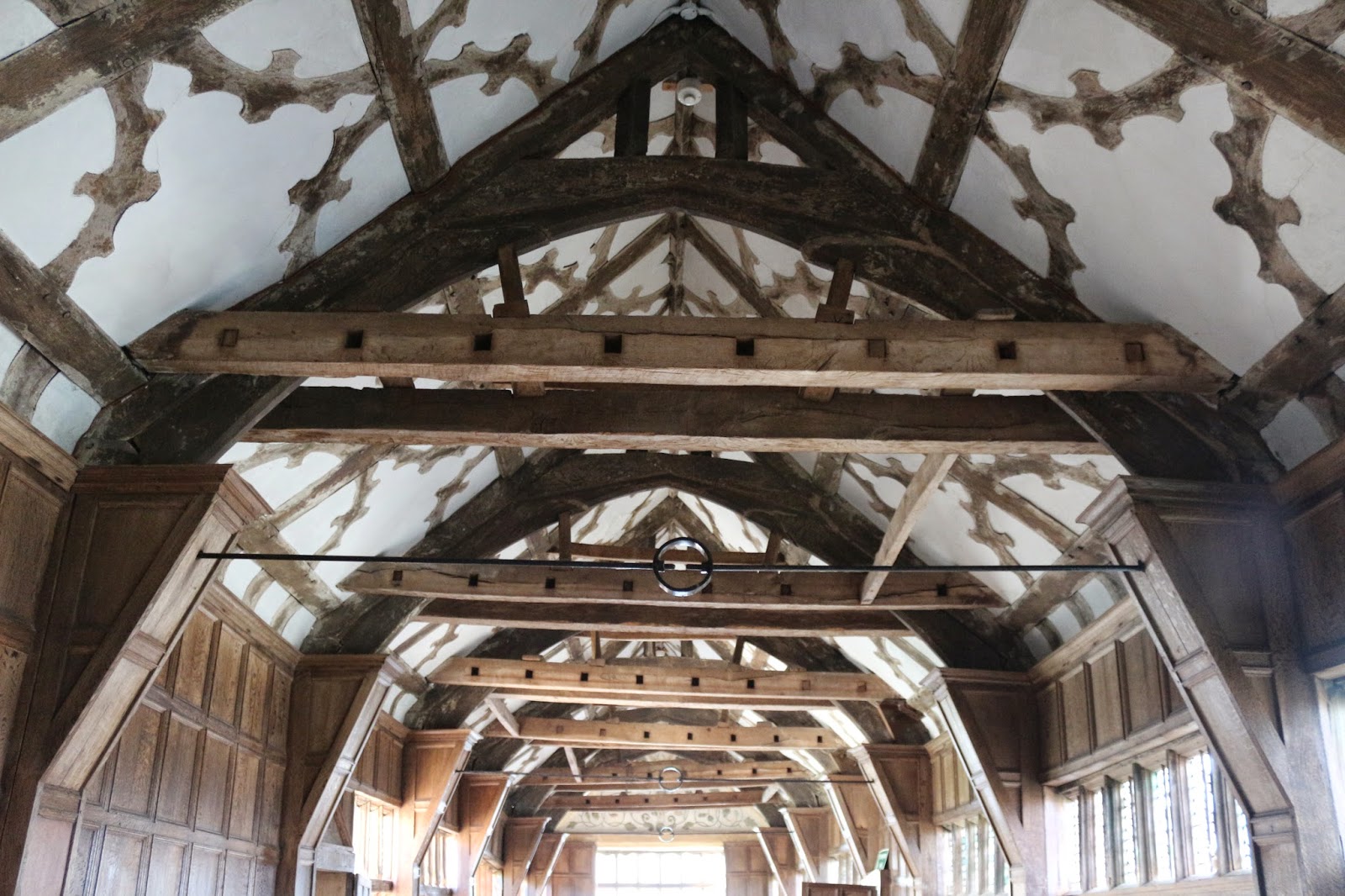
Still following the building fashions of the day, the Moreton family decided to build the Long Gallery on top of the South Range. Very nice for indoor games but, oh, the problems it brought. Think what might happen if you plonk a structure with a riven stone tiled roof, heavy oak beams and a partial cement floor on top of a wooden framed building - and it did.
More carvings. This set is from the carpenter who made all of the windows - Rycharde Dale. Probably a better window maker than a woodcarver or a speller.
And who can guess what this odd shaped hole is for? Wrong, wrong, wrong. It's an opening for a dog kennel, dating from Victorian times. I bet they never had to apply for planning permission - in triplicate - to do this as they would nowadays.
An interesting play on words.  This piece of stained glass depicts the Moreton surname in a playful way.  More: the black head of the wolf. Tun: the barrel resting below. Ha, ha - who said the Tudor's didn't have  sense of humour.
Here's a shot taken inside the Long Gallery showing the steps taken to counteract the problems caused by the weight of the roof. Looking at the apex in the foreground and working downwards: the dark wood at the top is the original; some 30 years later the lighter cross beam was put in place to prevent the splaying; then a metal tie beam was installed and then, but not so visible towards the sides, large metal plates were bolted against the beams.  What can't be seen in situ, but can in an exploded model of the house, are a whole set of steel girders hidden away and providing a 21st Century solution to a problem started in the late 1580s.
On the floor beneath the Long Gallery, a number of large support columns were constructed to stop the structure above from collapsing downwards. I wonder what Mrs Moreton thought of having these intrusive beams taking up space in her lovely bedroom?
Me? I couldn't give a quack about the building. Just gimme some mud to root around in and I'm happy.

Thursday, 5 March 2015

An electrifying performance

I
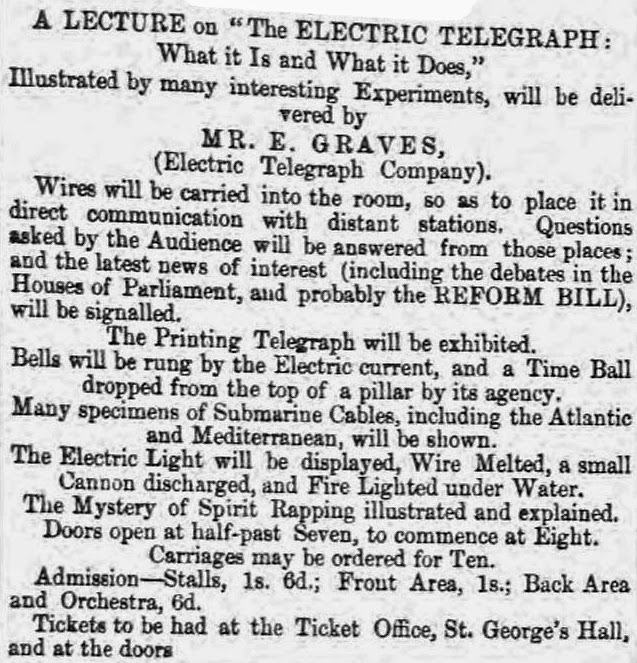
What are you going to be getting up to this evening? I don't know about you but I might phone a friend 'oop North and see how he's been spending his time, I might Facetime my mother in South Wales, I might fire off a few e-mails off to friends near and far, I might check-out a few of my favourite blogs from around the world and then settle down to re-watch my all-time favourite episodes of Downton Abbey, Call the Midwife or Downton Midwives (you know, the one with posh nurses. "Carson, one's waters have broken. Call Lady Mary"). Or perhaps I would pop along to the fascinating lecture at the St George' Hall in Brighton on "The Electric Telegraph, What It Is And What It Does"

Sadly, I can't make it to the lecture as I seem to have missed it by the small margin of 155 years; the confusion can be put down to my habit of reading old newspapers. As I get older I find I get more and more depressed by so much of what is happening in the news and even more depressed by popular reactions to it. I find I can't even walk past a newsstand nowadays without my blood pressure climbing to dangerous heights and I'm pretty close to getting a lifetime banning order from Mrs P, stopping me watching Question Time and the Politics Show on television. That's why I take refuge in old newspapers: it's difficult to get too worked up about mistakes that have already been made and at least you know how the story ends.

And that is how I came across the above notice from the Brighton and Hove Gazette of March 1860 as I was trying to track down (unsuccessfully as it turned out) a mention of an ancestor of mine. Reading the list of marvels to be demonstrated by Mr Graves, I can't help musing that it must have been a fascinating time to have been alive (given the proviso that you were also fortunate enough to be able to afford a carriage to collect you at ten and buy enough food to stop you from starving). Technological innovations were queuing up to with all the enthusiasm of bargain hunters at a Boxing Day Sale. Telegraphs, electricity, lights, printing, photography; they were all falling headlong into common usage and transforming society in a way that is reminiscent of the digital revolution of our more recent past. 

But tonight, as I watch TV, FaceTime, surf the internet or whatever, I will think of that lecture I missed and how fascinating it would have been to have shared the wonder and the marvel at the demonstrations of Mr Graves and his colleagues.

Wednesday, 4 March 2015

As the actress said to the bishop?

Not quite. More like what the actor and the bishops said together. A few days before Michael Sheen delivered his passionate speech at Tredegar (link here),  the House of Bishops published a “pastoral letter” (Who is my Neighbour? - access a copy here) calling for “a fresh moral vision of the kind of country we want to be”. “The different parties have failed to offer attractive visions of the kind of society and culture they wish to see,” it says and calls for citizens to engage fully in the political process: “Unless we exercise the democratic rights that our ancestors struggled for, we will share responsibility for the failures of the political classes.” In its 52 pages it says many things and calls for us to vote “with the good of others in mind”. It endorses no political party but, true to form, it has been criticised by many Tories who feel that there is a left-wing leaning to the Bishop's message. Predictable though it is, I still find this knee-jerk response irritating: rather than simply disagreeing with its contents and pointing out where they think differently, they take issue with the fact that it was written at all. Bishops should not comment on this sort of thing, they reckon. On wealth and poverty, on equality and fairness, on how our communities are governed, on right and wrong. But if our church leaders can't comment on these things, who can? Actually, anyone who agrees with the Tories, that's who. Those with a contrary view should shut up.

Here are a few quotes from this seditious document, copies of which are no doubt being burnt at Tory HQ as I write:

"How can we build the kind of society which many people say they want but which is not yet being expressed in the vision of any of the parties?"

 "The privileges of living in a democracy mean that we should use our votes thoughtfully, prayerfully and with the good of others in mind, not just our own interests."

"In Britain, we have become so used to believing that self-interest drives every decision, that it takes a leap of imagination to argue that there should be stronger institutions for those we disagree with as well as for those 'on our side.' Breaking free of self-interest and welcoming our opponents as well as our supporters into a messy, noisy, yet rich and creative community of communities is, perhaps, the only way we will enrich our almost-moribund political culture."

"It is not possible to separate the way a person perceives his or her place in the created order from their beliefs, religious or otherwise, about how the world's affairs ought to be arranged. The claim that religion and political life must be kept separate is, in any case, frequently disingenuous - most politicians and pundits are happy enough for the churches to speak on political issues so long as the church agrees with their particular line."

They note that "with few exceptions, politicians are not driven merely by cynicism or self-interest" but nevertheless, "the different parties have failed to offer attractive visions of the kind of society and culture they wish to see…. There is no idealism in this prospectus".

 They express the hope for political parties to discern "a fresh moral vision of the kind of country we want to be.  How can we build the kind of society which many people say they want but which is not yet being expressed in the vision of any of the parties?"

 "The extent of loneliness in society today, with the attendant problems of mental and physical health, is one indication of how far we have drifted into a society of strangers. But that drift is far from complete - and few people, if asked, would say that a society of strangers represents a vision of society which they desire."

"We are seeking, not a string of policy offers, but a way of conceiving and ordering our political and economic life which can be pursued in a conservative idiom, a socialist idiom, a liberal idiom - and by others not aligned to party."

Allowing for the different styles (one is delivered with raw passion and vitriol, whereas the other is much more measured and nuanced), there are many similarities between Sheen and the Bishops. Both are saying "you politicians are out of touch and have no real vision for moving the country towards a fairer and more equal society". And surely no one can argue against that? What a daft question! Of course there are many people who can and will argue against it. Unfortunately, most of them are people who can pull the levers of power and self preservation. A pox on all of them, I say.

Monday, 2 March 2015

Michael Sheen at Tredegar

A wonderful barn-storming speech by the actor Michael Sheen has, quite rightly, featured prominently in the news today. Delivered from a bandstand in a typically blustery Tredegar, Aneurin Bevan’s birthplace, he rounded on all politicians and notably lambasted Labour’s timid leaders and their lack of conviction. Why, oh why, can't Ed Milliband, or anyone for that matter, in the Labour Party speak with such conviction and passion? Here's the speech for you to enjoy. Even if you disagree with him, admire the rhetoric.

Many parts of what he said resonate particularly with me and I've selected a few below. The full text of his speech is at the end if you'd like to reach your own conclusions about it. 

“In today’s political climate, where politicians are careful, tentative, scared of saying what they feel for fear ... all political parties drift into a morass of bland neutrality and the real values we suspect are kept behind closed doors. Is it any wonder that people feel there is little to choose between?”

Of Labour politicians he says: “You must stand up for what you believe, but first of all, by God, believe in something".

“Do we want to be a society that is exploitative, that sees people as commodities, as numbers, and mere instruments of profit? Or do we want to be a society where each person is recognised, where all are equal in worth and value – where that value is not purely a monetary one?”

“Do we want to be a society that is supportive, that is inclusive and compassionate, where it is acknowledged that not all can prosper, where those who are most vulnerable, most in need of help, are not seen as lazy or scrounging or robbing the rest of us for whatever they can get? Where we do not turn our backs on those facing hard times, we do not abandon them or exploit their weakness, because they are us. We leave no one behind, we only say we have crossed the finished line when the last of us does, because no one is alone and there is such a thing as society.”

"To those who have discarded all principles, save that of profit before all else; to those who have turned their backs on the very idea of a truly democratic society, and aligned themselves to nothing but self-interest; to those who have betrayed the vision of equality, and justice, and compassion for all – that vision that provided the crucible from which came forth the National Health Service – I say to you, as Aneurin Bevan said in Trafalgar Square in 1956: you have besmirched the name of Britain; you have made us ashamed of the things of which formerly we were proud; you have offended against every principle of decency and there is only way in which you can even begin to restore your tarnished reputation. Get out. Get out! Get ... out!"

FULL TEXT OF MICHAEL SHEEN'S SPEECH
In 1945 Aneurin Bevan said: ‘We have been the dreamers, we have been the sufferers, and now, we are the builders.’ And my God, how they built. And what they built. Every bit as much a wonder of the world as any architectural marvel, or any natural miracle … The National Health Service. A truly monumental vision. The result of true representation. Of real advocacy. A symbol of equality, of fairness, and of compassion.

The nation that swept the post-war Labour government into power was made up of people who had faced the horrors and the hardships of the second world war. And had bound together as one community to overcome them. They had been sustained and inspired by their feeling of comradeship, and their sense of responsibility for their fellow man and woman. Compelled to help those in need and those struggling in the face of hardship.
             
These were the experiences that shaped them, and this was the vision of life that the welfare state was born out of. Faced with an enemy that sought only to divide, the National Health Service strove for unity. Where they traded in fear-mongering, and blame, and exploitation of the vulnerable, the NHS represented compassion, and generosity, and acceptance. Where they slavered with voracious self-interest, the NHS symbolised courageous self-sacrifice for the good of all.

In his book In Place of Fear, Bevan said: ‘The collective principle asserts that no society can legitimately call itself civilised if a sick person is denied medical aid because of lack of means.’

‘No society can legitimately call itself civilised’: now that begs the question, what sort of society do we want to be? What is our vision for ourselves? What are the qualities and the principles that we aspire towards, and choose to defend?

Because it is a choice. Do we want to be a society that is fractured, divided, disconnected? Do we want to be a society that is suspicious and mistrustful of its own people? A society that is exploitative, that sees people as commodities, as numbers. Mere instruments of profit, to be used while they have use, drained of whatever they can offer, and when they are seen as no longer useful, just abandoned, cut adrift. Preferably unseen and never again heard from.

Or … or … do we want to be a society where each person is recognised? Where all are equal in worth and value. And where that value is not purely a monetary one. A society that is supportive, that is inclusive and compassionate. Where it is acknowledged that not all can prosper. Where those who are most vulnerable, most in need of help, are not seen as lazy, or scrounging, or robbing the rest of us for whatever they can get. Where we … we do not turn our backs on those facing hard times. We do not abandon them or exploit their weakness. Because they are us. If not now, then at some point, and inevitably, they are us.
 
We are not afraid to acknowledge that we can be ailing, that we can find ourselves weak, that we can be infirm, and that we all at some point need help. We don’t shy away from this hard truth, we embrace it. Because in that way, together, we are always strong. We leave no one behind. We only say we’ve crossed the finish line when the last of us does. Because no one is alone. And there is such a thing as society. This is what I believe to be Aneurin Bevan’s vision of a living tapestry of a mixed community, as he said.

At a time now, when people mistrust politicians as being too professional, too disconnected, no longer representing the voice of the people they have been elected to serve but more likely to represent the voice of wherever the money is. No longer standing for anything meaningful, or inspired by strongly held beliefs.

At a time like this a man like Aneurin Bevan seems like a mythical creature. Like a unicorn perhaps. Or perhaps more fittingly, a dragon. He didn’t care what the polls were saying. He didn’t worry about his PR, or what the current popular trends might be. His vision was long term. It was far-reaching, visionary in its scope and revolutionary in its effects. He had cast iron integrity and a raging passion. This was a man who had no fear in standing up for what he believed in. And he made no bones about how he felt. This was a man who publicly stated: ‘No amount of cajolery, and no attempts at ethical, or social seduction, can eradicate from my heart a deep, burning hatred for the Tory party.’

In today’s political climate, where politicians are careful, tentative, scared of saying what they feel for fear of alienating a part of the electorate; where under the excuse of trying to appear electable, all parties drift into a morass of bland neutrality; and the real deals, the real values we suspect, are kept behind closed doors – is it any wonder that people feel there is very little to choose between? Bevan said: ‘We know what happens to people who stay in the middle of the road. They get run down.’

So when people are too scared to say what they really mean, when they’re too careful to speak from their hearts, when integrity is too much of a risk, it’s no surprise that people feel disengaged with politics.

There is never an excuse to not speak up for what you think is right. You must stand up for what you believe. But first of all – by God, believe in something.
Because there are plenty out there who believe in grabbing as much as they can for themselves. Constantly sniffing around for markets to exploit, for weakness to expose. They won’t say it, of course – they’re too smart for that. No one says they want to get rid of the NHS. Everyone praises it, across all parties. It is about as powerful a symbol of goodness that we have, so it would be too dangerous not to. But for decades now, there has nevertheless been a systematic undermining of its core values.

This is beyond party politics. The Labour government arguably did as much damage to the NHS as any Tory or coalition-led one. This is about who we want to be as a nation, and what we believe is worth fighting for. Too many people have given too much, and fought too hard, for us to give away what they achieved and to be left with so very little. To those across the whole party political spectrum, and to anyone in any position of power or authority, I ask you to search your heart, and look at who and what you serve.

To those who have discarded all principles, save that of profit before all else; to those who have turned their backs on the very idea of a truly democratic society, and aligned themselves to nothing but self-interest; to those who have betrayed the vision of equality, and justice, and compassion for all – that vision that provided the crucible from which came forth the National Health Service – I say to you, as Aneurin Bevan said in Trafalgar Square in 1956: you have besmirched the name of Britain; you have made us ashamed of the things of which formerly we were proud; you have offended against every principle of decency and there is only way in which you can even begin to restore your tarnished reputation. Get out. Get out! Get ... out!

Sunday, 1 March 2015

A word overused, misused and abused

Here are photographs of five people who were all described, in completely separate news items on a single day last week, with the same word. Do you recognise them? And can you guess the word?
From the top:
Lt Cdr Chris Gotke
Madonna
Staff Sgt Kate Lord
Lance Corporal Joshua Leakey
Margaret Thatcher

And why were they in the news?
Lt Cdr Chris Gotke: awarded a medal for crash landing a plane safely during an air show.
Madonna: for taking a tumble at the Brits awards ceremony in London.
Staff Sgt Kate Lord: awarded a medal for establishing an innovative training programme for female Afghan soldiers.
Lance Corporal Joshua Leakey: the latest soldier to be awarded the Victoria Cross for bravery in Afghanistan.
Margaret Thatcher: for her part in the Miners' Strike of 30 years ago.

And the common word used to describe them (and their actions)?
Hero.

And that's not all. A quick search of recent BBC headlines gives us the following: Mark Carney, the governor of the Bank of England, comes to us as a 'hero' of financial circles; one of the judges on Dragon's Den is, apparently, an entrepreneural 'hero'. Good grief, even a celebrity chef has been given the status of a 'hero' of the kitchen.

Let's go to a dictionary for a definition:

HERO (Definition): “A person distinguished by courage and admired for brave deeds. A person who has noble qualities and has performed selfless acts. Regarded as a model or an ideal for others due to heroic action.

Hero, a word that gets thrown around a lot, but is not always deserved. It's yet another word that is in danger of becoming meaningless because it is used to describe so many different people for so many different reasons - as in the above list. Its overuse means that the original meaning is getting lost. Which means that those who truly deserve the title are then lumped in with those who have manifestly not made the same sacrifice. Try comparing the actions of those I've mentioned and think which one (and in my opinion, there is only one) really deserves the epithet of 'hero'.

Now to the related but much trickier topic of calling all soldiers heroes. I understand the emotional need for some to do this as it allows families to feel their child did not serve, and possibly die, in vain. And in our sound-bite driven political climate, I certainly understand the political requirement that every elected official cite the word over and over while talking of soldiers. After all, it justifies their own war mongering decisions that shed other people's lives. But in reality, the word hero doesn’t apply to every person just because an individual enlists and wears a uniform. Unfortunately we seem to have become fond of the term hero for all sorts of overly nationalistic and political reasons. Don't we insult our true heroes when we throw the term around so casually? Don't we insult the likes of Joshua Leakey when we lump him in with Madonna and Thatcher?