Wednesday, 22 August 2018

I supported Jeremy Corbyn but it's time for him to go.

I supported Jeremy Corbyn when he was elected but now I think it's time for him to go. There, I've said it. It's not easy to do but it's something that's been niggling me for a while and it had to come out.

I liked Jeremy Corbyn. Everyone liked him. I don't dislike him personally now. When he was elected three years ago, he came into our lives like a bearded socialist whirlwind who turned the Labour Party on its head. He got many people who couldn’t normally give a damn about politics to care and brought even more into the Labour Party fold. We have only to look locally for proof of that - Labour has never been so strong and active as they now are in Cornwall. The Corbyn factor is plain to see. But, a cautionary note from those of us with long political memories: remember the heady days of Liberal activism? Lots of support at the local level but almost ziltch nationally.

 
When Jezza came in, he was like everyone’s new hot date, with his older, well worn, rebellious look. After all, there’s no rebel like a Labour Party rebel, is there? His policies were exciting, interesting and appealed to young people and many others around the country. Renationalising the railways makes sense, everyone hates austerity (including the economists) and forgiving student debts was never going to go down badly. What's not to like? We all knew that he was going to get slaughtered in the press and we shouldn't have expected anything else from them. That’s what the Daily Mail and Daily Telegraph and the rest of them do – they exist as Tory attack dogs. For a lot of people, myself included, the thinking was: we'll ride it out and build a popular movement, a left-wing open house that appealed to people up and down the country. And then we'll move from strength to strength. Except that this hasn't happened. Instead of going from the hot date to the long-term boyfriend, Jezza has instead become the creepy guy who just won’t leave you alone in the pub or wherever.

I live in Cornwall and have lived in Kent and I know the challenges the Labour Party faces to get elected: sadly Corbyn is not the man to meet them. There’s lots of different incidents I could pick up on. His failure to effectively deal with the anti-semitism row, the intimidation at local Labour levels, his ineffectual  EU referendum campaign, his failure to get his MPs to support him, his failure to support Kez Dugdale in Scotland, his failure to expand the party’s electoral appeal, his failure to see Mrs May off at PMQs – the list goes on and most of them are self-inflicted. The Press can't be blamed for everything.


I’ve voted in every election I've been eligible for. In all bar a few, when I've voted tactically, I have always voted Labour. I'm a tribal, visceral Labourite and I’m not going to stop voting Labour. But for a party to be able to hold the Tories to account, let alone govern, it has to be able to organise its MPs into a credible opposition. Which takes us to one of the questions Corbyn had to answer when he came in: how was he, as a man who voted against his colleagues over 500 times, going to marshal them, and put together a team? He didn’t and he hasn't. He's failed. He’s the leader of the Labour party, yet he failed to gain even his closest colleagues’ confidence. I'm afraid I trust the vast majority of Labour MPs far more than I trust Jezza's judgement, especially after his abject EU referendum campaign. Each of them knows the process of politics and government far better than most of us ever will. They know how hard it is. I believe the Labour party belongs in power, like every other Labour party member. But in order to get into power, we have to have a Labour leader who is actually electable – Jeremy Corbyn isn’t. It’s beyond naive to pretend that Jeremy Corbyn is the next Prime Minister in-waiting. He seems to be devoid of authority or discipline and he’s utterly unelectable. He was supposed to reinvent the Labour party as something exciting and modern post-Blair, instead of which he’s shown himself to be a dinosaur from the 1980s and has failed to organise an effective opposition


Leadership matters. Leadership is essential. The Labour Party needs a leader with energy, authority and imagination. Jezza isn't the one. But if not Jezza, who? And that's where it becomes very difficult: who indeed?

Monday, 13 August 2018

The silly season is upon us.

July and August are very much the silly season politically and it seems that this is a term which the politerati are taking more literally than they usually do. There are boxes of frogs which seem calm, rational and sensible by comparison.

Labour and the Tories (who got us into this mess) are not bothering overly much about the looming Brexit deadline and the increasing possibility of crashing out without a deal, or a so-called “blind Brexit” in which the UK leaves without the terms of its exit being finalised. This last option is rather like jumping off a cliff in the hope that there’s a nice big inflatable airbag waiting for you at the bottom, and not some jagged rocks. But this isn’t the big political topic right now. Instead Labour and the Tories are competing with one another about which of them is more bigoted.

Labour can’t be arsed opposing Brexit. It can’t be bothered presenting a cohesive and coherent policy to counter the most dysfunctional, inept, and vindictively selfish Conservative government in living memory. Thatcher’s government was every bit as vindictively selfish, but at least it was efficient about it. You’d think that Labour would have an easy time against Theresa May’s bunch of talentless clowns, but no, Labour would far rather tear itself apart over accusations of anti-semitism. However the tragedy for the rest of us is that even if Labour wasn’t falling over itself to shoot itself in the foot, it would still not be capable of mounting an effective defence against the Tories’ reckless Brexit because Jeremy Corbyn is as keen on leaving the EU as Liam Fox is.

Meanwhile the Tories aren’t even pretending any more that they’re no longer the nasty party. No amount of cheesy photo ops can disguise the fact that the Tories fundamentally exist in order to enable nasty bigots to extract as much cash as possible from any given situation. It’s only now that they are facing the music in the media for at least some of their many faceted bigotry, because in his column for the Telegraph, the most embarrassing Foreign Secretary in the history of a country which once went to war over its right to export opium to China, used patronising and insulting language to denounce the face veils worn by a minority of Muslim women. Johnson said that the veils look ridiculous, and to be fair he is something of an expert in looking ridiculous.

The party is now desperately trying to close down the accusations that it’s Islamophobic with an investigation into Johnson’s comments which is only being carried out so that Tory politicians can claim that they can’t comment on the matter because it’s the subject of an internal party investigation. They’re hoping that everyone will forget about the matter over the summer, then in a few months time they’ll produce a report saying that the remarks were rude and unnecessary, but which falls a long way short of forcing Boris Johnson to resign from the party. He's a joke but, let's no forget, he's just one in a whole pack of jokers.

Bowing low: From Mrs May to Max Wall.

An interesting article in the Guardian the other day (https://www.theguardian.com/commentisfree/2018/aug/09/theresa-may-curtsey-royals-prince-william) by Gaby Hinsliff dealt with the rather dated custom of curtseying. She points out that there is probably no relaxed and normal way of doing it and observes that Theresa May manages to make unusually hard work of it. Her style seems to be a grovellingly low dip that makes you think she is either about to fall over or might have caught a heel in a grating. There have been some very unkind comparisons with Gollum from Lord of the Rings in the press but I won't dwell on those. Instead I'll just mention Max Wall: those who remember him will know what I mean instantly. Anyway, just in case you are curious, here is the pose that prompted Ms Hinsliff's piece and it happened during the recent WW1 commemorations in Amiens.

But, perhaps, the oddest thing isn’t that Mrs May perseveres with this most old-fashioned of traditions. It’s that the younger royals in particular (you know, the famously modern and inclusive younger royals, who are forever suggesting that they’re just like the rest of us, really, underneath) don’t politely put a stop to this form of forelock-tugging that has so obviously had its day. There really is something uncomfortably archaic about the sight of a woman in her 60s ritually abasing herself before a man half her age, who has done nothing to warrant such reverence besides being born into his current family; who may or may not prove to be a good king in the distant future, but whose achievements are so far mainly limited to having been a helicopter pilot and then having some children.Why on earth should elected power defer to inherited privilege in this way? Does William not find it as awkward and embarrassing as everyone else does? And if he does, why doesn’t he let it be known that his future subjects should cut it out?

Show common politeness and courtesy, of course, but is it really necessary to bow and scrape? It's not as if it is compulsory, as the palace’s own protocol guide for makes clear. It may be the traditional courtly greeting, but even the Queen will happily accept a handshake if that’s what people find comfortable. So why does Mrs May do it? Maybe it's because she feels the sort of reverence for the monarchy that is common among Tories of a certain generation. Or because she remembers the fuss about Cherie Blair refusing to do it? Or because she doesn't have the confidence not to?


There are lots of images of Mrs May bending the knee and it would be unkind to dwell on them. Oh, alright, a couple more for you.


And if you want an example of how a modern Head of Government meets the Head of State or her family, we need look no further than north of the border.


And for any youngsters who might be wondering, Max Wall was an extremely funny, in my opinion, music hall and early TV comedian. His alter ego was Professor Max Wallofsky.


Tuesday, 7 August 2018

REMEMBER, THE TORIES GOT US INTO THIS MESS.


REMEMBER, THE TORIES GOT US INTO THIS MESS.
All the way through the Referendum campaign, we were assured that leaving the EU didn’t necessarily mean leaving the customs union or the single market. As the Brexit vote was won for leave on the very narrowest of margins, you’d think that would mean that the government would attempt to reconcile those who voted to remain, and would seek a form of Brexit which was least likely to exacerbate a deep and bitter division. And pigs might fly. This is the UK, and in the UK the winner takes all and the loser can get stuffed. The UK still hasn’t grasped the distinction between democracy and majoritarianism. As soon as the Brexit vote was in, the Conservatives decided that what it really meant was that the country wanted the most extreme, the most self-harming, the most destructive Brexit possible.
REMEMBER, THE TORIES GOT US INTO THIS MESS.
The Secretary of State for International Trade, Dr Liam Fox, once boasted that a trade deal with the EU would be the “easiest in human history” to negotiate because the French need us to buy their wine and the Germans need us to buy their cars. This sort of wisdom and insight explains why the government, which the disgraced former defence secretary inexplicably remains a part of, wasn’t making contingency plans for the UK falling out of the EU without a deal.
Now Liam has changed his tune, and is saying that it looks increasingly likely that the UK’s Brexit bus will crash out without a deal, and admits that it’s a strong possibility. This is, of course, according to Liam, entirely the fault of the EU for wilfully refusing to grant the UK all the benefits of EU membership without any of the annoying obligations that come with it.
REMEMBER, THE TORIES GOT US INTO THIS MESS.
Of course what this is really about is Liam and his fellow Brexists getting their excuses in early. If, as anyone who isn’t wearing a Union Jack blindfold can see coming, Brexit ends up as an unmitigated disaster, Liam is determined to make sure that it’s those Germans with their towels on the sunloungers who take the blame for it. In Liam’s universe it’s certainly not Liam’s fault. It’s certainly not the fault of all those Brexit fanatics who swore blind that the UK could leave the EU and still enjoy unfettered access to the EU’s single market without having to sign up to freedom of movement and those other EU freedoms that they didn’t like. It’s certainly not the fault of a British Conservative party which has spent the past two years arguing with itself about a series of positions that the EU had already stated were unacceptable, instead of spending their time working on a Brexit which might actually work in the real world. It’s certainly not their fault because they’re British, and that means they’re plucky, and everyone in Europe looks up to them, because of Dunkirk and Vera Lynn. So it’s not Liam’s fault then. Clear on that?
REMEMBER, THE TORIES GOT US INTO THIS MESS.
Meanwhile the official Opposition in the House of Commons ought to be scoring massive political points against a government which is presenting them with a target the size of a minor planet from a distance of about six inches, But no, that would be far too easy. When it’s not abstaining, Labour prefers to tear itself apart over internal disputes, because there’s only one thing your average Labour MP hates even more than the Tories and that's another of your average Labour MPs. However even in the highly unlikely event that the Labour party was able to get its collective act together, it still wouldn’t be resisting the Tories and their insane Brexit. Because, for reasons which have never been satisfactorily explained, Jeremy Corbyn is every bit as committed to an insane Brexit as Liam Fox is.
REMEMBER, THE TORIES GOT US INTO THIS MESS.
Right now, the only thing keeping Theresa May in power is that her MPs are even more terrified that Jeremy Corbyn might win a snap General Election than they’re afraid of the damage that a chaotic Brexit might wreak. But , in an interesting twist, there are those in the Tory party who are tempted to allow that to happen. A weak and chaotic Corbyn government can take the public flak for a catastrophic Brexit while the Tories and UKIP who inflicted it upon us can blame Labour and blame the EU for the mess that they’ve been instrumental in creating. Then a hard right Tory government could sweep into power a couple of years later and destroy the tattered remnants of the UK’s public services and complete the transformation of the UK into a unitary state with a low wage economy that acts as a tax shelter for the wealthy. There’s your Tory British values for you.
REMEMBER, THE TORIES GOT US INTO THIS MESS.
Now it is possible that none of this will happen. It is possible that everything might turn out just fine. All things are possible. It is theoretically possible that Liam Fox is going to wake up one morning, look himself in the mirror, and suddenly realise that his politics have been based on a selfish mendacity, then he’ll make a public apology and devote the rest of his life to unpaid medical work for a charity. But that’s not likely to happen either.
REMEMBER, THE TORIES GOT US INTO THIS MESS.

Friday, 3 August 2018

On this day in 1918, Gunner Richard Stidwell died.

 Richard Stidwell's name does not appear on the Stoke Climsland War Memorial but he is buried in the church graveyard with a military headstone. His story is unusual in several respects and one with a presently unsolved mystery

Richard was born in Boyton in 1895, one of the sons of John and Betsy Ann (nee Lawrence). The family were farming in Laneast at the time of the 1901 census and had moved to Winsor in Kelly Bray by the 1911 census. Richard’s father, John, had died in 1907 and, in the 1911 census, his mother is listed as the head of household: Richard’s occupation is given as a farm labourer.

Luckily, Richard’s full Service Record exists and from this we can see that he enlisted ‘for the duration of the war’ in Callington on 23rd October 1915. He joined the 1/5th Cornwall Company of the Royal Garrison Artillery as a Teamster, although there is mention of the 2/5th in his record. He served for only 182 days before he was discharged as medically unfit, because of tubercle of the lung, on 21st April 1916. It seems that he was discharged to live with his mother at Kitty Bren, Bowling Green and he subsequently died of pulmonary tuberculosis on 3rd August 1918 at Zaggy Lane, Callington. He was buried in Stoke Climsland graveyard on 8th August of the same year.

Richard Stidwell's headstone in Stoke Climsland graveyard.


An extract from Richard Stidwell's death certificate.

Between the date of his discharge and his death, Richard appears to have travelled to Coventry to work in a munitions factory as an engineer's labourer. It was probably there that he met his future wife, Mary Tideswell, who was also employed there as a forge worker. They married in Coventry Register Office on 9th October 1917 and must have moved to Cornwall soon after as a son, George, was born locally on 14th April 1918. A grand daughter of Richard has indicated that Mary, and their son, returned to Staffordshire, and her family, after his death.
The marriage certificate of Richard and Mary Stidwell.
Every year, near Armistice Sunday, a poppy wreath is placed on Richard's headstone in Stoke Climsland graveyard. It is accompanied by a note that reads ‘from his Comrades in Arms in the 1st, The Queen’s Dragoon Guards’. This regiment is based in Cardiff and, as far as can be ascertained, Richard never had any connection with it during his service years, neither is there any connection with the Cornwall Company of the Royal Garrison Artillery. Who is responsible for the appearance of the wreath? Wide ranging enquiries have been made but all have been blank so far. Perhaps this mystery will remain unsolved?
Richard Stidwell's headstone with its annual poppy wreath.
Inscription that accompanies the poppy wreath.
Although he is not commemorated in Stoke Climsland, Richard Stidwell is remembered on the Callington War Memorial.


Monday, 30 July 2018

There's a lesson to be learnt here

It is a time of political chaos, when the Government of Britain is wracked by internal divisions and factions. Cabinet meetings are characterised by open hostility and serial resignations, and the Prime Minister seems to stand back and watch the fighting so as not to alienate one faction or another. The issues being argued about are Britain’s place in the world and it’s trading relations with other countries – issues that are essentially economic but which have become lost beneath a jingoistic cloak of patriotism and colonialism. Leading politicians involved in the struggle change positions with alarming regularity, creating confusion amongst their supporters and a degree of dismay amongst the wider electorate. It will all eventually end in political tears for many of the people involved.

Sounds familiar? A synopsis of Mrs May's Tories? Wrong! It was, in fact, the Summer of 1903. Joseph Chamberlain – a champion of Liberal free trade who had recently become a convert to the idea of tariffs and Imperial Preference – had resigned from the Government. Whilst he was no longer a member of the cabinet, he was still a powerful political player and his son, Austen Chamberlain, remained in the cabinet to represent his cause. The Prime Minister, Arthur Balfour, content to stand back and try to gauge which way the wind was blowing, was rendered useless and went on to lose the General Election in 1906. Now, historians tend to look back on the events of 1903 and ask, “What on earth was it all about?” When the country should have been concentrating on modernising its industrial structure and improving the social conditions of its population, it wasted its time with a sterile argument between politicians who were championing their own fanciful ideas. Sounds familiar? 

I am not trying to suggest that current events are an exact repeat of the ridiculous arguments of 115 years ago. But surely there are lessons there to be learnt. Unfortunately, ego, vanity and incompetence prevent this from happening.

And the cartoon at the top? I'm not sure I can decipher all the code on Chamberlain's bedfellow's caps. I think I get the references to admiralty, monarchy, Irish, Indian, and High Street. But the ladies nightcap next to Joseph escapes me. I guess you had to be there and have knowledge of the events political to understand the meaning. And did both Chamberlains really wear monocles? Does anyone know?

Tuesday, 17 July 2018

Brexit, more Brexit and yet more Brexit

Way back in 2016, when the world seemed a much saner place – which is saying quite a lot because the world was pretty messed up in 2016 – the idea that the UK might leave the EU without any deal or with a deal that left us outside of the single market and the customs union was regarded with horror. Now here we are in 2018, facing the very real prospect of crashing out of the EU with no deal, and leaving the single market and customs union is now touted as the will of the people by our Westminster rulers. "That's what you all voted for", they cry.

It’s the worst of the worst nightmares of the Remainers in 2016. No, it's even worse, as we now know that the campaign was bought by dirty tricks and the flagrant breaking of electoral law by the Leave campaign. The vote was bought by dirty money and outright lies. There are allegations and suspicions of Russian meddling in the campaign. Then after the Leave campaign secured the result that it had longed for for so many decades, we discovered that, despite having a lifetime to prepare, not only did it not have a Plan B, it had no Plan A. It had not a clue. All it had was a hatred of the EU and all its works.

British politics ever since has been defined by the pursuit of the impossible by impotent imperialists. They think Brexit is the Viagra that will make Britain stand proud again, but it’s just a sop to a senile fantasy of an empire that shrunk away a long time ago. It’s the blue pill of blissful self-indulgence, the ignorance of illusion. All of our futures, all of our prospects, all of our possibilities are being held hostage to Boris Johnson’s ego and careerism, to the vanity of Liam Fox, to the insouciance of David Davies  to the self-serving backstabbing of Michael Gove, to the casual cruelties of Iain Duncan Smith and to the Rule Britannia wet dreams of Jacob Rees Mogg. Good grief, what a bunch of tossers. And don't get me started on the rest of them. OK, as you ask, I will....

This is possibly the worst, the most inept, the most malign and malicious British government in living memory. It flails about from crisis to crisis. It lurches towards self-destruction and it is taking us all down with it. Theresa May’s government may not survive much longer – but there is no answer to the question, “And then what?”

Another general election won’t solve the problem. At best it will replace a weak Conservative government which doesn’t have a clue how to tackle the Brexit its leadership is committed to with a weak Labour government which also doesn’t have a clue how to tackle the Brexit its leadership is committed to. Both the main parties are determined to take the UK out of the EU so it can strike trade deals of its own at the very time that the IMF is warning that the trade war sparked off by Donald Trump could cost the global economy $430 billion.

Theresa May and the Labour leadership both refuse to countenance a second EU referendum to decide the question of what sort of future best suits the peoples of the UK. There is a failure of politics in the UK, a failure of political leadership, and there is no apparent way out of the mess. However, perhaps only a popular referendum can provide the political clarity that British political leadership cannot. Let the people speak - again. The failure of Brexit is a failure of political leadership, a failure of the very concept of Britishness that is so beloved by Brexiteers. It’s a failure of the British state. Britishness is being destroyed by those who say that they love it. And don't forget, folks, that it's politicians that got us into this mess. Unfortunately, I'm not confident that they have the nonce to get us out of it. A plague on all their houses.

Monday, 16 July 2018

On this day in 1918, Leading Stoker Albert Colwill was lost at sea


Albert Colwill was born on 15th June 1889, the second son of William and Thurza Colwill. At the time of his birth, his father was a farm labourer and the family was living at Higher Wooladon Farm, which is between Lifton and Launceston. A couple of years later, in the 1891 census (5th April 1891), his father is listed as an agricultural labourer and the family was living in one of the Albert Cottages at Bradstone, which housed workers on the Duke of Bedfords’s estate. By the time Albert was 11, the family was living at Tencreek Cottages, just outside of Menheniot. His father is a general agricultural and it is probable that Albert helped out on the farm. By the 1911 census (2nd April 1911) Albert was living and working at Batten’s Farm, North Hill, as a servant and waggoner. His parents lived nearby in Batten’s Cottage: his father was a general labourer. By the time of his death in 1918, William and Thurza had moved yet again, this time to Higher Downgate in Stoke Climsland.

Albert enlisted into the Navy at Devonport for a 12 year term on 7th April 1913. His given date of birth, and one that appears on all subsequent records, is 15th June 1893 so, for some reason, he must have given a wrong age. At the time of his enlistment his occupation is given as farm servant. He is 5’ 5 ½”, with an expanded chest measurement of 35”. His eyes are brown, his complexion dark and his hair dark brown.

After a period of training as a Stoker 2nd Class attached to Vivid II (Vivid II was an ‘Accounting Base’ at Devonport) he was assigned to the destroyer HMS Ajax on 16th October 1913 where he remained until 31st January 1917. Over that period he progressed through the Stoker ranks, from Stoker 2nd Class to Stoker 1st Class, to Acting Leading Stoker and then to Leading Stoker. HMS Ajax was a new ship when Albert joined and it saw action at the Battle of Jutland on 31st May 1916. Upon leaving HMS Ajax, and after several months attached to Vivid II, Albert joined the mine-sweeper/Q ship HMS Anchusa on 30th May 1917. A Q-ship was essentially designed as a decoy vessel to deceive and lure submarines. Unfortunately it was torpedoed by the German submarine U-54 (54 (Hellmuth von Ruckteschell) off the north coast of Ireland on 16th July, 1918 the majority of the eighty officers, men and boys were killed. Albert’s body was not recovered for burial. The official report of the incident reads "Having sailed from Lough Swiley on 14 July, she screened a homeward-bound convoy off the Northern Ireland coast the following morning and was then ordered to return to Lough Swilly. On the way she was diverted to assist with a search or a submarine reported in the area, but without success, after which she resumed her passage to Lough Swilly. At 2:07am she was hit on the starboard side by two torpedoes fired from a submerged U 54 (von Ruckteschell). She broke up and sank rapidly, going under in just two minutes, the boilers exploding as she sank. Twelve survivors were picked up the following morning in position 55.37N, -7.35.W".

Albert is remembered on the Royal Naval Memorial in Plymouth (Panel 28) as well as those in Stoke Climsland and North Hill Parish. He is also included on the Roll of Honour in St Tourney's church in North Hill, which is just a few yards from where he was living in Batten's Farm.
The Roll of Honour at St Tourney's Church. Sadly, as it is a stitched work, it is suffering from the ingress of damp and will need some remedial attention if it is to survive.
Albert Colwill's citation from the above.
The sinking of the Anchusa was reported by Georg Haidt, the wireless operator of the U54. This gives a unique insight into the incident by the 'enemy'. A translation follows the German text.

Am 13. ging es mit großer Fahrt über Wasser nach Westen. Viele Tümmler spielten um uns herum. Das war für uns ein Zeichen eines bevorstehenden Witterungsumschlages. Gegen Abend überzog sich der Himmel, und der Seegang wurde stärker. War das Wetter schuld, daß sich in der weiten Runde kein Gegner blicken ließ? Erst am 15. mittags, nachdem wir vorher den defekten Kreiselkompaß umgebaut hatten, kamen die ersten feindlichen Bewacher in Sicht, die bis gegen Abend vergeblich hinter uns herjagten.
Nachts zwei Uhr dreißig näherte sich uns ein 13 000-Tonnen-Dampfer. Sofort wurde zum Angriff übergegangen. Das Schiff, es mag wohl wertvolle Ladung an Bord gehabt haben, lief mit solch hoher Fahrt, daß wir fast nicht Schritt zu halten vermochten.
Zwei Uhr fünfundfünfzig kam das Kommando: „Rohr eins und zwei los!“
Ein Doppelschuß auf 1000 Meter Entfernung!
Zwei mächtige Detonationen und – der Dampfer sinkt. Noch trotzt er, bäumt sich auf und ragt mit dem Bug senkrecht aus dem Wasser. Eigentümlich schwelende Flammen zucken aus dem Schiff.
Wir entfernen uns mitäußerster Kraft“. Plötzlich speit dort mitten im Meer ein Vulkan. Unter unerhörtem Krachen fliegt der ganze Dampfer, in Atome zerrissen, in die Luft. Ein weißglühender Fleck, sonst nichts! Auf uns hagelt es ununterbrochen herunter. Eisenstücke in allen Größen schlagen rings um uns ein. Eine riesige Sprengwelle läuft auf und begräbt uns bis über den Kopf im Wasser. Wie aus Stein gemeißelt stehen wir da und starren das gewaltige, Verderben bringende Schauspiel an.
 
On the 13th travelled at high speed westward on the surface. Lots of porpoises were playing around us. For us, that was the sign of an approaching weather change. Towards evening the sky became overcast and the seaway became stronger. Was it because of the weather that we could see no opponents in the distance around us? Not until midday on the 15th, after we had rebuilt a defective gyrocompass, did the first enemy escort ships come in sight, which had been fruitlessly chasing after us till towards evening.

At 2.30 at night a 13000 ton (sic) steamer approached. Attack was started immediately. The ship must have had a valuable cargo on board – it was running at such high speed we could hardly keep pace with it.

At 2.55 came the command: “Tubes one and two fire!” A double shot at 1000 metres range! Two powerful explosions and – the steamer sinks. Nevertheless it rears up and pushes its bow vertically out of the water. Curious smouldering flames flicker from the ship.

We make away at “Utmost power”. Suddenly a volcano spews from the middle of the sea. Amid unheard-of noise the entire steamer, torn to atoms, flies into the air. A white-hot glowing spot, then nothing! It hails uninterruptedly down on us. Bits of iron of all sizes strike all around us. A huge shockwave runs up and buries us over our heads in water. We stand as if carved in stone and stare at the tremendous, destroying drama.


Saturday, 14 July 2018

Donald trump's Visitation

Sometimes you have to feel really sorry for the people of England. There they were, depressed and hungover, out of the World Cup, home to what’s quite possibly the world’s most dysfunctional government, heading out of the EU despite voting heavily to remain and without even the prospect of an independence referendum to offer a modicum of hope. You wouldn’t think that it could possibly get any worse, and then Donald Trump comes to visit.

Football didn’t come home, but Donald Trump did, and incredibly the British government managed to find someone who hadn’t resigned to go and greet him. It was Liam Fox (or to give him his proper title, the Disgraced Former Defence Secretary Dr Liam Fox) who turned up to greet The Donald when he came down to earth at Stansted airport.  Somehow, it was quite appropriate that the British Government met the world’s leading serial fantasist with a serial fantasist of its own.

The US Embassy has issued some ridiculous scaremongering advice to American citizens to hide away for the duration of The Donald's visit. But we all know the difference between Americans in general and Donald Trump in particular. Americans have nothing to fear in the UK. We welcome everyone to our country who isn’t an orange coloured bigot who gropes women, lies and separates children from their parents in order to score some cheap political points.

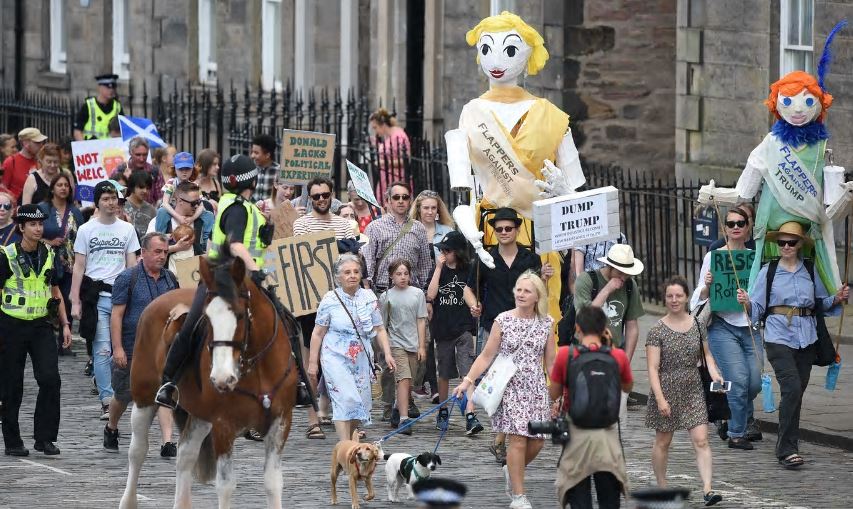
Some have questioned the point of protesting against Trump, because it’s not like seeing a protest in London, Glasgow, Edinburgh, or anywhere else is likely to make him change his mind. However, changing Trump’s mind is not what these protests are about. Everyone attending knows that they have as much chance of changing Trump’s mind about his misogyny, his racism and his undermining of democracy, as they do of changing Mother Theresa’s mind by calling her a Maybot. The reason for protesting against Trump’s visit is because if you don’t protest, if you’re not vocal about your feelings, then those in power take your silence as consent. Silence is complicity.

Anyway, Trump’s mind might not be capable of being changed. Changing your mind means having the capacity to distinguish between fact and fiction and, as far as Trump is concerned, the truth is whatever was the most recent thing to come out of his mouth. When dealing with a narcissist like Trump, it’s impossible to engage with him using logic and reason because he is not motivated by logic or reason. The only thing that motivates Trump is his own extremely bigly and extremely thin skinned ego. He said ,just before arriving in the UK, that he thinks that people in Britain like him. That’s all the more reason to show him that we don't. We reject his politics of hatred and division.
There are also those who say that it’s hypocritical to protest against Trump, but not to show the same degree of anger against the likes of Erdogan of Turkey or other human rights violators who visit the UK. And ,to be fair, there are a lot of human rights violators who are invited to the UK by the British Government. The British Government’s idea of international diplomacy is to calculate how many weapons it can sell, and it’s not too fussed about those weapons being used against innocent people. However the difference is that Erdogan or some random Middle Eastern dictator doesn’t strut the world stage posing as the “leader of the Free World”. The reason that there are more protests against Trump is that higher standards are expected of a democracy and even higher standards are expected of the world’s most powerful democracy. If you claim to be the leader of the Free World then the Free World is going to hold you to account. In the Free World, if its leaders are not accountable, then the term Free World has no meaning at all. We protest against Trump precisely because the USA is the world’s most powerful democracy. If President of the USA trashes democratic values and undermines the social and political order in other democracies, as Trump does, then that poses a direct and immediate danger to the UK, and the rest of Europe that the likes of Erdogan doesn’t. Protesting against Trump isn’t about signalling our virtue. It's more than that: it’s self-interest and it’s self-defence.

Protesting against Trump’s visit is also a protest against a British government which is spitting in the face of the UK’s European partners in order to prostitute the UK to a racist buffoon who cages children and separates toddlers from their parents. We protest against Trump because we have a British government which likewise demonises migrants and separates families due to racist and unjust immigration laws. We protest against Trump because the British Government is taking the UK out of the EU in order to transform the UK into a cut-rate version of Trump’s America. We protest against Trump because we don’t want Trump’s America here.

As a nation, we may be divided on the constitutional question, divided on the political parties we support and the football teams we cheer for, but let’s show that we are united in our condemnation of the vile politics of Donald Trump. I salute those who are taking to the streets. I wish I could join you.

Friday, 29 June 2018

Brexit: two years on and one to go.

Gosh, doesn't time just whizz past? Would you believe that this week sees the second anniversary of the Brexit referendum? And one year today sees us waving the EU goodbye. Twenty four months down the line and any reasonable person would have expected that a halfway competent government would have used this time for careful planning, highly detailed project management, and comprehensive decision making, all of which should have laid out a clear road map for the glorious post Brexit future which we were assured is going to await the UK. By this stage in the game, with the date of our departure is so close, we should have had some sense of what the government is aiming for. 
 
Instead, what we’ve got is a toxic mix of hubris, confusion, in-fighting, wishful thinking, fantasy, nostalgia, and sheer utter self-delusion: all of which have created a deep uncertainty and instability and the looming threat of a catastrophic expulsion from Europe which will poison our links with those countries which are supposed to be our closest allies. Jobs are at risk, public services are threatened, businesses are making plans to relocate elsewhere, and the UK has turned into a peripheral and unimportant state which is only prevented from being the laughing stock of the world because it does not have Donald Trump as Head of State. 

Here we are, two years down the line, and we still have no idea what our government's Plan A is. We had a general election which was supposed to give Theresa May a mandate to seek whatever kind of Brexit suited her. Unfortunately for her, she lost her majority as the electorate looked upon the self-centredness, the confusion, the greed and the xenophobia, and said “nah”. But despite losing her majority Theresa hasn’t changed tack. She really has only one string to her bow.

Two years ago we were told that a soft Brexit was remaining a part of the customs union and the single market, a hard Brexit was leaving them and crashing out with no deal at all was an unthinkable calamity that no one was even considering. The difference two years make: now we’re told that not leaving the single market and the customs union is no Brexit at all, leaving them with a deal is a soft Brexit, and the swivel eyed British nationalists in the Conservative cabinet think any sort of accommodation with the EU is a betrayal. The prospect of crashing out of the EU with no deal is a very real prospect.

It’s a litany of depressing gloom that’s worse than a November weather forecast. There’s no realistic plan to solve the conundrum of the Irish border. British citizens who live in other EU states and EU citizens who live in the UK have no clear idea of what’s going to happen after Brexit. Health workers are leaving the NHS and going abroad. There is no planning for the queues and delays that will be created at ferry ports as lorries use motorways as parking lots. Successive British governments have always relied on the financial sector to drive the British economy, but this week the European Banking Authority warned that Britain’s preparations for the impact of Brexit on the financial sector are inadequate. The EU’s most senior banking regulator has advised that banks should proceed on the assumption that the UK would crash out of the EU in March 2019 without a deal. Airbus and other major companies have announced that they are having to consider whether to shift production and other facilities out of the UK. Instead of the promised bonanza of extra spending because the UK will no longer be contributing to the EU, we’re faced with an unprecedented squeeze on public spending, a massive ballooning in government borrowing, and rises in taxes.

Any normal person who was responsible for this magnitude of cock-uppery would be traumatised by the sheer horror and disaster that they had unleashed upon millions of people. They would be unable to sleep easily in their beds, kept constantly awake by the terror of realising the harm that they have caused, crying into their pillow as they desperately tried to make peace with whatever deity they worship. But Theresa May’s government are not normal people. They get to sleep just fine, in coffins, wearing full evening dress. The only god they worship is the god of their own ambition. They don’t give a toss about the effect of Brexit on the rest of us. They are going to be OK whilst the rest of us pay the price.

Meanwhile, Tony Blair  (remember him?) warns that we’re at risk of a return to the dark politics of the 1930s, apparently unaware that he’s possibly the single individual who has done more than anyone else to destroy public trust in traditional politics. The UK is descending down a dark and threatening path to a vainglorious Britain of shattered dreams and broken promises.

It's all so bloody depressing. And to all those who voted for this mess, thank you for absolutely nothing. I'm thinking of putting a sign on my front door - if you voted for Brexit, bugger off!

Tuesday, 26 June 2018

Some more of what the artist really meant

Fill in your own captions.

The well known Cornish folk duo, Poldark and Garfunkle.
Sorry, say that again. You've forgotten to pack the phone charger?
Have you ever wondered how the legendary Native American warrior Falls-From-Canoe-Just-As-About-To-Stab-Moose got his name?
You've got to be kidding me. You are telling me that not one of us remembered to bring the front door key?
(Parent, from other room): "I don't want you just sitting in front of that painting all day.  Now go outside and play."


Sunday, 10 June 2018

Lancelot John Barrington Walters: A Welsh Connection

One of the joys of the internet is that you never know what you'll come across. Here's a recent example that pleases me. As part of the series of biographies on the men listed on our local WW1 memorial, I have already featured details of Lancelot John Barrington-Walters (here). Before committing myself to a final version for the book I'm compiling, I always check the internet for anything I might have missed previously or something that may have been added more recently. And so it was that new information on Lancelot lead us into the Wye Valley on a quest for a previously unknown connection.
Our quest took us to the church of St Catwg (Cadoc) in the hamlet of Cwmcarvan in rural, very rural, Monmouthshire. Many thanks to Bill Powell for opening the church for us and acting as our guide.
The church dates from the 13th or 14th century but was extensively restored by the Victorians. Their intervention was quite benign and it now has a pleasing simplicity, without any of the garish embellishments that they sometimes introduced. Nowadays there is a service but once a month with a congregation of only 4 or 5. However, it is also used as a de facto village hall so it seems that the secular and religious aspects of rural life are existing side by side.
Bill pointed out something unexpected to us: a war memorial to the fallen of Cwmcarvan Parish. Unexpected because, as far as I can ascertain, the memorial is not logged on any of the usual databases. I think I'll make it as a mission to spread its existence more widely, if only to the Commonwealth War Graves Commission. The inscription is very weathered but Bill Powell kindly provided the following transcription:
This cross was restored in 1921 to the Glory of God and in honoured and grateful memory of the men in this parish whose names are inscribed below who laid down their lives for their country in the Great War 1914-18.
Spencer H Drummond. Capt. Rifle Brigade 1915.
Lancelot J.B. Walters. RN. Lieut. HMS Partridge 1917.
James E Winter. Pte. Lancashire Regt. 1914.
William J Edwards. Pte. South Wales Borderers. 1916.
RESQUIESCANT IN PACE
And this is what we came to see: a stained glass window dedicated to the memory of Lancelot John Barrington Walters. It's in reasonable condition, with just a little buckling of the glass. In terms of the iconography inherent in the choice of St Ariel and St Raphael as the subjects in the windows, appropriately for Lancelot's naval service, St Ariel is known as the 'anel of the waters' and St Raphael is the guardian of pilgrims on their journeys. AS he is here, he is often shown holding a fish, an allusion to a healing episode in his past.
The inscription at the bottom of the two panes shows the worst buckling so I've cropped and stitched the segments to make them a little more legible.
And what is Lancelot's connection with Cwmcarvan? The answer lies in this other window in the church, dedicated to Captain Henry Edward Walters. Captain Walters owned the nearby 'big' house, Caer Llan, for many years and was Lancelot's uncle. Given the similarity in the service histories of uncle and nephew, I can understand any special bond between them. I would have thought it was highly probable that the young Lancelot had spent time enjoying the Caer Llan estate, or is that me being fanciful?
The inscription at the bottom of the window in more detail. When Henry Walters died, the estate passed initially to this wife and then, quite shortly afterwards, to his nephew, Robnett Walters, the step-brother of Lancelot. Robnett was born in Stoke Climsland which, in a way, brings us full circle back to Cornwall.