Showing posts with label Northern Cyprus. Show all posts

Friday, 25 December 2015

Northern Cyprus: May 2015: Part 5

It's Xmas Day and all is joyful within (and we've had/are having a wonderful time, thank you for asking). But outside the weather is still pretty dismal and prevented us from getting any fresh air. Time to revisit Cyprus for some more sun, warmth and colour.
To Veni Vici in Lapta for an Italian meal. An excellent restaurant and the experience was enhanced by the misplaced apostrophe. We pedants do love a catastrophic apostrophic caligraphic cock-up. Or was it? Perhaps the bottom line had been missed out and it should have read "...cooked by international chef's girlfriend/mother-in-law/boyfriend...or whatever". Or maybe they were offering a magnificent prize for whoever pointed out their mistake to them? And we missed out. Boo hoo.
These Pine Processionary Moths really fascinate me. Their close relative, the Oak Processionary Moth, is beginning to cause a problem in the UK but it hasn't yet reached the West Country. Who knows what climate change will do to its range. We've had Dutch Elm Disease, Larch Dieback and Ash Dieback so UK trees are taking a bashing at the moment.
"Is this my best side?" says Mr Swallowtail. "Any side is your best side" says I, "you are beautiful to look at from all angles".
This is a Marbled White, a rather skittish butterfly that did not stay still for very long.
And here's a Grayling which seemed to prefer flitting over the hot gravel of the track I was walking in. I failed completely to get a shot of it with its wings open. But I remember having great fun trying.
A Large White, previously known as the Cabbage White. This latter name gives away its preference for members of the Brassica family as its food plants, 
A good specimen of a Clouded Yellow Butterfly. There were quite a few of them around but they were uniformly difficult to get a reasonable photograph of.
 
Just a beetle on some Knapweed.
Some flowering cactus to remind us that soon, very soon, our garden will be full of yellow daffodils. And as I found to my cost by getting too close, those spikes penetrate clothes and puncture skin very effectively.

Wednesday, 23 December 2015

Northern Cyprus: May 2015: Part 4

Fairly dismal weather in Cornwall recently and it doesn't look like we'll see any marked improvements soon. Searching for an antidote to the gloom, I came across a couple of 'draft' posts from our sojourn in Northern Cyprus earlier this year. I'm not sure why I didn't post them at the time but I'm glad I came across them as they are a nice reminder of happy AND WARMER AND DRIER times!
Whilst others decided to laze by the pool or go shopping, the Dynamic Duo of Bujold and Parsons decided to head for Buffovento Castle. Perched high upon a mountain, it gave the Crusaders a commanding view of the surrounding landscape.
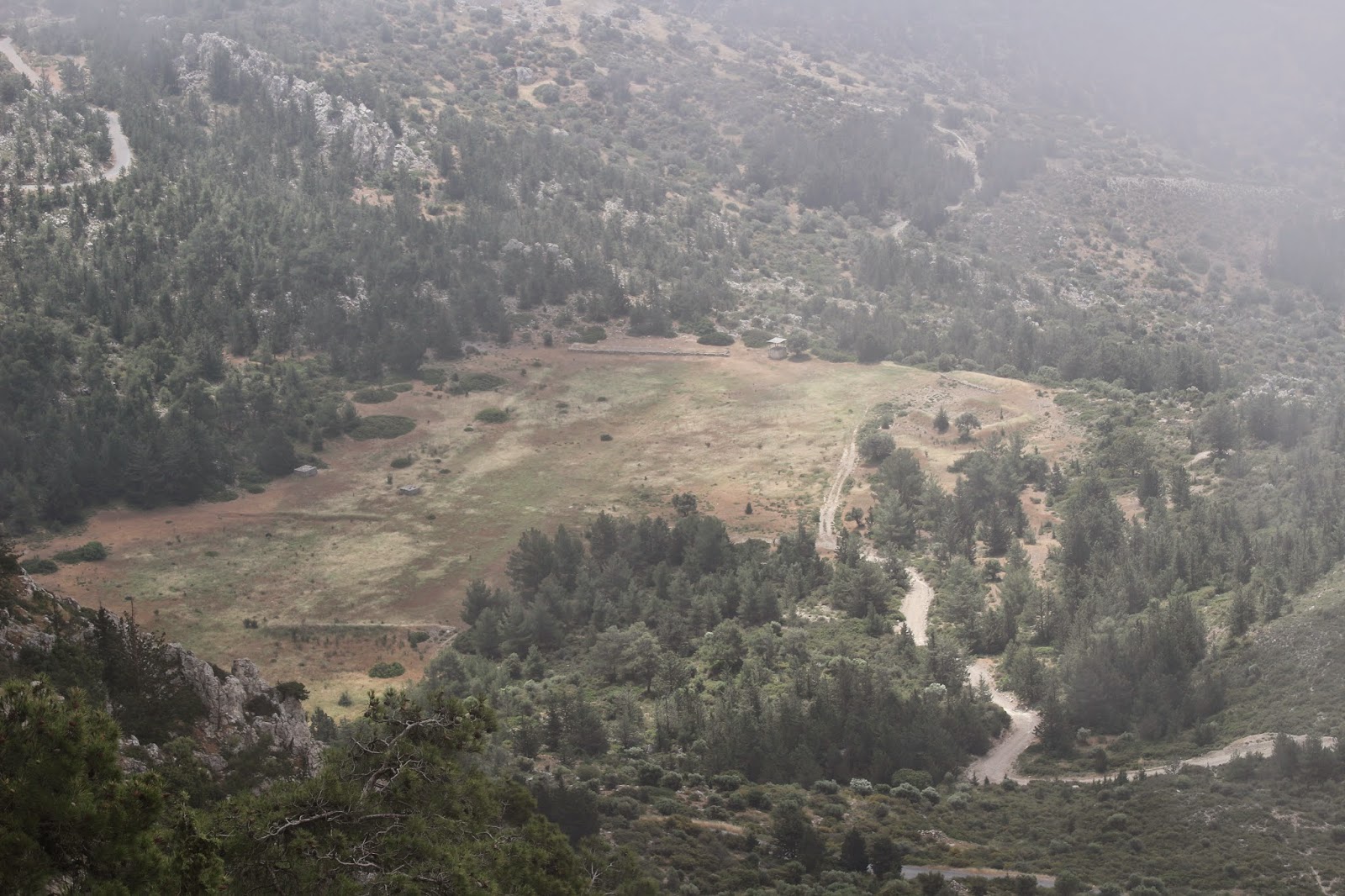
Nowadays wherever we go, one of our first questions is "what is your Wi-Fi code?". In days of yore, it was "where's your jousting field?". At Buffovento, they would have nodded and said "down the hill a few thousand feet".
It follows from the above that if you can go down a few thousand feet, you can also go up. And go up we did. Although most of the climb was not as vertiginous as the stretch shown in the photo, it was still a decent stretch of the legs. But that did not daunt my companion who scampered up like a mountain goat or, to be more accurate, un chèvre de montagne or, to be pedantically precise, un très vieille chèvre de montagne.
The castle was build in several 'layers' and had an irregular shape due to the contours of the mountain it was built on. Although not visible here, most of the rooms were constructed with rainwater cisterns beneath them. Coincidentally, we've just spent some time at the Eden Project in Cornwall and they are making a big deal out of their rainwater trapping systems. A case of old technology being rediscovered?
Odd photos by the wayside Part XXVI. Almost as high as we could go and we come across a carefully placed empty bottle of J.P. Chenet - Ice Edition ROSE. What's the story behind someone carrying this all the way up? A proposal, perhaps, or an illicit assignment?  Or an upmarket picnic?
On a clear day, the coast of Turkey can be seen. But not on this day due to the heat haze.
Pentadacktylos - or the Five Fingered Peak. I would imagine that the ridge walk over the top of these would be fun, assuming that it was possible.
Some swallows nesting under the eaves of a house in the main street of the village of Bellapais. They deserve a mention in recognition of their acrobatics just over the heads of the people walking up the street.
Bellapais is famous for the remains of its 13th century monastery, of which this is the belfry with its single remaining bell.
The entrance to the refectory which is used for concerts and other musical events.
The spirit of Diana lives. It makes you wonder what sort of people are attracted by the name and the placard. Does Northern Cyprus have a 'care in the community' scheme? Perhaps I've stumbled across it?

Tuesday, 26 May 2015

Northern Cyprus: May 2015: Part 3

An enjoyable and informative day trip to Famagusta and its environs. Here's just a few photographs to give a flavour of the day.
The Lala Mustafa Pasha Mosque originally known as Saint Nicholas's Cathedral is the largest medieval building in Famagusta. It was built between 1298 and around 1400 and was consecrated as a Catholic cathedral in 1328. The cathedral was converted into a mosque after the Ottoman Empire captured Famagusta in 1571 and it remains a functioning mosque to this day. This view was taken from in front of what was originally the main door into the cathedral and looks down the nave, which is now the main praying area of the mosque.
Tucked away right to the side at the bottom of the nave is the screened area where women pray. It was also the place where the mosque vacuum cleaners seem to be kept, upon which I pass no comment about equality.
This building is the Cathedral of St George of the Greeks. It was probably built in opposition to the nearby Roman Catholic cathedral of St. Nicholas. The view shows the semicircular apse at its eastern end. Originally the central part of the cathedral had a large dome which was blown up in 1571 during a bombardment by Turkish artillery. The Greeks and Turks have never been good neighbours!
Founded in 300 BC, Famagusta remained a fishing village for many years but, as a result of the gradual evacuation of nearby Salamis, it developed into a small port. With the onset of Lusignan rule in the mid 1100s, it increased in importance due to its natural harbour and the walls that protected its inner town. This development accelerated in the 13th century as the town became a centre of commerce for both the East and West and it was transformed into one of the 'richest cities in Christendom'. In 1372 the port was seized by Genoa and in 1489 by Venice and they continued the development of its commercial activity and wealth. I like this photograph because it marries the old and new: the walls of the old castle overlooked by the accoutrements of the modern port.
Just to the north of Famagusta, Salamis is one of Cyprus's main archaeological sites. It was one of 10 city kingdoms in Cyprus and its origins go  back to the 11th century BC. It rose to prominence in the 6th century BC with a royal court and a mint for its own coins. The Persians destroyed the city in 306BC but it flourished again under the Romans from about 60BC. Fortunes waxed and waned, often in the wake of earthquakes until a series of disasters (the harbour silting up and attacks by Arab raiders) all helped to finish it off. Around 650BC, the inhabitants fled down the coast to what eventually became Famagusta.
The site covers several acres and, once inside, we could wander at will and, joy of joys, climb, touch and feel to our heart's content - the very best way to get to grips with an ancient site (learn a lesson, Stonehenge). The photograph shows the Agora, which was the meeting place and market of the city. Two sides were lined with columned arcades to provide shade in summer and shelter in winter. Only one of the columns has survived. The courtyard has temples dedicated to gods of commerce and was once decorated with statues and fountains.
The amphitheatre dates from the time of Augustus and originally consisted of 50 rows of seats for more than 15,000 spectators. Performances took place on the raised stage decorated with statues. After it was destroyed by earthquakes in the 4th century it was demolished and building materials used on other parts of the site. Today it has been restored as far as it can be and is used for occasional events - in fact, one of friends recalled being there several times for regimental concerts/gatherings.  We've seen a few amphitheatres in our time and this one is in excellent condition. It's unusual in that the back-stage buildings are still intact and the fact that it faces away from the sea - most face towards the water.
 
All around the site, many trees seemed to be festooned with white snails. Were they dead? Apparently not because I picked a few off and looked. What were they doing there? Cue a Google search back at base! I learnt that many species of snail go into a form of summer hibernation known as aestivation and in so doing form these large clumps. They are the White Garden Snail (Theba pisana), also called Sand hill snail, White Italian snail, Mediterranean coastal snail or Mediterranean snail. After cleaning them, the locals find them a culinary delicacy. Me? Not tempted.
Lots of these lizards running around the site.
The forty four seat Roman latrine beside the gymnasium, just off the Agora. Apparently the Romans put a greater premium on efficient evacuation than privacy. Although much of the detail has been lost, in their prime there were separate seats and running water for post-ejection ablutions. In some ways, sanitary arrangements for most on the island have gone backwards since then. 
On our way back to the villa we called in on the monastery which bears the name of St Barnabas. It was originally built in the last part of the fifth century, to commemorate the discovery of his body, and the kudos it brought to the early Christian Church of Cyprus. The church is exactly as it was when its last three monks left in 1976. All the paraphernalia (pulpits, wooden lectern and pews) are still in place. It contained a rich collection of painted and gilt icons mostly dating from the 18th century. One wall had a display of discarded artificial limbs, thrown away by penitents whose prayers had been answered. Unfortunately, the photograph I took of these didn't come out so you'll have to take my word for it that they do exist.
And here's a display of three icons showing St George.

Monday, 25 May 2015

Northern Cyprus: May 2015: Part 2

Our villa (not without its issues but I won't dwell on those) had a good sized swimming pool and, whilst the others had a bit of poolside R & R, I took myself off for a wander into the hills. Spectacular views all the way and, perversely though it may seem, there's something very enjoyable about walking in the steaming heat. Maybe it's because it's not something I can do in the UK: maybe it's because I've got a screw loose. Whatever the reason, it suits me and there's always something interesting to see.
Amazing, isn't it? You spend hours waiting for a Cyprus Pied Wheatear to come along and two turn up.
A 
There were several of these 'nests' at the top of pine trees on my way up the track. Some were much smaller than this one but all had the same general shape. I haven't come across anything like this in the UK and a Google search when I got back to base revealed them to the colonial nest of the caterpillars of the Pine Processionary Moth. Called Processionary because the caterpillars process head to tail in a long column when they leave the nest. They are destructive little devils and leave their next at night to munch their way through the needles on the branches. They are a definite pest and, or so my reading tells me, have infested forests in the eastern part of Canada. The nests were too high up the trees for me to explore them further which is probably just as well as the hairs on the caterpillars are quite poisonous. Poisoners as in 'can kill a small dog' poisonous.
I think the botanical name for this one is "spikey thing". Simple, star-shaped and very attractive. 
The track I was following degenerated into a path following a dry stream bed through a ravine. A delightful place, silent except for the sound of birds and the air redolent with the smell of rosemary and others scents that I couldn't put a name to. For me, this is one of the most pleasurable aspects of walking in a hot country.
Looking up towards the royal apartments of St Hilarion Castle.
And looking back towards the sea, over Kyrenia.
Another view of St Hilarion Castle, with less zoom on the lens. It gives a better idea of how impressive its location is.
  

Thursday, 21 May 2015

Northern Cyprus: May 2015: Part 1

We are spending/have spent 12 days in Northern Cyprus, staying in a villa above Karmi (near Kyrenia) and being hosted by our once-upon-a-time neighbours back in Cornwall. As we have been very busy since we've been here, I haven't been able to blog on a regular basis but I'll try and catch-up with a number of post-dated entries so I've got some sort of record of our time here.

We flew into Larnaca airport in Southern Cyprus - the Greek half - and travelled north to cross the border into Northern Cyprus - the Turkish half. The politics of the island are complicated and I'll refer to them as and when relevant to whatever I touch on. We had a night's stay in a charming village in the Troodos mountains, before continuing on to our villa. Highlights of the first couple of days included a meal out at the Old Harbour in Kyrenia (now known as Girne) and a visit to the hill top Crusader castle of St Hilarion. An amazing location and an amazing feat of engineering. And, as you can tell from the photographs, the weather is pretty good! Hovering between the mid-twenties and mid-thirties or, to put it another way, hovering between the comfortable and uncomfortable. But we'll soon acclimatise. Or melt.
Where we stayed on our first night - Lofou in the Troodos Mountains, the highest range in (Southern) Cyprus.
A panorama of the Troodos Mountains, before dropping down onto the central plain and the border crossing into Northern Cyprus.
Kyrenia harbour at night.
Hummingbird Hawk Moth, just after it had fed as its proboscis is being 'rewound'. Amazingly busy little beasties and quite difficult to get a shot of them when they are relatively stationary.
Looking down onto Kyrenia as we climbed up the footpath to St Hilarion Castle.
We think this was a Cyprus Pied Wheatear, indigenous to the island.
Looking up to St Hilarion Castle. And, yes, it was a bit of a climb, made more 'interesting' by the high temperatures.
Another view of St Hilarion Castle
A thistle flower just about ready to open.
Dandelion - I liked the shape and the light shining through it.
A most welcome lemonade at a harbourside restaurant.
Gone fishing.
Swallowtail butterfly. Lots of them around at high elevations, flitting here, there and everywhere.
Same one as above. Try as I might I just could not get it to cooperate by alighting with its wings open and at the right angle.