Quid me anxius sum? (Alfred E Neuman, Mad Magazine circa 1956). Facio, ita.
Monday, 26 November 2018
An open letter to the Prime Minister
Dear Prime Minister,
Thank you for your recent begging letter. I'll try not to be too churlish as, after all, congratulations are in order. Under your premiership. the UK may be divided as never before, fearful of the future, angry and anxious, but gainst all the odds you have managed to unite this disunited and dysfunctional kingdom. Everyone thinks that your deal stinks.
You ask for everyone to get behind you. That’s a big ask. You started Brexit negotiations by deciding to ignore the wishes of that half of the UK which had voted to remain and by deciding unilaterally that those who had voted to leave wanted the hardest possible Brexit. At every stage in these sorry proceedings you were motivated first and foremost by your own career interests, and then by keeping your miserable and fractious party together. Your plan was, and is, to do whatever it takes to further the interests of the Conservative party, and now you have the nerve to write to the people of the UK begging us to get behind you in the national interest.
You began in bad faith and have continued the same way. You initiated the Article 50 process without having a clear plan other than wishful thinking and the unshakeable belief that the EU owed the UK its cake and its cherries because Britain is special. You activated Article 50 when you did because local elections in England were looming. Securing a greater number of Conservative councillors in the shires of England was far more important to you than this so-called national interest which you’re now pleading with us to get behind. You compounded our view that you were acting purely in your own selfish self-interest by embarking upon an entirely unnecessary general election at a crucial point: at a point when the UK should have been framing a coherent and cohesive set of Brexit plans. Instead, you decided that it was an ideal time to try and get one up on the Labour party and secure a large majority for your visionless Brexit, your blank Euro cheque. And you failed. You ended up losing the majority that you did have. The people of the UK told you plainly that we didn’t want your hard nose Brexit that pandered to the Tory right, and yet you ploughed on regardless. Nothing has changed.
Throughout the entire sorry and miserable past two and a half years, you have acted selfishly and mendaciously. And now you wonder why we’re not prepared to give you the benefit of the doubt.
At every step in this Brexit process, your government has been characterised by blinkered self-interest and incompetence. You’ve spent the past two and a half years negotiating with your own party. The UK interest really hasn’t got a look in. And now you want us to get behind your deal, Theresa? Well, in your own words: now is not the time. Now is not the time for us to meekly follow you. Now is the time for us to say, we’ve had enough. You’ve brought this upon yourself.
Yours without sympathy,
Deri Parsons
Disgruntled of Higher Downgate
Thursday, 15 November 2018
Up the Fowey for a stretch of the legs
And now for something relatively different - a walk that doesn't involve the coast or a moor. This one took us to St Neot and alongside the River Fowey for a while. Lots of autumn colour and enough up and downs to make it a good stretch of the legs and lungs.
| We started and ended at |Treverbyn Bridge and the circular route was around 6.5 miles. The elevation profile was as hilly as it looks. |
| Although it's had to imagine now, Treverbyn Bridge was once on the main road between Liskeard and Bodmin. Nowdays all vehicular traffic goes over the newer bridge to the right. |
| I suppose you might as well be comfortable when you are fishing. This river is really good for Brown Trout, or so I've read. |
| Looking down the River Fowey. |
| A pattern of leaves, with just a touch of green from holly and lichen |
| It seems absolutely ages since I've had a good wallow in some proper mud. Loverly. |
| Another stile, a little steeper than most and with the added joy of a hurdle to negotiate at the top. There's no point in making things easy for walkers. We relish a challenge. |
| A green lane leading off the open land down to the farms. Once upon a time, these would have been used to take cattle up for their summer grazing. Perhaps they still are. |
| The old farmhouse of Wortha looking rather foreboding in the mist |
| An ideal spot for our lunch break: by a rushing, gurgling stream. |
| And it's back to the beginning. A route to be repeated, possibly in the spring when the woods are bedecked with fresh greenery. |
Saturday, 10 November 2018
Coastal Footpath: Tintagel Castle to Trebarwith Strand. Plus St Clether as a bonus
With the forecasters telling us about high winds and lots of rain, let's do the obvious thing and walk along a stretch of the Coastal Footpath. And very good it was, too. We do like these sorts of days, we do. There was a bonus at the end with an impromptu visit to the church and Holy Well at St Clether.
| As we only multiply (two children, seven grandchildren), we felt we could ignore this sign at the entrance to the graveyard. |
![]() |
| St Materiana is thought to have been a Welsh princess of the 5th century, the eldest of three daughters of King Vortimer the Blessed, Not a lot is known about her and there is only one other church in Cornwall, Minster at Boscastle, dedicated to her. This is a detail from the stained glass window in 'her' church. |
| As for many, the Victorians had a hand in remodelling the interior but the rood screen is original and is a fine example of mediaeval carving. |
![]() |
| This Norman font is thought to have been brought from St Julitta's chapel at nearby Tintagel Castle. There is a face at each corner, all similar but not identical. Who were they modelled on? |
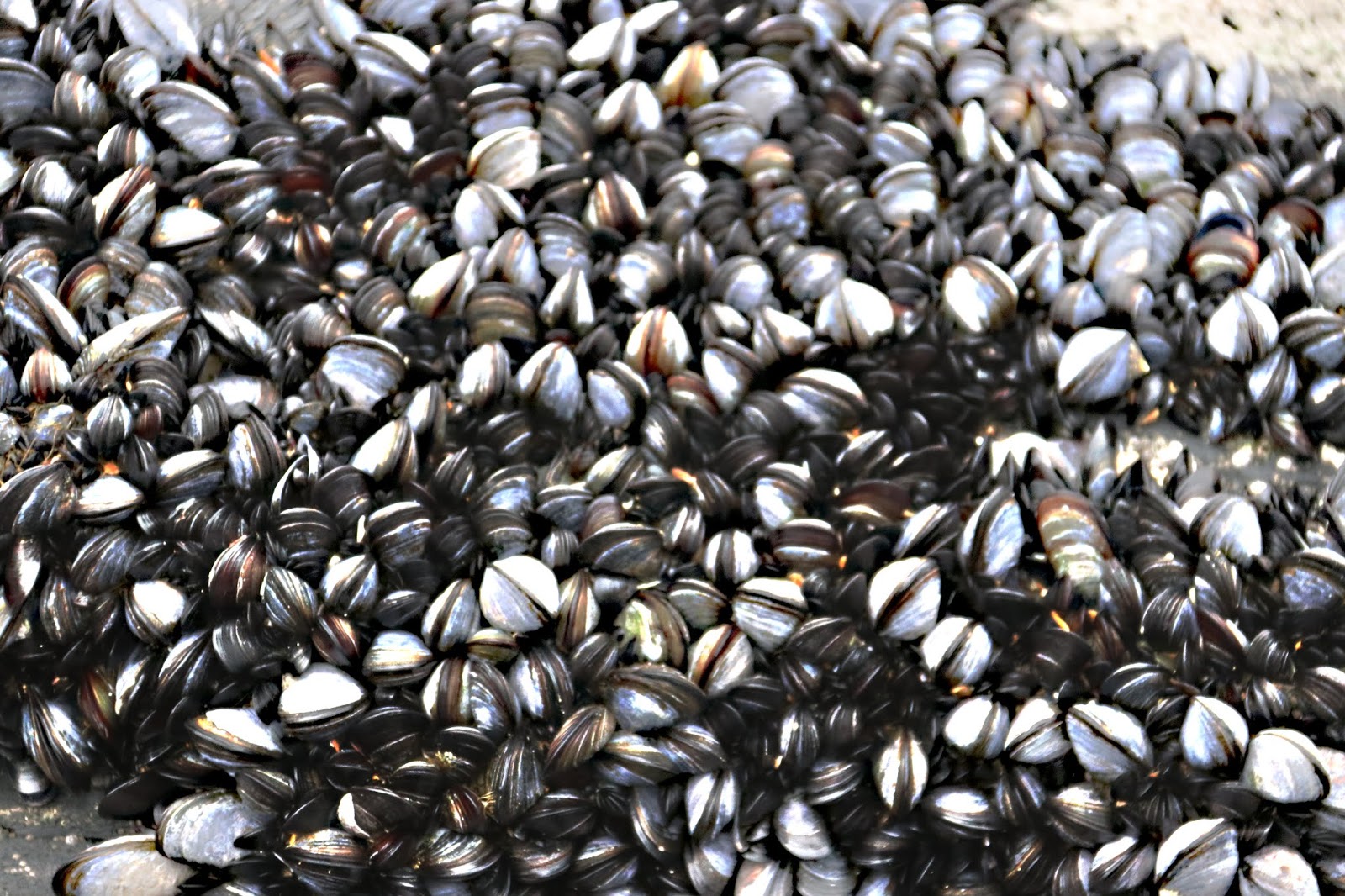
| From a man-made pattern to a natural one - young mussels clinging to the rocks at Trebarwith Strand. |
| We did not see many other people out on the cliffs today and I think I'll try and catch this one up. She looks rather attractive and, who knows, she might come home with me. |
| I won't go into the details here but the placement of this War Memorial was subject to much heated discussion between the various churches and chapels in Tintagel. It was not a time of great unity. |
![]() |
| St Clether as depicted in a very luminous stained glass window in the church. |
| Just a couple of days before Remembrance Sunday and a memorial window has been prepared. Simple but effective. |
| Remodelled by the Victorians but still very atmospheric. The ceiling line felt quite low and gave the interior a very comfortable feeling. |
| The well-house covering the holy well of St Clether, a pleasant 1/2 mile stroll near the Inny from the church |
| The altar which has been there for some 1500 years. |
Sunday, 4 November 2018
On this day in 1918, Wifred Arthur Cornish died
Private 67960
Wilfred Arthur Cornish
1st Battalion, Auckland Regiment
New Zealand Expeditionary Force
Died 4th November 1918
Age 37
Wilfred Arthur Cornish has the dubious distinction of being the last local man to be killed in action in WW1. He was born on 15th September 1881, the third of the six sons of William and Anne (Annie) Cornish. William was the long serving headmaster of the Luckett Board School and it was in the School House at Luckett that Wilfred lived for all of his life in the UK. His brother, John Adams Cornish, was killed in France in July 1916 and at least two of his brothers also served during the war.Wilfred Arthur Cornish
1st Battalion, Auckland Regiment
New Zealand Expeditionary Force
Died 4th November 1918
Age 37
Wilfred joined the Royal Navy when he was 19, enlisting at Devonport on 14th September 1900 and signing on for a 12 year engagement. His entry level was Ship Stewart Assistant (SSA) and his first postings were at a number of shore establishments around Devonport. Throughout his naval career his location alternated regularly between shore establishments and ships. His progress up the ranks culminated in his promotion to Ship’s Stewart (SS) on 9th January 1908, only for him to be demoted to SSA on 31st July 1908 for ‘returning from leave drunk’. He remained at this level until his term of engagement expired on 23rd September 1912.
![]() |
| SS Rotorua |
| Report from the New Zealand Herald (June 6th 1917) |
On 6th August 1914, shortly after the outbreak of war, Britain accepted New Zealand’s offer of an expeditionary force of approximately 8000 men. When countrywide recruiting for the New Zealand Expeditionary Force’s (NZEF) ‘Main Body’ began on 8th August 1914, the response was overwhelming. In September 1915 Wilfred did try to join the army but was not accepted, being deemed medically unfit due to ‘flat feet (left)’. He was more successful with his second attempt in September 1917 but then only with the rating of C1 ‘likely to become fit for active service after special training’. The special training needed was never specified.
![]() |
| SS Balmoral Castle |
He was assigned to the 3rd Reserve Battalion and then travelled to Europe on the SS Balmoral Castle, leaving Wellington on the 24th April 1918, disembarking in London on 21st June. On the same day, he was entered Sling Camp, near Bulford on Salisbury Plain, and remained there until 30th September when his battalion left for France, docking at Etaples on 3rd October. He eventually joined his unit in the field, D Company of the 1st Battalion of the Auckland Regiment, on 8th October 1918. Wilfred’s Company was soon in action and engaged the enemy in and around the town of Le Quesnoy. The Battalion War Diary for 4th November notes: ‘A miserable night but the morning broke fair and fine. At 5.45 a.m. we moved forward, 15 minutes after zero hour........ when crossing the Ruesnes - Le Quesnoy road, an enemy plane came over and immediately after this artillery opened up and heavily shelled the line of advance, but very few casualities were caused’. As there was no other incidents mentioned that day, it is reasonable to conclude that Wilfred killed during this barrage, just 17 days after he landed in the country.
He is buried in Plot I.C.3 in the Ruesnes Communal Cemetery, just to the east of Cambrai and close to the border with Belgium. There are now 84 soldiers who died in November 1918 commemorated there, nine of whom were part of the NZEF.
From correspondence included in Wilfred’s Service Record, it seems that there was some question over monies owing to him by the NZEF. His mother queried the fact that she had not received any War Gratuity. The explanation given was that as Wilfred had made an allotment to his mother of 3s per day from 21st April until his death, this had accounted for all the money owing to him. As a separate event, his father was granted probate of Wilfred’s estate of £60 by the Bodmin Registry Office on 15th December 1919.
Subscribe to:
Posts (Atom)