Sunday, 11 February 2018

Hurtigruten norsk tur: Andre del

Our second full day of cruising. After sailing overnight from Kristiansund, we docked at Trondheim for 6 hours (6am until noon) and spent the afternoon and most of the evening getting to Rorvik. We left Rorvik just after 9 pm and were scheduled to have a few short stops at ports during the night. The route had us threading between various islands rather than being out in the open sea, a good thing for those who are not too keen on lumps and bumps. I'll write more about the logistics of the boat later on but, suffice to say for now, it is very relaxing and well organised. By the time we wake up in the morning, we should have crossed into the Arctic Circle and have entered latitudes where we would expect to see the Northern Lights. Our cabin intercom is on permanently so that we get the (optional) notification if and when they are on display.
The Finnmarken alongside the dock at Molde. Not a lot to see in Molde. We were only there for thirty minutes or so and didn't have time to explore in depth. For future reference: the High Street has a branch of Boots.
A multi-coloured ferry heading to (or from) who knows where. But we do know when. And which Hollies song have I just alluded to? Come on, pop lovers, it's not a heavy question. Ooops, what a clue.
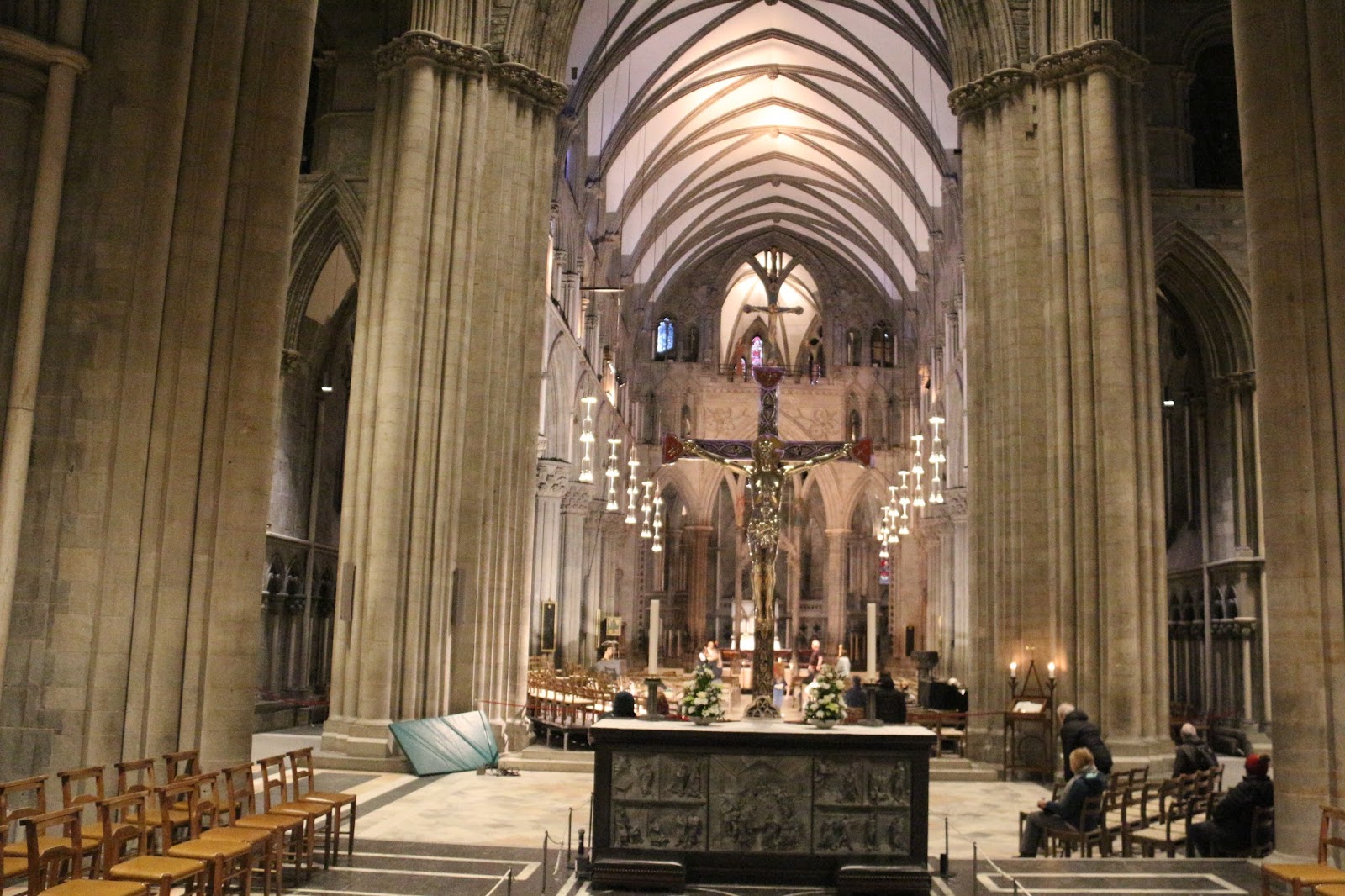
Nidaros Cathedral in Trondheim Built over the site of the grave of Saint Olav, the king of Norway in the 11th Century, who became the Patron Saint of his country. It dates from 1070 to 1300 and is the northernmost medieval cathedral in the world. I'm not sure what I was expecting but the interior was a very pleasant surprise. It was like entering two massive halls. I was impressed.
The cathedral had a 'no photographs' policy so what you see here are all illicit images. Not that that makes them any the less enjoyable. The young lady to the left? She was a juggler and was joined by three or four other jugglers. We presumed they would feature in the service which followed. Perhaps in the sermon? Was there a Parable of the Four Jugglers? Or the Return of the Prodigal Juggler?
The mediaeval Chapter House, with two painted reliquaries in the facing wall.
A carving made by a Sami artist. It's made of polished elm and the central figure is encircled by carvings of Sami symbolism. Just after this I was told off for taking photographs, which was just after I was told off for wearing a hat and spikes on my boots. It was my turn for the naughty chair.
The cathedral graveyard looking rather sombre under a covering of snow.
Nidaros Cathedral in all its splendour. I wonder how many Europeans from 'down south' were enticed to come along and help with the building? I'm pretty certain that local skills would have had to have been supplemented with those more expert in building cathedrals.
Merchants' houses viewed from the Old Town Bridge (Gamle Bybro or Bybroa). It, the bridge, was built in 1681, at the same time as much of the old town was reconstructed after a fire. It has undergone many changes over the years and is now one of the tourist attractions of the town. Within 5 miles of us at home, we've got at least three bridges dating from around 1450. No-one considers them to be tourist attractions: they are just old bridges over which you drive to wherever - even Devon, if you must.
Sorry! Some things just bring out the schoolboy in me. Google Translate tells me that it means 'look' in English. How boring but I bet it's given hordes of British tourists much amusement.
Downtown Trondheim on a busy Sunday morning. Deserted but a very pleasant place to walk around. Despite the eye-watering prices of food and drink, there seemed to be no end of places to get both.
And it's goodbye to Trondheim on the northern leg of our trip. We do call in again on our way back down south but I doubt that we'll be getting up that early to revisit the town.
 
Seascapes everywhere. Which, thinking about it, is hardly surprising as we are on a boat surrounded by, err, sea.
One thing I like about views is that they are constantly changing..
Essentially the same view as above but with the sun highlighting a mountain and making a feature of it. Thirty seconds and it was gone, receding into the distance.
The Kjeungskjaer Lighthouse, at the mouth of the Bjugnfjorden, which leads to Trondheim. It's the only octagonal lighthouse in Norway and is known as, you guessed, the Red Lighthouse. It's been automatic  since the late 1980s and can now be rented as a holiday let. Apparently the top floor is called the 'Honeymoon Suite' and has a toilet that is flushed by sea water that you have to carry up many flights of steps. Not sure Mrs P would have considered this an acceptable alternative to our one-nights' honeymoon in Salisbury in 1988. Only joking, it was 1970.
The Red Lighthouse looking more like the Black Lighthouse. It's built on the last of a group of skerries that effectively close off most of the mouth of the fjord, making navigation rather tricky before the days of radar, GPS and sonar. And whatever other aids our jolly captain has at his disposal.
OK, I know all about the desirability of generating energy from renewable resources. And the coastline of Norway is an ideal place to locate wind turbines. But, but, but...I can't get over the fact that they are, to my eyes, ugly intrusions, generally into a pristine landscape. Unsightly but necessary. Sigh! Before anyone reminds me about electricity pylons (you know who you are), why would you expect me to break the habit of a lifetime by being logical and consistent?
Sunset - not the Northern Lights. The Western Lights, in fact.
More Western Lights.
All along the coastline, there are little villages, clustered around a landing stage and, in a lot of cases, a fish processing 'factory'. With no visible roads leading to most of them, the importance of travelling by sea is a given. To such places, the advent of satellite and internet communications must have been community-saving.
And now a bit of flim-flam. There we are to the right on the bow of the Finnmarken. Mrs P is waving to the  world via a webcam. Unfortunately the world was otherwise engaged. Maybe we'll try again: maybe we won't. World, you had a chance and you may have blown it.


Saturday, 10 February 2018

Hurtigruten norsk tur: første del

To Norway to take THE Hurtigruten trip. Billed as the 'world's most beautiful voyage', our expectations are high. As are they for seeing the Northern Lights. We get our money back if they don't turn up. But the omens are good. We flew from Bristol to Bergen and let's let a few photographs take up the story for here.....
Our route is basically up and down the Norwegian coast from Bergen to Kirkenes, almost on the border with Russia. It's a distance of around 2500 nautical miles and calls in at 34 ports - what we don't visit on the way up, we call in on the way down. Roughly half of our time will be spent above the Artic Circle.
The harbour lights in Bergen. They play havoc with the autofocus of the camera and it was too cold for me to fiddle around with the manual settings without gloves.
But there was a single spot on the side of a building that stood out. I like the lines and quiet feel of this shot.
Man on mini-scooter. So what? It was pouring with rain/sleet and this chap has the job of untying the mooring ropes to allow us to get underway. He whistled as he worked.
Leaving Bergen at around 11 pm.
Every direction you look, unless it's towards the open sea, there is scenery. We don't see a lot of mountains or snow in Cornwall so it's something different for us.
The bridge at Maloy under which the ship sailed. Apparently, when the wind blows from a certain direction the bridge produces its own sound pitched at a High C. Fancy that.
In 1904, most of Alesund was burnt to the ground in a devastating fire. The town was rebuilt in the Art Nouveau style. Not my favourite period but the rebuilt has left a legacy of some very attractive buildings.
The styling extends to many buildings with decorative plasterwork.
Wherever we were in Alesund, a lifting of the head produced a glimpse of the surrounding snow-capped mountains. It elevates the most prosaic of street scenes.
I suppose there was a certain inevitability about the fact that we would end up in a graveyard! This was is associated with the kirk in Alesund. Extremely tidy and most graves had flowers on them and, in many, a lantern of one form or another. Are they ever lit in unison? If so, it would be quite a sight in the dark. Spooky even.
Well wrapped up from the cold. Five layers on top and four below. More layers than the Michelin Man.
 

Monday, 5 February 2018

The wrong answer whatever the question

An accurate assessment of the state of British politics at the moment is that if the answer is Theresa May, then you must be asking the wrong question. Unless, that is, the question is, “Who is the British politician least likely to give a straight answer to a straight question?” Or possibly, “Which British Prime Minister shows less emotion than her Madame Tussaud’s waxwork figure?" Or even, “Who’s the Prime Minister who promised an impression of Margaret Thatcher but actually delivered one of a comedy matron in a Carry On film?" But other than that, Theresa May is invariably the wrong answer to the wrong question.

The Tory party is teetering on the edge of exploding, which, under normal circumstances, would be a good thing. Indeed, something to applaud. The problem is, however, that they’re hell bent on taking the rest of us with them as they go up in smoke. The entire UK is being held to ransom by a small group of far-right Conservative MPs for whom the hardest possible Brexit is an article of faith. Negotiating with them is not possible. Compromises with them are not possible. These are people who have never changed their minds since Margaret Thatcher became leader of the Conservative party and they dropped any pretence of the paternalistic One Nation Conservatism of the first half of the 20th century. They were wrong then, and they’re still wrong now. Theresa May is staking her job on placating the implacable, at the expense of what’s good for everyone else.

This is the Conservative party which says that it damages the national interest to release the UK government study which demonstrates that any form of Brexit is bad for the national interest. Absolute cobblers. The biggest threat to the national interests of the UK is the Conservative party itself. They appear not to give a toss about what’s best for most people in Britain, as they pursue a Brexit that will benefit mostly the rich and the well connected.

The cultist Brexiteers of the Tory right are sure as hell not trying to take the UK out of the protections afforded to ordinary workers and citizens by the human rights and protective legislation of the EU in order to transform Britain into a paradise of civil liberties and employment rights. They’re not taking the UK out of the EU in order to strengthen protections against the exploitation of working people by global companies. They’re going to destroy what public services remain. They’re going to sell off what public assets are left. They’re going to offer lucrative contracts to their friends in big business. Their post-Brexit Britain for the rich means impoverishment for the rest of us.
But it’s what the people voted for! It's the will of the people! They cry repeatedly. Absolute cobblers again. The people didn’t vote to see their real income fall. They didn’t vote for their children to live in penury. They didn’t vote to lose their jobs. They voted on the basis of lies told to them by the Brexit Bunch. They insist that Britain must be outside the customs union, outside the single market, and they insist that’s what people voted for. Well, it bloody well isn’t. The people had a chance to vote for the hard Brexit of the Conservatives in June 2017: they looked at it, they looked at Theresa May, they turned up their noses and they stripped the Tories of their majority.

It’s not even that this government doesn’t know what it wants out of Brexit, what kind of Brexit that it would like to achieve. It would be bad enough if Theresa and her co-conspirators were simply clueless. But they do know exactly what sort of Brexit that they want, and they know that it doesn’t exist. They want a Brexit that allows Britain to leave the customs union, to leave the single market, to be free from all and any EU rules and regulations, but to still enjoy the exact same access to the EU for trade and services that Britain has right now. They want to restrict the right of EU citizens to settle, work and live in the UK, but for British citizens to have the exact same freedom of movement and settlement that they currently have. And they know that the EU will never consent to any of this. But facing up to that reality means that the Conservative party has to face up to the extremists in its own ranks. Some would say that we’re being governed by hypocrites, cowards and liars. But I'm much too polite.

Facing up to that reality means facing up to the truth that Britain isn’t special. Britain isn’t great. It’s just a middle ranking European country with a WW2 fetish about a plucky little island that stood alone. The hard line Brexiteers forget that Britain didn’t win the war all by itself. It only won because it was part of the Allies. The clue is in the name. If you want to win, you need friends. All that Brexit is achieving is to destroy what friendships that the UK has left. This isn’t a plucky little island that’s punching above its weight. It’s an international laughing stock.

We’re in for a rough ride, but there’s one thing we can all be quite certain of. However bad things get in the UK, however low this state sinks, however much national humiliation is heaped upon it, the Conservatives will protect themselves and their friends in the city and the rest of us will pay the price of Tory hubris. And that really makes me angry.

Sunday, 4 February 2018

Definitely not child labour

We recently had an interesting conversation with our twelve year old grand-daughter about part-time work.  And I couldn't help thinking of how times have changed. Remembering the number of jobs I'd had by the time I had reached her age makes my childhood seem positively Dickensian. It was anything but that, just of its time.
 
When I was growing in South Wales in the 1950's and 60's, there wasn't much (any?) spare cash around for pocket money so having a Saturday or part-time job was a rite of passage for a lot of my friends and myself.  We'd do almost anything for a 'few coppers for sweets'. Nowadays it seems that pressure to succeed at school, amongst other things, means that fewer children are doing what I did. Recent evidence shows that the number of schoolchildren with a part-time job has been in steady decline over recent years. Whilst, to older generations and parents, it may be reassuring to think of children spending their Saturday afternoons poring over homework rather than working, part of me is sad at what they’re missing.
 
I’m sad at an education system that piles on the pressure and conspires to keep children indoors and at their desks. I’m sad, too, that they won’t have a chance to develop the skills that don’t get taught in schools, such as how to fake a smile (useful), operate a till (invaluable) or get on with someone difficult (a vital life skill). With the jobs I had, I learnt about the tedium of menial work and the ghastliness of some customers, but also the value of physical labour and the camaraderie of casual work. Away from the critical gaze of my family, I got a taste of independence, responsibility and a sense of self-worth that I hadn’t known before. And along the way, I picked up a plethora of skills that have stood me in good stead over the years. We hear a lot about the work-life balance, maybe where teens are concerned, there’s something to be said for the work-work balance. Exams are important, of course they are, but so is a bit of graft and getting your hands dirty. Only after they’ve known the torture of an eight-hour dishwashing shift will they truly know about life.
 

The very first Saturday job I can remember was delivering a few Football Argus's in the late afternoon around the streets of Bedwas. I was 8 or 9 at the time and did get a few 'coppers for sweets'. I'm not sure how long this lasted but, at this distance, I'd guess at the length of the football season. And that was the first of many and my adventures as a 'hand for hire' will feature in another post.

Friday, 2 February 2018

From Merrivale down the Walkham Valley

An impromptu walk with just two friends and it was out onto Dartmoor again. It's a walk we've done a couple of times previously but at different times of the year. Why do it? Because, as well as taking us through a wooded valley and open moorland, there's a lot of history to see, ranging from what some say is the most important Bronze Age site in Europe to early 19th century industrial archaeology. And it was the first walk I'd done with my brand spanking new GPS (a SatMap Active 20, thank you for asking).  So that was one thing less to moan about. Actually, there was absolutely nothing to moan about. Although it was a little cold and windy, we managed to avoid the rain, and that's always a bonus.
The route was just under 6 miles and was energetic enough to gives us a good stretch of the legs and exercise the lungs. We started in the car park at Merrivale, dropped down the Walkam Valley to Daveytown and Withill, thence through Crptor to reach the Old Railway by Swelltor Quarries. From there, we stayed on the track as it looped around King's Tor and then bore north to head across to Merrivale Down and back to our starting point. We didn't rush it and it took about 3.5 enjoyable hours.
From our starting point, looking north-east towards Mis Tor - there are actually two of them (Great and Little). It occurs to me that we've never actually walked up either one. We ought to as it's reasonably accessible and would do for a Sunday afternoon stroll.
The River Walkham in full spate, with an interesting collection of pipes taking water off for use elsewhere (contrast with the Long Ash leat mentioned later on).
No greenery in the canopy but plenty of green below.
Quite a few ponies around at various places on our way around. They have a great knack of looking at walkers with distain. For those who might be interested, pony sausages and burgers can be bought at the market in Tavistock. I kid you not.
Moss covered rocks everywhere, giving a lush verdant appearance to the woods.
The Mis Tors from a different angle. Keen eyes will pick out the red flag on the top indicating that the army firing range is being used, hence prohibiting access. Not that any sensible walker would want to risk being hit by a bullet. Having said that, some walkers seem to regard the flags as pretty decorations rather than a warning of dire consequences.
With all the rain we've been having, it came as no surprise to find some of the normal crossing points on streams unpassable, necessitating some rather difficult forays into the undergrowth to be able to cross without wading.
In the far distance we can make out Kit Hill. It's about 15 miles from where we were standing.
The spoil heaps of Swelltor Quarries. Long ago abandoned but stemming from the early 1800s. As ever, when I see activity on this scale, I can't but help thinking about the human cost. Just imagine - most of what is there was the result of muscle power.
It's amazing how trres are able to survive the piles of quarry waste. I'd be less surprised if the piles were just a couple of feet deep but these are towering stacks of granite. I wonder how deep the roots penetrate.
Coming around the King's Tor loop, we are faced with the old workings of the Foggintor Quarries, last worked in the 1950s. The track we are on was originally built as a horse-drawn tramway in the 1820s and later converted to a trackway for steam-driven locomotives. The line closed in the 1950s, coincident with the demise of the quarries that it served.
Trying to figure out the best way to cross this particular stream. And it wasn't the spot being studiously considered
On the edge of Merrivale Common is this standing stone. It's got T carved on one side.....
....and A on the other. Tavistock and Ashburton. This is an old guidestone, erected around 1700, to guide travellers to and from Tavistock and Ashburton, in the days before roads. There are only a few of these remaining at various points along the route. A forerunner of my GPS?  
And now we enter the area of the fantastic Merrivale Antiquities. There's stone circles, burial chambers, cairns, groups of hut circles, standing stones and stone rows. It never ceases to amaze. This is a site to tremendous significance and is a special place to walk through.
Looking down the southern of the two double stone rows. Each is about 1/2 mile long. What was their function? Nobody really knows. Ceremonial? Ancient chronometer? Tribal capital?
At the right time of day and in the right season, the stones cast strong and rather eery shadows. Do they have some significance to the function of the site? Many have speculated and there are many theories about alignments. Do I believe these theories? I haven't come across one that convinces me but I do believe that alignments within and outside these structures were both important and significant.
 
This large cist beside the southern row. “Cist” comes from “Kistvaen – a stone coffin, from the Celtic cist, a chest, and maen, stone,  ‘v’ being used as a mutation of ‘m’.” . It appears to have been intact until 1870, when the huge cover slab was split across the centre to make a pair of gateposts.
Talking of alignments, I was wondering whether the northern stone row alaigned with the TV mast on North Hessary Tor. If it did, would this mean that the ancients were interested in Coronation Street or Celebrity Big Brother? Fanciful, perhaps, but something to muse on.
The Long Ash Leat, built in the 1880's, that runs down between the stone rows and then takes water to Long Ash Farm. Compare this with the present-day utilitarian solution of metal pipes seen on the Walkham earlier. For many farms, the problem was not so much lack of water but getting it to where it was needed from deep ravines. In the absence of pumps, leats were a practical solution, albeit requiring a lot more effort. But let's not forget that labour was cheap way back.
Just a robin but a very friendly robin. Apart from the obligatory corvids, there was little in the way of birdlife to see. Lots of twittering in the trees but nothing that was visible enough for a photograph.