Monday, 17 February 2020

Along the coast from Wembury

The difference a couple of weeks' make. Here's a post I've been working on of a walk we did just before the weather broke and we had Storms Ciara and Dennis. Remember a time when the skies were blue and rain didn't come sheeting down?

The weather was set fair and where better to walk than along the coast? This time we ventured over the border into Devon for a stroll from Wembury Bay back to Heybrook Bay. Not that far from Plymouth but a million miles away from the hustle and bustle of the city. As it turned out, a walk with some fascinating history as well as the views.
The route was easy to follow: along the coast for a mile, then inland with a sort of 'up and over' hump back to the coastal footpath at Heybrook Bay and hence back along the coast to our starting point. We'll give ourselves barely 5 miles for this one.

The beach at Wembury with the Great MewStone in the distance. Way back people lived there and it was even used as a place for the banishment of felons, a sort of Devonshire Devil's Island. Then it was bought by the War Office because it was in the line of fire from the gunnery school, HMS Cambridge, formerly based at Wembury Point. I think 'in the line of fire' was a euphemism for them using it for target practice. The MOD restricted public access to the island, a move that, despite a constant rain of ordnance, greatly benefitted the wildlife living there. Following HMS Cambridge's decommission, the National Trust ran a successful fundraising campaign that resulted in the acquisition of both Wembury Point and the Great Mewstone. The old gunnery school was demolished, with a lot of work put into reclaiming and encouraging a natural coastal landscape, and preserving the island to protect the birds and wildlife that have flourished there. The Mewstone is not open to the public and is a very important site for a variety of seabirds like shags and cormorants.
 
Looking eastwards from Wembury along the coast to Start Point.
Halfway on the walk, just before we turned off for the 'hump', looking back towards Wembury, with the tower of St Werburgh clearly visible. Not a particularly choppy sea but with enough waves to make it interesting.
Where we've been and where we are going, but not necessarily in that order.
The 'top' part of our route took us along a 1/2 mile of muddy track. Lots of ivy and mud but very few leaves on the trees.
It was a very clear day and the Eddystone Lighthouse was easy to spot on the horizon. It was probably 6 miles out from where we were. The inset shows it as it is closer up, with the modern lighthouse to the left and the stump of Smeeton's version to the right. The top parts of Smeeton's structure are what you can see on the Hoe in Plymouth.
I've already mentioned the old gunnery school, HMS Cambridge, that once graced, and dominated this area. Its outer boundary was marked by a series of boundary stones, each marked with a rope and anchor and a unique number. We came across several of them on our way around. This is the one with the clearest markings.
One of the (many) peculiarities of the Royal Navy is that all bases, including those on shore, are deemed to be ships and are called HMS something or other. Such is the case of HMS Cambridge, land-based for many, many decades. But the name originated with a real floating HMS Cambridge when a gunnery training school was first mooted for Devonport, around 1855. The photograph shows THE HMS Cambridge to the right, with the hulk of HMS Caledonia to the left linked to it as a tender. Eventually, the training school was land based at Devonport, before eventually moving out to Wembury Point just after the end of WW2.
There is a family connection with HMS Cambridge in that Mrs P's x2 great grandfather, George Henry Laws, was based on the original ship in the 1860s, as the above extract of his service record shows. At one time the hulk of HMS Foudroyant acted as a tender for HMS Cambridge and it was on Foudroyant that Mrs P's x3 great grandfather, Thomas Western, once sailed, not at the same time as his son-in-law, George Henry. Sadly, George Henry and his wife, Charlotte Western, both died young and in the same year, 1877, leaving four orphaned young children. But that's a story for another day.
It is said that are few, if any, parish churches in Devon sited in a more beautiful and picturesque location than St Werburgh’s. Standing as it does above Wembury beach and opposite the Mewstone, it is easy to see why the church has become a favourite to couples planning a wedding. In fact, a member of the church told me that it was only the regular weddings that kept the place open, as the regular congregation is very small. Its exposed position explains the rather unsightly concrete rendering on the seaward walls.The main part of the present church was built by the Normans in 1088, replacing an earlier Saxon wooden oratory. In the 1880s there were substantial restorations made which, to my untutored eye, seem to have been done with some sensitivity. Certainly there was nothing there that screamed 'Victorian Gothic' at me. But what do I know? Not a lot about the interior of churches, perhaps, but I do know that the church tower has long been used as a navigational aid for ships heading into Plymouth/Devonport.
St Werburgh, the saint to whom the church is dedicated, was noted for her beauty and qualities of character that brought her a number of offers of marriage. But she refused them all, saying Jesus was her spouse, and is honoured in the Church as a virgin as well as a saint. She was the daughter of Wulfhere, King of Mercia, and St Ermenilda, which also made her a grand-daughter of St Sexburga and great-niece of St Etheldreda.One legend tells of her struggle against the attempts of Werbod, a nobleman of her father’s court, to gain her hand in marriage. The king liked Werbod and would have allowed him to wed his daughter if she had consented freely. St Werburgh’s mother, as well as her two brothers, Wulfhad and Ruffin, were not quite so keen on the match and the two princes sought out St Chad, the Bishop of Lichfield, in his woodland hermitage to ask his advice. Werbod, knowing their opposition to his designs, showed the pagan king the two princes returning from their visit to St Chad and incited him through slanders to put them to death. Werbod died himself soon afterwards and the king, stung by remorse over the murders of his sons, repented and submitted himself to the guidance of his queen and St Chad.St Werburgh was no longer afraid to tell her father of her vocation to be a nun and he not only granted her request but also conducted her in state to Ely, where she was met at the gate of the abbey by St Etheldreda and her community. When the king died in 675 he was succeeded by his brother, Ethelred, who persuaded his niece to return to the Midlands to supervise the female religious houses of his kingdom. She founded several monasteries in Mercia.St Werburgh died in Kesteven, Lincolnshire, between 700 and 707 and was buried at Hanbury, Staffordshire, but by the 10th century her relics had been moved to Chester to keep them safe from Viking incursions and they were venerated there throughout the Middle Ages, with her shrine in the cathedral a place of pilgrimage until the Reformation.All of which is very interesting but sheds no light whatsoever on the association of the saint with Wembury church. No one seems to know why. And if you are thinking that Wembury is derived from Werburgh, you'll be wrong. It isn't.
 

The church contains many memorials, a veritable treasure trove for those of us who like them. The most splendid of these commemorates the Hele Family. It stands to the memory of Sir John Hele who died in 1608 and his family. The memorial holds small figures of the Hele children whilst Sir John is semi-reclining, propped up on one elbow. Below him is his wife, recumbent, with a little girl seated on a chair by her feet. Sir John and his wife appear to have been a particularly fecund couple as I counted 13 statues of children. I think the little girl in a chair is symbolic of an early death.
A very nicely carved font but not as old as it might appear, or so I've read. I'd put it down as Victorian but I stand to be corrected on this.
This was a little gem to come upon. A war grave with a story to tell. Who was Jeremiah Siyabi? And what was the South African Labour Corps? And how come Jeremiah was buried in Wembury? Hooray for Mr Google who quickly came up with answers for these questions and who also revealed a rather touching story which is worth telling.
Very little is known about Private Jeremiah Siyabi of the South African Native Labour Contingent SANLC). Records give no mention of his family and merely say that he died in an accident (falling off a cliff and dying of his injuries), aged 45. SANLC was a regiment set up in 1916 at the request, and cost, of the British Government. It was disbanded in 1918. The men of the regiment were employed as labourers and paid just £3 a month. They were kept in conditions worse than those of prisoners of war and were separated from Europeans by high fences, topped with barbed wire. At all costs, they were to be kept away from white women, they were not allowed out of the camps without an escort, were not allowed in shops or bars and were not to be entertained in the homes of Europeans. No medals were awarded to the men of the force, even though the British Government had provided one for all who had served with SANLC. There are very few war graves in Britain of soldiers from the SANLC, just three in Devon. It is amazing and wonderful that Private Jeremiah Siyabi is buried in a white British Churchyard in a beautiful position overlooking the sea, and has been given a memorial stone as good as any given to any soldier who died serving Britain in World War 1.
After the War, none of the black members of the South African Native Labour Corps, received a British War Medal or a ribbon. Their white officers did. This was a African decision. Black members of the South African Labour Corps from the neighbouring British Protectorates of Basutoland (modern Lesotho), Bechuanaland (Botswana) and Swaziland did receive medals.
Members of the Wembury community were touched enough to erect a separate headstone to Jeremiah (seen to the left of that of the CWGC) and unveiled it in a dedication ceremony on 11th November 2018. Well done them. Take a look at the rather moving You-Tube clip of the ceremony below and spare a thought for Jeremiah and the many citizens of the Empire who fought in far-off Europe and are largely forgotten.


Sunday, 16 February 2020

Keep on blogging


See the source image

I’ve just realised that I've been doing this blogging lark for just over 10 years now, since January 2010, to be exact. Gosh - how time flies. One of the fun things about it is rereading old posts. I see posts from years gone by and I don’t remember what I said or why I said it (Iris Robinson's knickers back in January 2010 - who remembers that now? I certainly didn't.)  But I do enjoy going back and reading what I've written.  Some of it still makes me laugh. Some of it makes me think.  Some of it makes me think…what on earth was I thinking?

I often say to myself “I said what?”. I have admittedly said things that would really p**s off a lot of people today. But my thoughts have not changed that much over the years, although I have developed a little bit of a filter. Commenters kicking your arse for things you say helps you develop one.

I have learned to filter out “bad words.”  I don’t really think there are bad words as such, only bad intentions, but since many people react negatively to some words, regardless of the context, I have learned to just stay away from their usage.…..most of the time.

I try, despite ample evidence to the contrary, to stay away from politics. This has been hard as I have always enjoyed the cut and thrust of political discussions. I'm so old that I can even remember a time when people could share different political positions and still remain good friends. Sadly, that is no longer the case.

There are many subjects I've learnt to avoid. Don’t make fun of someone’s religion. Don’t joke about sexual orientation. Be careful when discussing someone’s intelligence and do not post anything about anything to do with race.

There are so many topics that are just best avoided. I get that but what does continually surprise me is the seemingly innocuous topics that will manage to be provocative to someone. I
can make a comment about biscuits, wasting water, using a sponge, almost any subject will make someone angry. And this is amongst the rather limited audience of my blog.  If I make a satirical or obviously tongue-in-cheek comment about any of life’s problems, someone will offer me a solution. I've often wondered why there are many would-be problem solvers reading my posts. What does that say about me?

Ten years! That is a long time, for someone with my limited aspirations. Lately  though I've noticed that my readership is decreasing. I don’t know if it is because my posts are rubbish or that this blog thing is losing steam. I’ll go with the latter, because, well because, I know I am fabulous so it can’t be the former.

I often think about quitting.
Then some reader drops me an email telling me that they enjoy my posts or I get a really nice comment from someone I really respect. Or I get a really vitriolic response from someone who has taken exception to one of my more political efforts. That’s all it takes for me to continue. I don’t think I can quit, but I just may not post as often. 

Many great painters, writers, musicians and other artists were abject failures until they kicked the bucket. Then others discovered their genius.
Who knows, maybe I am an undiscovered genius.  So, I will continue to post occasionally, because someday these posts will be recognized for their brilliance and importance.

Nah, probably not…who cares,  even if only a few people read these posts, I do enjoy the process. It's a bit like singing in the shower, really. Essentially a solitary task, with spin-off benefits for others within range - or not!  

https://static.tvtropes.org/pmwiki/pub/images/singing_shower.jpg

Thursday, 16 January 2020

A few days at Trevaunance Cove #2: Bays, coves and Poldark

We've walked a few miles on the Coastal Footpath over this break, all of it we've done before. But, because of the passage of time and/or walking it in different seasons or directions and/or just plain memory loss, it all seemed fresh to us. Walking it feeds the senses and the soul

We had to leave the cottage early as our choir was singing at the funeral of one of our members, the delightful and much missed Francis Gardiner. To make the most of our time down west, we did one last walk on our way back.
One last look at Trevaunance Cove before we depart and head for home. Not a surfer in sight.
On the way back we managed to fit in another circular walk. This was just under 5 miles and took us to Holywell Bay, Porth (Polly) Joke and Crantock Beach. A nice mix of scenery with lots of sweeping vistas. The weather was clear but quite windy in places.
A memorial plaque to someone affixed to a bench is a common sight but plaques to dogs are something I've never seen before. As well as rabbiting on this area, called The Kelseys, perhaps the dogs run amok on the sands of Holywell Bay, our next stop.
  One of Holywell Bay’s most distinctive features are the twin rocks just off the coast. These two huge rocks are known as Gull Rocks or Carter’s Rocks and the twin islands are instantly recognisable in many beach scenes in Poldark. Apparently, the beach represents the Warleggan's beach next to Poldark's Nampara. Each series, or so I'm told, seems to have several shots featuring Gull Rock and Ross galloping along the sands.
Gosh, talk about us being lucky. We were on the beach just in time to see some of the Poldark cast at leisure. And here they are...……………...
"Oi, George Warleggan, get orf my wave. And, bleddy Demelza, where are you off to?"
"Tis too bleddy cold for Mrs Ennis and me, Ross. We're off for a pasty and a cakey tea."
The way out of Holywell Bay involves ploughing through some extensive sand-dunes which is not a fun exercise. However, the views make it worthwhile. The next cove along from Holywell is Porth Joke, also known as Polly Joke. The name, Polly Joke, is thought to be derived from the Corhish Pol-Lejouack meaning Jackdaw cove. It's a rather secluded place and there is no road or car park nearby, which means that relatively few people visit it.
Standing on Pentire Point West, looking across Crantock Beach towards Pentire Point East and the island known as The Goose. There is another avian-related island, The Chick, just down the coast off Kelsey Head. Beyond Pentire Point East lies Newquay, a place we try to avoid whenever we can. Too busy for most of the year and not a patch on St Ives.
An infra-shot of Trevaunance Cove. Not really convinced by the way the colours have come out.
This one is better but low light levels do not bring out the best of IR.
A field of cabbages which would look really good in larger format IMHO.
Wheal Coates.

A few days at Trevaunance Cove #1

We've just had a short break in Cornwall. Cornwall? Don't you live in Cornwall? Well, yes we do, but we like Cornwall and what's better to do than spending time on the coast? And with the advantage of having to drive for only just over an hour before we get there! This time Trevaunance Cove, near St Agnes, 'twixt Perranporth and Portreath, was our base, in a cottage overlooking the cove.
On the way down we stopped off at Perranporth for a stroll along the sands and a drink. It's a 'dog friendly' beach so there were lots of people around exercising their pets but the presence of so many canines did not detract from its raw beauty. The last time Mrs P and I were here, we had to wade around the point to avoid being cut-off by the incoming tide. The moral of that story? Always check the tide tables before taking a short cut along the sands. All this time later, I'm still not sure that Mrs P has forgiven me for that lapse of judgement.
Whilst down here, we did three walks. Walk 1 (6+miles) took us eastwards, up the Coombe Valley and inland back to St Agnes. Walk 2 (another 6+miles) took us westwards along the coast to Chapel Porth and then inland back to St Agnes around St Agnes Beacon. Walk 3 (2.5 miles) was an inland loop from Chapel Porth - the high winds kept us off the coastal footpath. A very enjoyable trio of walks, with varied scenery and lots of fresh air. 
Walk 1: Looking back into Trevaunance Cove. The pile of rocks on the beach in the mid ground are the remains of the ill-fated harbour. Rebuilt three times over the centuries and always destroyed by the sea. It's hard to believe that once this area was heavily industrialised due to the activities of numerous mines and quarries. Look closely and you can make out our red Qashquai outside of the cottage we were renting. Not the best we've had but it was OK.
Walk 1: Heading inland from Barkla Shop along a muddy stretch of woodland. There's nothing quite like a bit of slippery mud to get the calf muscles working hard. Not true, as walking up sand dunes is worse.
The position of our cottage meant that, just a few yards across the lane, we had a bird's eye view of the cove and its surfers, who were there on every incoming high tide. Your typical St Agnes surfer seemed to be a 40+ male. I did not see any female surfers and very few youngsters.
It is quite a spectator sport but not for me as the water's far too cold - at all times of the year. I could be persuaded to have a sneaky admiration for those who do but my primary thought when I see them is "bloody daft".
Walk 2: The area around St Agnes is riddled with mining remains - ruined engine houses, vegetation-covered wheel pits and buddles etc. Several of the shafts of the various mines are still open, but covered with "Clwyd Caps", which are the pyramidal wire meshes seen here.
Walk 2: This really is a stunning part of the North coast and has been recognised as such by many film makers over the years. The most recent of these are those responsible for Poldark. St Agnes Head seen here portrays Nampara Valley in certain shots. I will add that any references to Poldark are based on what I've read and heard - I've never watched any episode from end to end and, to be honest, I only watch to irritate Mrs P with my snide comments about the plot and the acting.
Walk 2: Looking towards the west, over the expansive sands of Porth Towan. At low tide, it is possible to walk from Porth Chapel to Porth Towan. With our Perranporth adventure very much in mind, it's not something I'd suggest to Mrs P without careful studying of the tide tables. Wherever and whenever you walk along the Coastal Footpath, you are accompanied by the sound of crashing waves and tumbling surf - wonderful. Apparently, the cliff top paths way down on the left have been used to film Ross Poldark on some of his many (many, many, many) galloping scenes.

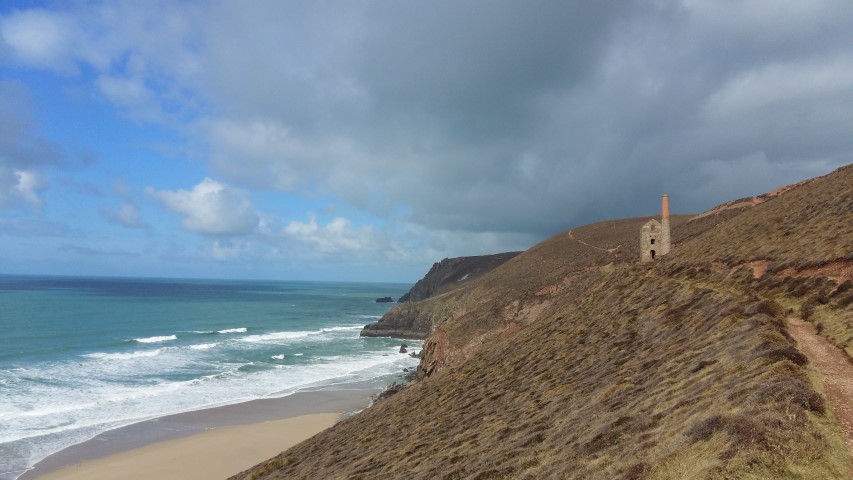
Walk 2: This part of the coast is dominated by the ruins of Wheal Coates. Earliest records indicate a mine at the site since 1692. The present mine opened in 1802 and was closed in 1889 when the price of tin fell. It came into full production in 1815.  Flooding and bringing ore to the surface were the main problems of the mine until steam-driven equipment was available, as the mine's underground operations extended for some distance under the sea. The mine was sold in 1844 and thereafter allowed to flood. A new owner reopened the mine in 1872 but work was sporadic until its 1889 closure. For some years, the yield was 20lb of tin per ton of ore. In 1906, new ownership hoped to work the mine for both tin and copper as Wheal Coates had produced a small amount of copper ore, more than a century earlier. At the height of its production, 140 people were employed at the site to mine a seam of tin just below sea level but this and a subsequent period of operation from 1911-1913 were not very successful because tin production was sporadic. The mine was closed for good in 1914 and is now looked after by the National Trust.  
 
Picture
Walk 2: Here we are looking back toward Wheal Coates with the Towanroath Shaft engine house in prominent view, possibly is one of the most photographed places in the county. Taking the wide path to the engine house, you really feel that you are walking in the footsteps of the miners that worked here some 200 years ago. And then you get thinking about the atrocious conditions they worked in and the pittance they were paid. If you are not careful, you could fall off the cliff in anger.
Walk 2: Every now and again, you come across something unexpected and poignant. This was in one of the narrow paths coming off St Agnes Beacon into the town. All we have to do nowadays is to turn the tap and think no more about it. But that's not the case for countless millions around the world and young girls still have to trek miles to get water supplies.
Walk 2: Back at Trevaunance Cove for the evening light.
What I like about this shot are the changing colours of the water - from blue to green to grey.
The only people we saw actually going in for a swim. I don't think they stayed in very long. Who can blame them? Certainly not me.
Walk 3: The sea at Chapel Porth. Not a lot here apart from the National Trust car park and a seasonal café. Out of season, it's a very quiet spot. In season? That's another matter. Avoid, avoid, avoid.
Walk 3: Bad weather and the caution that comes with advanced years took us inland for our third walk. The route was simple: park at Chapel Porth, walk up Chapel Coombe and then come back via the top of the coombe. All the way around we were walking through what was Great Wheal Charlotte, also known as Wheal Charlotte. This is a long abandoned copper and tin mine and all that is left now is the wall and door arch of the engine house and an adjacent fenced-off mine shaft. The mine opened in 1806 and was originally called North Towan. After operating profitably for a period, it was renamed Wheal Towan; however, the mine closed shortly afterwards. It opened again in the late 1820s, and was renamed New Charlotte and after that Great Wheal Charlotte. In 1877 it was renamed Charlotte United. The engine house held a 60 inch pump and was built in 1828. The main shaft was 82 fathoms (approximately 500 feet) deep and was next to the engine house. But the surrounding area is dotted with other shafts, many of which are capped with clywds, others are just marked with posts. Tread carefully!
Looking across Chapel Porth beach towards Wheal Coates and St Agnes Head. This gives a better idea of the extent of the mining complex. Getting 20lbs of tin from a ton of ore gives a good idea of how much processing was needed and how much waste material was produced.
The incoming tide at Trevaunance, with Storm Brendan beginning to have an impact. We spent ages just staring out to sea and enjoying the breakers. Simple pleasures which, luckily, we both share.
Watching this pair cavort around the beach was an interesting diversion to watching the waves. If I ever got a dog, this would be the type I'd go for.
Not quite the lone surfer but he was one of just two who braved the conditions. Having said that, he and his mate seemed to spend most of their time bobbing up and down, rather than grabbing a ride. What, we wondered, makes one wave more rideable than any other?

Wednesday, 1 January 2020

New Year's Day 2020: Ditsworthy Warren

Happy New Year to anyone who reads this. 2020 and the start of a new decade. And what better way to start the year off than with a bimble on Dartmoor? Nothing quite as ambitious as our last walk along the Cornish Coastal Footpath, just a gentle stroll near Sheepstor. Bimble? That, apparently, is the term used for what we did. Another one for Scrabble enthusiasts? You see, reading this blog can be educational.
We took a circular route to Ditsworthy Warren House, a short way up the Warren itself and then back along the track that leads to the Eylesbarrow mine complex. At just over two miles, nothing too taxing but nonetheless enjoyable for that.
At this time of year, the moor looks rather barren, with just the dead bracken adding a splash of colour.  This area featured in the film War Horse or so I've been told. It's not one that I've watched, I'm afraid.
Ditsworthy Warren House, which is starting to look rather neglected. Once the home of the warrener and his family, it is now very occasionally used as a bunkhouse by the army for troops on exercise. It is isolated, although a popular destination for walkers, and atmospheric. Warrener? He who looked after the warrens and the rabbits contained therein.
Once upon a time (actually it was circa 1972) we found one of these on the moor and took it back to the flat we had in Plymouth. There we painted it with luminous paint and put it on display in our lounge, where it featured with a foil-covered mannequin's head and a unwanted toilet. Oh, to be young and daft again. Our tastes have matured over the years. Or, more accurately, Mrs P's have and mine have probably remained pretty much the same.
A few shots with my IR-adapted camera that give a slightly different perspective on the landscape.
Ditsworthy Warren House looking very bleak. I like this one as it looks like it felt.
The building to the right, to be found immediately in front of the Warren House, was where rabbits were hung prior to them being shipped off to wherever they were being sold. Plymouth market? Destined for the navy in Devonport via the Royal William Yard?
The skull in glorious IR.