Sunday, 17 November 2024

Dartmoor Walk: White Tor from Peter Tavy

 A good day was promised so it was a good chance to go up onto Dartmoor whilst we could. It's been relatively dry for a while now and we could walk without having to slosh around too much. In the event, it was quite dry. I;m not too sure how much longer we'll be able to end a walk dry shod.

We've already done roughly two thirds of this route previously, but in the opposite direction to the way we took this time. Starting outside the church in Peter Tavy, we followed the West Devon Way to the church at Mary Tavy and then took miners' track and footpaths to Hill End Bridge. From there, we headed across Cudliptown Down and up to White Tor. From the lofty heights of this tor, we dropped down to Stephen's Grave and rejoined the West Devon Way back to our starting point. It came in at 7.25 miles and I'd rate it at the top end of the moderate range, although some might question this as the ascent of White Tor certainly had its moments.
St Peter's at Peter Tavy was built in the 14th century, with an older church on this site from the 1180s and the named rectors going back to that date. It has been restored in the 1800s. It's a typical granite church on the western side of Dartmoor.
The church interior - lots of stained glass and some wonderfully colourful ceiling bosses.

 These Renaissance carvings started life as a very specially carved pew set, maybe placed in the south transept, maybe up near the chancel, then they were taken down in the nineteenth century and made into a tower screen (note the keyhole and cutting for a door). After that, they were once again disassembled and placed in the south transept.

A green window into another world. We only get a beguiling glimpse of the garden beyond but, in this instance, I think it's enough. I don't want to see more, no matter how tempting it might be, just in case the mystery is lost.
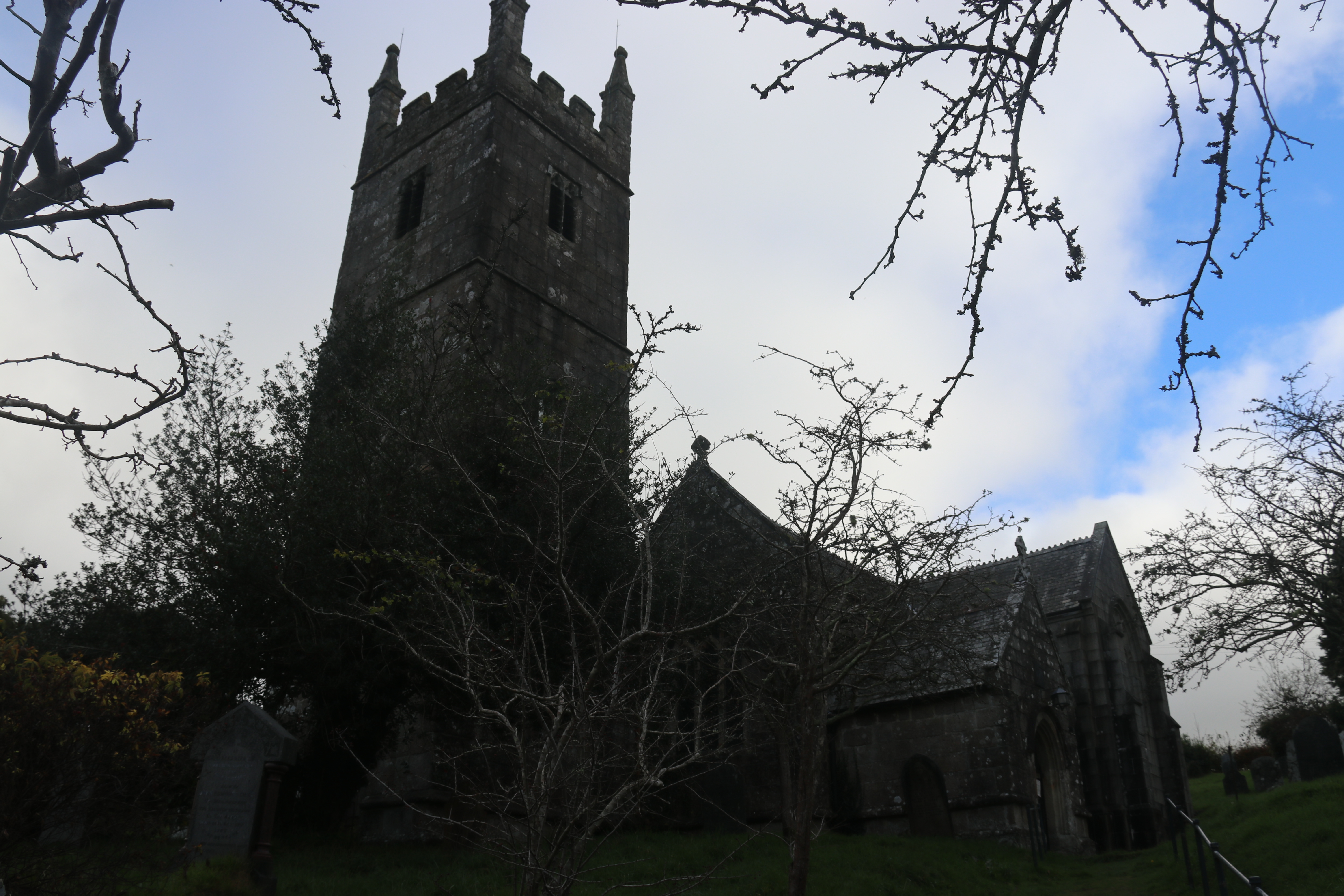
And across some fields and alongside the River Tavy, we come across the second church on our walk, St Mary's at Mary Tavy. We've been here many times but it's never been open for us to visit. That's why the church is in silhouette as what lies within is a mystery to me.
Heading out of the valley now and heading onto the moor. That's a sunlit Cox Tor to the right and Boulter's Tor looming on the left.
The 19th Century Miner’s Dry of Wheal Friendship Mine – where the wet clothes of miners would be dried prior to their next shift. 
The lane leading up to Horndon. We've never actually walked up here when it's been as dry as this. Normally, it's like the bed of a stream.
Isn't it nice to see a welcoming sign? This is a private woodland but the public are invited to enter. If only all Dartmoor landowners had that philosophy.
Looking along the Creason Leat, with the leat itself curving away. The undergrowth is still very lush. coming in from Horndon Lane alongside mine leat. Originally water from the leat would have been used to feed the south area of the Wheal Friendship complex in Mary Tavy. But nowadays the leat is one of two sources of water for the Mary Tavy power station (built in 1930’s). The leat feeds Wheal Bennetts reservoir before entering a 36in pipe and descending the 230 ft to the station to feed #1 plant at the power station. 
The weir on the Tavy at Hill Bridge. The fish pass is on the right and the take-off for the Creason Leat is on the left. I like the way all the leaves are lined up like a brown strip.
Look very, very closely and you might just make out the finger post pointing us in the direction we wanted. Perhaps there should be a finer post pointing to the finger post to make certain that walkers do not miss the way.
That pile of rocks just off centre at the top marks the fort on White Tor. That's where we were heading. The vertical distance makes it look closer than it actually is. It was quite a slog getting to the top, through a fairly extensive field of granite clitter.
To the north-east, the sun is shining at the top of Tavy Cleave, the source of the River Tavy.
The army observation post at the top of White Tor. The tor is just on the edge of the Merrivale and Willsworthy military ranges and, when they are firing, the red flag of warning will be flying.
Looking roughly south, with a glistening strip of the sea in the distance.
Looking through the granite clitter surrounding White Tor, with Leeden Tor in the distance. We were there a few weeks ago.
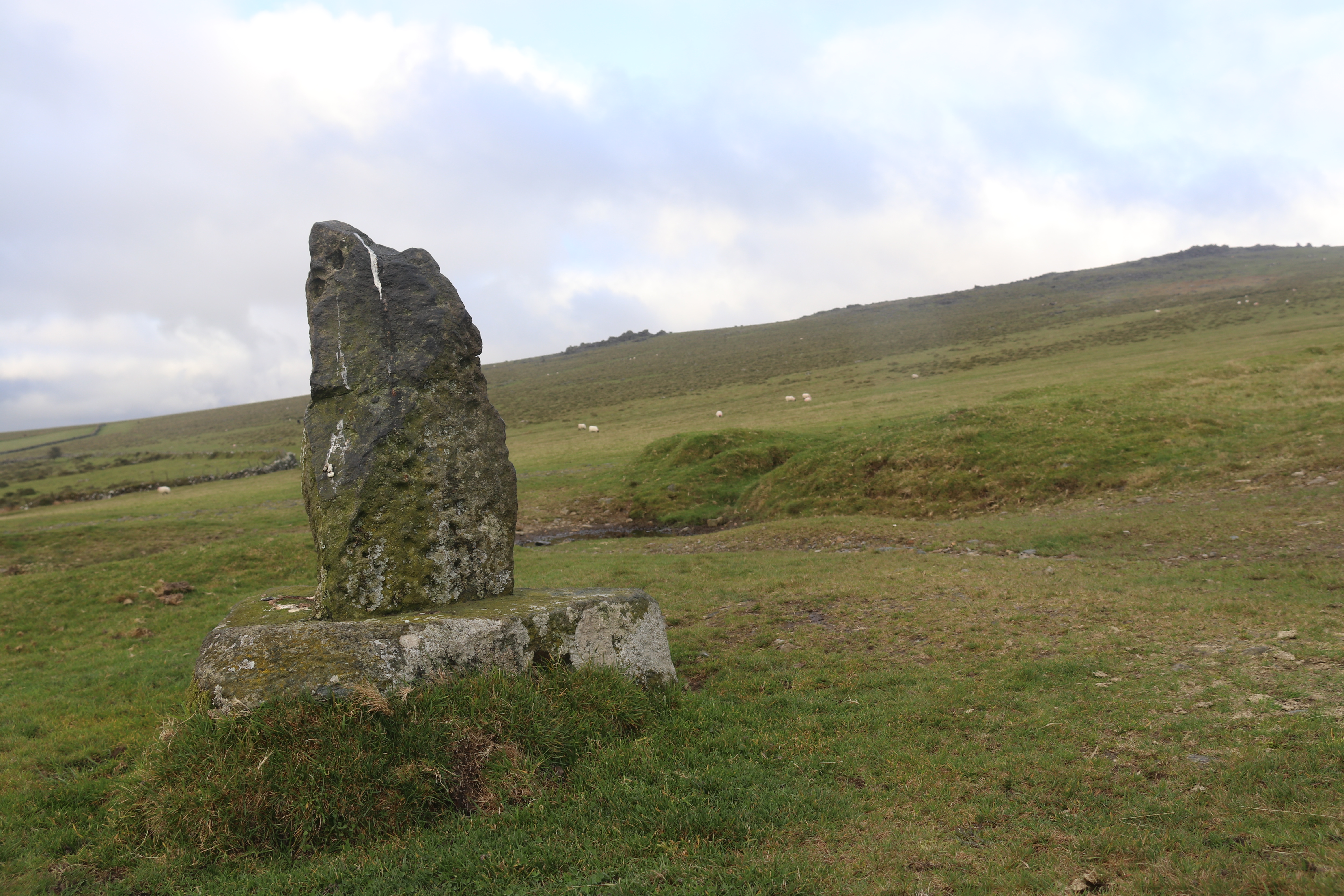
This is a sorry tale of a young man called George Stephens who lived in nearby Peter Tavy around 300 years ago. He fell deeply in love with a young local girl, however either she did not return his advances or her parents deemed George not to be suitable and they never were together. As a result George was heartbroken and committed suicide by poisoning himself. Any death from suicide could not be buried in hallowed ground so George was buried on the edge of Dartmoor at this spot, hence Stephens Grave and the headstone above.
Not sure that closing the gate will be very effective at keeping the ticks out.
A fairly typical low level deciduous woodland on the edge of the moor. A mixture of trees and boulders of varying sizes.
The most moss covered boulder I've seen in a long while.

Sunday afternoon stroll at Cotehele

 It's never less than a pleasure to visit Cotehele House and walk around the gardens. There is always something different to see each time we come and this visit coincided with the early stages of the construction of the Chistmas Garland. Enjoy the photographs.

The house settling in for the winter.
A rather striking Maple/Sycamore that has yet to shed all of its leaves.
The low setting sun and the Mother Orchard. It was a just a few weeks ago that we were here with our friends, Glynis and Mike, for our annual apple scrumping visit.
A copper sculpture celebrating bees and their vital role in pollinating fruit trees, such as those in the Mother Orchard. 
Apple trees and shadows.
The pond in the Upper Garden, with the dogwoods catching the late afternoon light very nicely.
Those autumn leaves come tumbling down.................
An early flowering single camellia, with guest.
Looking over the herbaceous border, towards the viaduct at Calstock.
The Christmas Garland under construction.
This year it looks a little more colourful than last year. Coincidentally, the following clip from the BBC was put up today.

Friday, 15 November 2024

Time for a change in routine?


I haven’t been able to write as much as I would like for the last few weeks for a variety of reasons - holidays, domestic chores and, well, life. I’m sorry for the lack of content and it’s not like there’s been a shortage of things to write about.

There was the election of Donald Trump, which had seemed absolutely inevitable for at least the last year or so. Yes, there are apparently tens of millions of people in the US who actively want their nation to be led by a corrupt and unprincipled criminal who can barely string a coherent sentence together, but the Democrats own a lot of the blame too for their arrogance and complacency. And there we were thinking that a shadow cabinet that included Badenoch, Priti Patel, Chris Philp, Robert Jenrick and Mark Francois made the UK look like a laughing stock. We’ve a way to go yet to beat the USA in the risible politician contest.

There was the election of Kemi Badenoch as Tory party leader. It’s quite extraordinary to see the Tories pick such a shrill, unlikeable, and out-of-touch figure as their leader, after all the years of Tory blowhards endlessly portraying the left as such. If Badenoch ever makes it into power, it’ll probably be as the junior partner in a far-right Faragist coalition brought about by Keir Starmer’s unpopularity. 


Which brings us to Rachel Reeves deeply disappointing budget. We desperately needed a decisive move away from the austerity economics, privatisation mania, and managed decline that have blighted the country for decades, but even with their enormous mega-majority, all Starmer’s Labour is offering is a bit of tinkering around the edges of "more of the same".

And then there’s the festering sore of Israel’s ongoing genocide against the Palestinians. It’s been well over a year, and it’s beyond clear that nobody with the power to stop it cares about the massive death toll, the war crimes, the forced displacements, the starvation tactics, the targeted assassination of medics, aid workers, and journalists, the systematic destruction of hospitals, universities, and sites of cultural and archaeological importance, or the repeated attacks on other countries in the region.

I could have ranted on about all of these issues, but would I really have been bringing anything new to the table by pointing out that Trump is appalling, Badenoch is an unlikeable weirdo, Starmer and Reeves are beyond disappointing and the Israeli atrocities are utterly depraved? Not really.

I'm feeling a little jaded with the world at the moment and I want to do something more than just write about current affairs from a fairly predictable perspective. My intention is to try to move away from day-to-day reportage for a bit, and dedicate more of my writing to the kinds of broader themes that will keep my blood pressure down and restore my somewhat off-kilter equilibrium. Our walks and anything that takes my fancy really. At least that's the intention and we'll just have to see how long I stick to that.

Sunday, 10 November 2024

Tyddewi Hydref 2024: Rhan Un

Hooray, back in St David's for another week. We haven't been here for several years and we are really looking forward to revisiting some of old haunts. As ever, a photographic record of what we got up to. And we'll start with one of our favourite walks.

And that walk was the 'Solva Circular'. Up and over the Gribin, inland to Pointz Castle and then back along the coast to the start. About 4.5 miles and a gentle reintroduction to walking in Pembrokeshire.
Looking down from the Gribyn, the headland under which Solva nestles, onto the meandering stream which enters Gwadn beach.
The steep path that takes us down onto Gwadn beach. Of course, going down means coming back up again. Good cardiovascular exercise.
Elvis has left the building. Actually, he was never in this cromlech but he, or rather St Elvis, did establish a church close by. St Elvis was the mentor of St David and lived in the sixth century. I bet he did a wonderful Choral Evensong (uh uh uh).
Half way around the walk and we come across Pointz Castle, which is a twelfth-century motte still standing about 30ft high with an outer ditch. It was built by Punch or Ponce (an alternative name for the site is Punch Castle), a tenant of the bishop of St Davids, and was later worked as a farm by the clergy. No traces of the outer bailey survive. Seeing it like this was a surprise as every time previously we've walked passed, it has been overgrown and its shape indiscernible. If only we'd known that the nearby farm now houses an ice cream parlour and coffee shop!
Just a path between two hedges. Pretty bare at this time of year but a tunnel of white blossom when the Blackthorn are in flower.
Pen Dinas - or head of the fortress/citadel/city. Site of an iron age fort on the promontory. A place to retreat to in times of threat. It's easily defended but not a place to stay for any length of time.
Looking towards Solva, with the houses of Upper Solva just visible.

This coastline is very similar to that of Cornwall but the geology brings differences. Here it is sandstone, which is somehow softer than the hard granite of Cornwall.
When we returned to Gwadn Beach we could hear the sounds of a seal. Where was it? Oh, there it is, high on the rocks. Not so. Magnify it and it turns out to be a White Egret. But where was the seal? Who knows but it was definitely there somewhere.
This row of four linked lime kilns is located on the south side of the harbour above the high water line at the base of the Gribyn headland. They date from the late 1700s and are Grade II listed. There were originally twelve in Solva and the burning of limestone was one of the main industries of the village. An 1811 report about the village describes "the hot vapour, and the dirt and noise of carting incident to them, make them very offensive proving a great drawback on a residence".
St David's Cathedral from the west end. Gratifying to think that we contributed to the regilding of the dial of one of the clock faces on the tower.
I should have started this post with a shot of the cathedral as our day began with us attending a bilingual Sunday Eucharist. It reinforced my decision to try and learn more Welsh. Not necessarily to be a fluid conversationalist but just to understand and read more than the pitiful amount I currently know. If nothing else, it will enable me to swear at the Welsh rugby as they lurch from defeat to defeat - 10 in a row after today's pathetic performance against Fiji. I wish I'd taken advantage of my time at Aberystwyth and taken the language lessons that were on offer.

Friday, 8 November 2024

Brewer's Droop?

There comes a time in the affairs of man when he should .... well, when he should find a good pub and have a decent pint of beer. But as I've been teetotal for a few decades now, it's not something that I ever do. But, if I did, I would seek out a pint of real ale as my taste buds can still remember being washed with a nice drop of Sam Smith's.  And I am still have a Pavlovian response to the powerful aroma of hops and malted barley.  All of this brings me to a recent vignette I read on two of the brewers of Tadcaster, a brewery town just west of York - Samuel Smith's Old Brewery and John Smith's New Brewery. The story behind these two breweries with similar names is worthy of re-telling.

The oldest of the breweries was, appropriately enough, the Old Brewery which was built in 1758 and by the 1840s it had come into the ownership of a certain John Smith. John Smith built up the business, expanded the trade, modernised the plant and equipment and thrived. He was joined in the business by his brother William and by the two sons of his sister Sarah Riley. When John died in 1879, he left equal shares in the business to his brother William and another brother, Samuel, who had a tannery business in Leeds. On their death, the will stipulated that the business should pass to their heirs. There were three problems: the first was that William had never married and therefore had no heirs, the second was that Samuel Smith - or his heirs who were set to inherit the business - had never been involved in the running of the brewery, and the third was that no mention was made of the nephews, Frank and Henry Riley.

A plan was hatched between William Smith and his nephews. And plot of land within a quarter of a mile of the old brewery site was obtained, a new purpose-built brewery was constructed and the trade, the fixtures, the fittings and the acquired expertise were craftily and rapidly moved there. As this new building didn't figure in John Smith's will it passed to Frank and Henry Riley on his death (the brothers rather cheekily had changed their name to Riley-Smith in the meantime). When Samuel Smith and his son (another Sam) arrived to take control of their legacy all they found was an empty building and a marked absence of trade.

Samuel Smith rebuilt the business trading from the old brewery and his company became Samuel Smith's. The Riley-Smiths had the advantage of the new large brewery and they traded under the name of John Smith's.

There was no love lost between the two firms and one can almost imagine raiding parties being sent out from one to make mischief at the other. Who won the battle between the Brewing Smith's? In some ways it is difficult to call. John Smith's grew faster and eventually became a powerful national brand. But then it got caught up in the wave of twentieth century mergers and acquisitions, first becoming part of the Courage Group, then Scottish and Newcastle and now part of the international Heineken Group. Samuel Smith remained comparatively small and independent, trading locally but achieving an international reputation for its quality beers. In some ways the battle was one between traditions and technology. For me tradition wins, and I’d always opt for a pint of Sam's.

Wednesday, 6 November 2024

The King, The Prince & Their Secret Millions

 (I probably should point out that we have an involvement with the Duchy of Cornwall in that it has an absolute claim on the mineral rights of our property. And for that privilege, and potential earnings, they do nothing. That's enough to make me a Republican. Oh, hang about.....)

I've just caught up on Channel 4’s Dispatches programme which revealed the extent to which the public is being charged/milked/scammed by the Windsor family. Or rather, at least the extent to which the programme and the investigative reporters of the Sunday Times were able to uncover. The Windsors go to great lengths to keep their finances a secret. This is an immense help to them when they plead poverty and ask for yet another increase to the money that they get from the government (ie the taxpayers) every year. The property portfolios which generate millions a year for Charles and his oldest son are a closely guarded secret. Even parliament itself has been refused access to the list of properties and land held by the Royals. These properties are part of the holdings of the Duchy of Cornwall which funds the heir to the throne, and the Duchy of Lancaster which funds the monarch.

The Windsors insist that these are private property when it comes to avoiding public scrutiny, but part of the monarchy when it comes to avoiding paying the same taxes that any other private property holdings company would be liable for. Yet these properties were not acquired in the normal way that a property holding company acquires property. The two duchies are making many millions of pounds every year by charging government departments, local authorities, NHS Health Boards, businesses, mining companies and the general public via a series of commercial rents and feudal levies on land which, for the most part, was seized by medieval monarchs from those that they deemed enemies, or from those whose lands they just felt like helping themselves to. Charles and his son owe their fortunes literally to robber barons. Medieval monarchies were not charitable institutions and the modern royals are continuing in the same vein, funding their luxurious lifestyle on the backs of we the peasants.

The Duchies operate as commercial landlords even though they have a special agreement with the Treasury exempting them from paying tax on their corporate profits. The Duchies are not directly funded by the taxpayer but leases and contracts in the King and Prince’s own names show they are making millions of pounds a year by charging the army, the navy, the NHS, the prison service and state schools to use their land, rivers and seashores. Yes, they own seashores. Real seashores.

The tax free income that the royals receive from the Duchies is in addition to the Sovereign Grant, which currently stands at £132 million annually which they receive from the government. This is meant to cover the cost of the royals’ official duties, palaces and households. Last year, the Duchy of Lancaster raised £27.4 million tax free for the King and the Duchy of Cornwall raised £23.6 million in tax free for the Prince of Wales. This is considered private income which the royals can spend as they see fit. The King and the Prince ‘voluntarily’ pay income tax on that part of their income from the Duchies which they deem not to relate to their official duties. The rest of us don’t get the chance to claim that we only pay tax voluntarily and to decide for ourselves which portion of our incomes we are going to pay income tax on.

But the property holdings of the Duchies are not all that the royals possess. One consultancy company put the combined wealth of the royal family at £67.5 billion. By any reckoning, these are extremely wealthy people. Yet, this huge wealth does not prevent the royals from charging rent and creaming off hard pressed public services. According to the Sunday Times: “The Duchy Files show the royals charge for the right to cross rivers; offload cargo onto the shore; run cables under their beaches; operate schools and charities; and even dig graves. They earn revenue from toll bridges, ferries, sewage pipes, churches, village halls, pubs, distilleries, gas pipelines, boat moorings, opencast and underground mines, car parks, rental homes and wind turbines.”


Amongst other findings of the investigation is the revelation that the NHS will pay the Duchy of Lancaster £12.4m over 15 years in order to rent a warehouse in London for ambulances. In January last year, the Duchy of Lancaster said it was pleased to be of assistance when Guy’s and St Thomas’ NHS Foundation Trust needed to find garage space for a new fleet of electric vehicles it was buying to tackle ambulance waiting times and it put out a press release saying that it had “granted” the trust a warehouse close to Tower Bridge. The press release omitted to say that the Duchy would be charging the Trust an annual rent of £829,348. That totals £12,440,220 over the 15 years of the lease. The NHS has been starved of funds for years but that is of no consideration to the Duchy of Lancaster. The NHS Trust which Charles is milking to the tune of £12 million is so strapped for cash that it has been forced to make job cuts, axing 58% of the roles in its Facilities and Capital Development team, the staff responsible for transport and construction projects.

The Duchies were retained by the monarchy in the 18th century when the bulk of the Crown Estates were surrendered to the government in return for clearing the debts of George the Prince Regent, later King George IV, and with the agreement that the government would fund the day to day expenses of the monarchy. At the time neither Duchy was seen as particularly valuable. Over the succeeding decades, obsequious British Governments agreed to the effective annexation of these state properties by the royals as their private and personal property.

Meanwhile the value of the holdings of the Duchies has ballooned and both Duchies have holdings far beyond their traditional territorial bases in Cornwall and Lancashire. Today they are modern property businesses with extensive assets spread across England which are jointly worth £1.8 billion, according to their annual reports. Adjusted to today’s prices, annual profits from the Duchy of Cornwall have soared from around £2.5 million in 1960 to £23.6 million today while profits from the Duchy of Lancaster have increased over the same period from about £2.5 million to £27.4 million. Charles pays only £5.9 million in income tax on the Duchy of Lancaster’s profits, about 25% of the profit he receives. He pays no other taxes on this income.

Recently to much fanfare, the Prince of Wales released a documentary about his ‘efforts’ to tackle homelessness. To no one’s great surprise these efforts do not extend to giving away any of his or his family’s land or obscene wealth or allowing homeless people to take up residence in any of his family’s many palaces and homes.

There has been no great publicity in the British media about the wealth and hypocrisy of the Windsors. The BBC has ignored the story completely. But it will be the first to tell us how “radiant” William’s wife is looking as it continues to perpetuate the fantasy that this is one happy family which cares about the lives of ordinary people. The lack of coverage of the revelations in the Dispatches report from the royal correspondents, whose job it is to report on the British Royal Family, is not surprising in the least. The same so-called journalists who promoted Prince William’s homelessness project are silent on his failures as an actual landlord. That tells you all you need to know, both about the greed of the royals, and the British establishment and its client media. Power to the people, I say, power to the people.