Showing posts with label Mull 2017. Show all posts

Sunday, 20 August 2017

Mull 2017: Iona

Here's something that I'd written soon after our trip to Mull but, for some reason, never got around to posting. As it completes my record with a description of some of our time on Iona, one of the main reasons for visiting Mull in the first place, here it is as originally typed. 

This is the last post on our recent break on Mull and I thought I'd show a few photographs taken when we were on Iona. From what I gather, we had chosen a good time to be on the island as it gets extremely busy during the high season. Personally I think I would have been very disappointed if I'd gone there and found myself just one of many. The place has a unique tranquility and is best visited when there are few other distractions, like people.
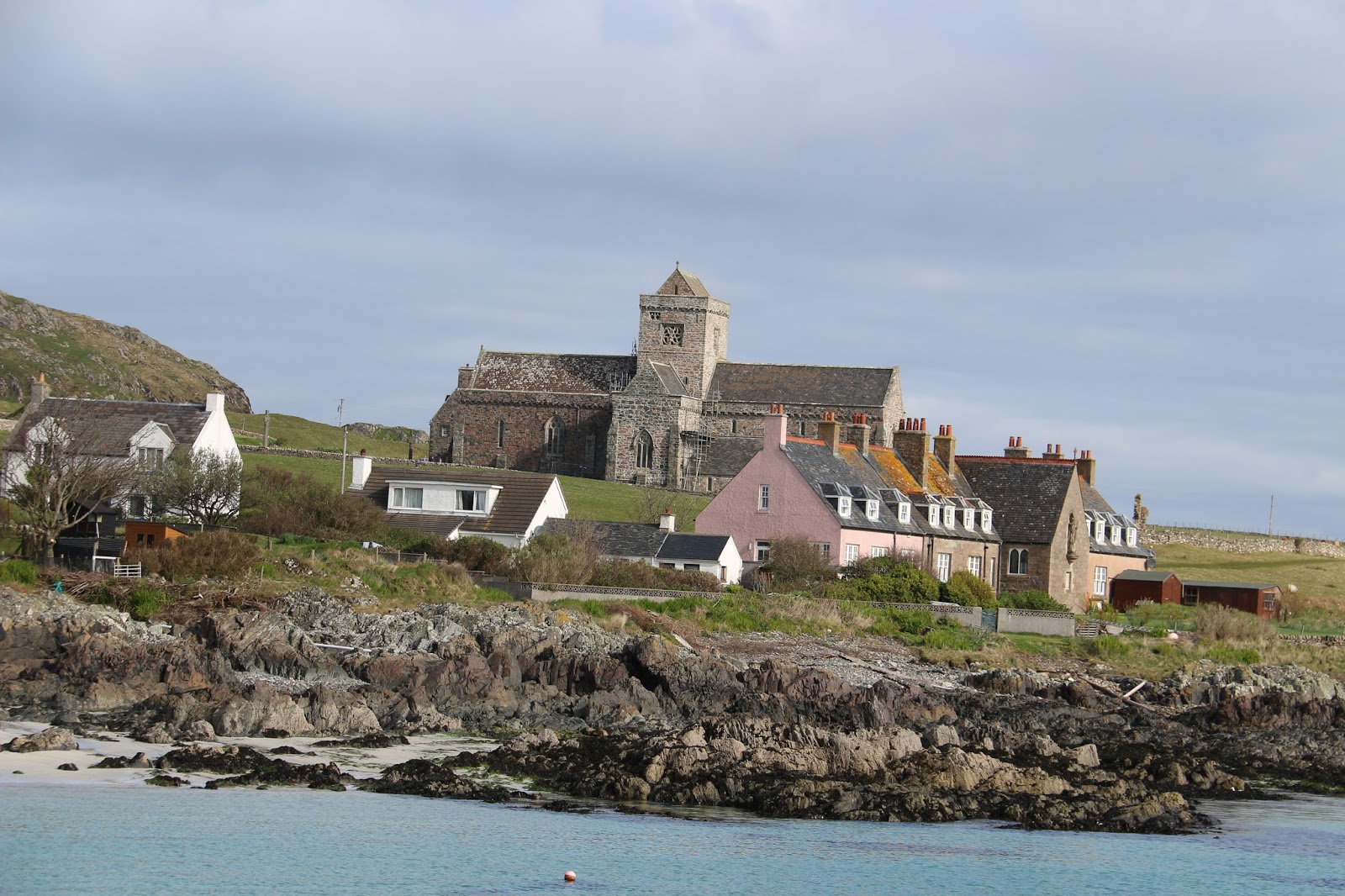
Iona has been an important centre of Christian worship since St Columba arrived in AD 563. Despite the repeated attention of Vikings, his monastery survived until the end of the 12th century. Around 1200, a Benedictine abbey was founded and, although monastic life on Iona ended with the Protestant Reformation in 1560, pilgrimages to St Columba's Shrine continued to thrive over the ages, right up to the present day.
At the centre of the grass court (the garth) around which the Iona cloister is built, lies this sculpture by Jacques Lipchitz called 'Descent of the Spirit'. It is one of three originals and was given to the Abbey by the artist himself. It shows the Virgin supported in a starry cloud descending to earth, represented by animals, birds and humans, and carried by the Holy Spirit, a Dove. I'd make room for it in my garden, if offered.
A view from the west end of the Abbey, looking over the font towards the altar at the far end. It was, for me at least, surprisingly but effectively austere. Pilgrims would certainly not be distracted by the presence of effigies or any other idolatrous images.
Around the outer cloister wall is an array of medieval grave slabs. Many of these originally stood outside in St Oran's Chapel burial ground. The carving is intricate, with common motifs including flowers, swords, and hunting scenes. Many of the slabs commemorate clan chiefs, including MacKinnon, MacLean and MacLeod chieftains. 

The layout of Iona Abbey follows a traditional monastic layout, with a cloister walk adjoining the church, although in this case the cloister is unusually sited on the north side of the church. Very little remains of the original medieval cloisters and what's there now was rebuilt in the 1950s and 60s. Though modern, the cloister is carved to resemble an authentic medieval cloister with double rows of columns supporting capitals carved with flowers and birds. 
Taking a break at the north end of Iona, looking out towards Staffa and Lungha. There are no footpaths on the island but, with the Right to Roam Act, most places are accessible.
The highest point on Iona is Dun I. Not pronounced 'Dun One' but 'Dun EE'. It simply means 'Mount Iona, I being the local name for Iona. Nomenclature aside, what is interesting about Dun I is that it is crowned by yet another Vanessa trig point, news of which will excite some of my readers as much as it did me. Look closely at this one and, unless I'm mistaken, you'll be able to make out the striations of the original cardboard tube that was used as the mould. Now, isn't that fascinating?
Just the top of one of the many Celtic crosses on Iona. I'd never really thought much about the design of these before and, in so far as it went, I would have said that the top was a combination of the sun/halo and the cross. However, someone in the Abbey pointed out that, given the number of early broken crosses they've come across, there is a view that the circular pieces were added to stabilise and strengthen the cross. Makes sense to me.
Another view of the interior of the Abbey, this time looking east-west towards the font and the main door. The choir stalls are in the forefront and were magnificently carved.
The Abbey Museum, as well as detailing the evolution of religion on the island, contains an amazing collection of Celtic crosses. Several were around 5 - 6 meters tall and must have been quite a sight when they were firmly embedded in the landscape.
Another monument on the island is the Iona Nunnery, an Augustinian convent located close to the Abbey. It was established just after the foundation of the monastery in 1203 and its ruins form the most complete remains of a medieval nunnery extant in Scotland. And I probably don't need to say it but, after the Reformation, the priory was dissolved and reduced to rubble. One thing I will always remember about my ramble around these ruins is coming across a group of, presumably, pilgrims relaxing and smoking some 'herbal' cigarettes. They seemed very happy and relaxed, as I was but without the assistance of anything herbal.
One last look southwards down the Iona Sound....
....before getting on the ferry back to Fionphort. We'll return to Iona one day.

Thursday, 11 May 2017

Mull 2017: Some grave matters

Whenever we are away, local graveyards, cemeteries and war memorials act as magnets to me. Quite often they are a window onto the social history of wherever we are and sometimes reveal interesting and poignant stories. I'm not sure how I should label this mild obsession of mine: it's certainly not 'necrophilia' (a rather morbid derangement). How about 'taphophilia' (“taph” from the Greek for tomb and “philia” meaning an inordinate fondness)? Nah, too clinical and not really what I do. I like to walk their paths, smell their flowers, see their statuary and read their epitaphs. Perhaps, because my interest has so many different facets, there is no single word or phrase for it. I’m all right with that. And now to what Mull and Iona had to offer in this regard.

In the small walled graveyard at Fionphort, I came across this headstone. It reads: Erected by D. McPherson, Appin. In memory of his beloved son, John, mate of SS Farho (lm). Wrecked on Tory Island. 22nd August 1874. Aged 35 years. His body was washed ashore here, a distance of 200 miles, 19 days later.
A little research reveals that SS Fairholm struck a rock in fog and sank off Tory Island on the north coast of Ireland. The full story is given in the newspaper cutting shown below. What was particularly poignant to me was realising that the Appin in the inscription is actually a small village on the mainland opposite Tobermory. With slightly different currents and/or wind directions, John's body might have returned home.
Taken from the Glasgow Herald and gives more detail of the events surrounding the sinking of SS Fairholm.

Another one from Fionphort and it mentions what happened to two sons of Duncan and Margaret Mae Gillivray MacKechnie, of the village.
Willaim MacKechnie, who is buried here, was a deck hand on HMS Lavatera and seems to have been 'lost at sea'. Swept overboard, perhaps? Lavatera was a small steam drifter (fishing vessel) built in 1913, she measured just 84 tons and originally fished out of Banff. In March 1915 she was taken over by the Navy, armed with a 3 pounder gun, and was employed as a patrol vessel. She was returned to her owners in 1920.
Their other son, Archibald, was killed on July 15th 1917, when his ship, HMS Redbreast, was torpedoed by U-boat 38 in the Aegean Sea. His body was never recovered and this headstone commemorates his memory. HMS Redbreast was an interesting ship in that it was one of the so-called Q-ships (also known as Q-boats, decoy vessels, Special Service Ships or Mystery Ships). These were heavily armed merchant ships with concealed weaponry and were designed to lure submarines into making surface attacks, giving the Q-ship a chance to open fire and sink them. The ethos of every Q-ship has been described as 'to be a wolf in sheep's clothing'. Whatever the ethos, it clearly didn't work for Redbreast. And the Q? This refers to the vessels' home port of Queenstown in Ireland.            

Just to the south of the landing stage on Iona is this granite memorial at Martyr’s Bay or Port nam Mairtear. It is not in memory of the 68 monks killed here by Vikings in 806AD, but to the men lost in the First and Second World Wars. It's a beautiful place with stunning views over to Mull and to Erraid, once the summer home of Robert Louis Stevenson.
Never one to miss reading a war memorial, I was intrigued to see this: "Bimbashi Colin MacDonald. Frontier Batt. Sudan DFC. FCS. Aged 29 years". Bimbashi? Never heard of it but Google tells me that it is a rank equivalent to Major, originating from the days of the Ottoman Empire and retained in the Egypt Service. A little more reading suggests that DFC. FCS. are not the initials of awards but are shorthand for Defence Force.
The Commonwealth War Grave Commission's website gives a little more information but doesn't give a clue as to why Colin MacDonald was serving in a Sudanese regiment.
A little more rooting around and I come across this entry in a Year Book for Edinburgh University. Colin MacDonald had joined the Sudan Political Service and enlisted in the Sudan Defence Force from there. It is likely that he was killed in an engagement with Italian forces.

The simple granite grave of John Smith, erstwhile leader of the Labour Party and one of the great 'what if's' of British politics. What if he had lived longer? What if he had formed a government? Who knows? His epitaph reads 'an honest man'. It could very well turn out to be fitting for the present incumbent of that same position.
I liked the simplicity of this pink granite headstone. 'Here lies all that could die of Bruce Kenrick'. And does the memory of him linger on? It certainly should as he seemed quite a force. Amongst his many achievements was founding Shelter. Google his name and you'll find out a lot there about him.
The elaborate marble tomb of the 8th Duke and Duchess of Argyle placed in Iona Abbey.
I couldn't but help contrast the simplicity of this marker for an unknown Merchant Navy seaman with the Argyle tomb. It is just one of six similar found in the graveyard next to Iona Abbey, all with different dates.

Friday, 5 May 2017

Mull April 2017: Some birds

Visits to the Scottish Islands always give the chance of seeing some birds that we don't get in the |West Country. The Mull trip was no exception and we came away with a reasonable list of sightings. And here's some of the evidence but before getting to them, a confession.

One day I'm going to write a blog entitled 'Things that can go wrong when using a digital camera'. You name it, I've probably done it and this holiday was no exception.
Cock-up #1 (CU1): Forgetting to switch from manual to auto focus when needed.
Cock-up #2 (CU2): Forgetting to switch the image stabilising on when I'm using a zoom lens.
Cock-up #3 (CU3): Forgetting to switch to sports setting when trying to photograph birds in motion.
Cock-up #4 (CU4): Forgetting to take the right lens with me when I KNOW I'll need my longest lens.
You'll see examples of potentially good photographs blighted by ineptitude and one or other of the above. But that's life and I did see the birds in the feather: that's the important thing.
A Curlew to the left, which we see in Cornwall, and a Whimbrell to the right, which we don't as they are restricted to the north-west of Scotland. They are fairly similar but the distinguishing feature is the beak. That of the Whimbrell is somewhat thicker and less downward curved (CU2).
The larger picture is of a Black Guillimot, with pretty much the same distribution as the Whimbrell, and the inset is of a 'common' Guillimot, which we do see down west. The bright red legs of the Black Guillimot are a useful diagnostic feature (CU1 and CU2 -  a double whammy).
A Great Northern Diver, widely distributed but not common. I'm not that good at identifying Divers but the speckled back of the Great Northern gives it away. I'm always open to correction by those who know better (CU2).
Wheatear, one of our earliest migrants. A busy bird, always on the move and never stopping anywhere too long. More often than not you only see it from the back, which is useful as its white rump is a clear feature (CU2, CU4 with a touch of CU3 as well).
I mentioned previously that we went Sea Eagle;White Tailed Eagle spotting at an RSPB hide in Glen Tiororan. Did we see any? Sort of. The fixed telescopes at the hide enabled us to spot a bird on the nest but, as it was about 3/4 mile away, it was impossible to get a decent photograph. The above is as as good as I got: it could have been better but this black flying arrow kept getting in the way. Some purists are somewhat sniffy about this type of organised viewing but we enjoyed it. It got us out into the countryside and we learnt a lot about the habits of the birds from the resident RSPB warden. We also saw at first hand how our RSPB membership subscription was being spent (CU4).
But when we were returning from our boat trip, we did motor past a Sea Eagle's nest quite near the shore. One of the birds conveniently sat on a tree stump for a while until it flapped off to escape from some irritating crows (CU4).
The huge nest was in a nearby tree, with the other bird of the pair sitting on their eggs (CU4).
Sea Eagle in flight, with the white tail and yellow beak clearly visible (CU3).
A composite of shots of the bird as it tried to escape from the marauding crows. These are big birds, the largest in the UK by far, with an eight foot wing span. Camera settings were OK for this set but the sun was in the wrong place.
On the island of Lungha we were fortunate to be able to get close to a few shags on a cliff top. They didn't seem to mind us eating our sandwiches a few yards from them. Here is one showing off the 'courting' tuft of feathers very nicely.
We had a great view of the courtship behaviour of the birds, with foot drumming, beak displays, throat clicking and general 'look at me, I'm great' posturing. The females looked impassive as the males preened and ponced about but isn't that always the way?
No trip to the islands would be complete without Puffins and we saw lots of them. It's always a delight to see them up close and they never seem to be perturbed by the presence of people gawking at them.
Puffins coexist quite happily with rabbits. They don't share the same burrows but they do live side by side without any problems. I wish we could have lingered longer on Lungha.


Wednesday, 3 May 2017

Mull April 2017: A visit to Staffa

Our trip to Mull presented the perfect opportunity to visit the geological gem that is Fingal’s Cave on Staffa. This we accomplished by taking a combined boat excursion from Ulva Ferry that also allowed us the chance to spend some time on the largest of the Treshinish Islands, Lungha, to see the puffins and whatever other birdlife was there at the time. The weather was as good as it could be, with blue skies and a calm sea. Could a day out be any better than this?
A seven hour excursion on a custom-built sea cruiser we were promised. This isn't what we had in mind.
Phew! Luckily Captain Hamish came to our rescue with the Salty Haggis, a fine sea-going vessel with plenty of room for the 15 of us.
Staffa is a dramatic looking island, with huge columns of hexagonal columnar basalt topped with the compressed ash of volcanic explosions. According to our resident geologist, basalt is an igneous rock, meaning it was formed from lava (or magma). Specifically, it is an extrusive igneous rock, meaning it formed as a lava flow at the surface. As you approach by boat you see this green-topped shape looming out of the sea, and as you come closer its unique structure becomes apparent
Rounding the island, you come upon Fingal’s Cave. Personally I much prefer the Gaelic name An Uamh Bhin, which means ‘the melodious cave’. That would, in fact, have lent itself better to Mendelssohn for his Hebrides Overture. However, it is universally known after the Irish hero Fionn MacCool, hence Fingal’s Cave. It was a bit naff but entirely predictable in a pleasant way that, as we moved closer to the cave, the boat crew fired up the PA system and piped out Mendelssohn's Overture. Hearing it in-situ makes you realise how well the music reflects its origins.
The on-foot approach to the cave is reasonably safe these days, with non-slip surfaces and a handrail to guide you. The tops of the basalt columns make pretty good stepping stones. Walking gives you a much better look at the columns and one of things you’ll notice is that, although they are described as ‘hexagonal’, they don’t all have six sides. This is, apparently, just one of those things. Geologists defaulted to calling them hexagonal long before they were properly studied, but they can have any number of sides (usually between 3 and 7). Once you get your eye in, you find yourself counting the number of sides to find the non-hexagonal ones!
When inside the cave, the sound of the waves breaking and echoing makes the visitor understand why it was originally called the 'melodious cave' and why it inspired Mendelssohn. I was inspired myself, in fact, but I could only manage a tuneless whistle. Look up and you see that the ceiling is studded with a mosaic of the moss-covered remains of broken/eroded columns.
Inside looking out. Blue sky, calm sea.
The columns don’t just go straight up and as the land has been squished (that's a geological term) and stretched and moved about over millions of years, the columns have ended up bent in places and seem like waves of rocks.
It really is an amazing sight and is in the 'see if you can' category. The alignments reminded me of the patterns produced by iron filings and a magnet.
A solitary Shag drying its wings in the sun. The silhouette clearly shows the distinctive tuft of feathers above the forehead which is present in its breeding plumage.
Looking back to Mull, with Ben More in the distance and the island of Ulva to the right.
Sitting near the highest point on Staffa, and just above Fingal's Cave, is a trig point. But not any old trig point. It's a circular trig point and one of the relatively few of the Vanessa design. Only seen north of the border, these are the gold medallists of the trig point spotting world - and this is the first Vanessa I've seen. Imagine my joy - it was a very quiet joy because I thought that jumping up and down in glee was not appropriate under the circumstances. So, you ask, what's so special about Vanessas? A little context will help you appreciate my joy.
When the OS triangulation had progressed to the Highlands of Scotland, it was necessary to design a new and lighter pillar, cylindrical in shape, in order to avoid excessive transport costs. These round pillars, usually called 'Vanessas', or sometimes 'Branders' or 'Kelsey Columns', were considered "less aesthetically satisfying" than the standard pillar, so they were only placed in inaccessible locations to "reduce the risk of criticism from the more sensitive element of the population to an acceptable level." Vanessa pillars weigh around 6½ cwt (330kg), less than half of a typical and more common Hotine pillar (14 cwt, or 711kg), and did not require such a large foundation, making them ideal for the rocky outcrops of the Scottish Highlands.
'Vanessas' are so-called because the name is derived from 'Venesta', the name of the company which produced the cardboard tubes that the concrete was poured into. And this is the bit of the story I really love, Venesta was chosen because of their expertise in making other cardboard tubes - the centres of toilet rolls. I can imagine the lateral thinking in operation here. "You know what we need is something like a giant toilet roll tube to mould these things. Now who makes 'em?".
When I get engrossed in something like this, I start to think that I'm losing the plot. I need help!
Ah, there's someone who can do just that. But she seems otherwise engaged..
And then it was back down the ladders to the boat and the rest of our trip. Next stop Lungha to see the puffins. But were they there? Stay tuned for the next exciting episode to find out.