Showing posts with label Tremaine. Show all posts

Friday, 22 March 2019

A walk in the countryside around Tremaine

For this walk, our leader had selected a circular route starting and ending at Tremaine church - St Winwalo's. It was unexplored countryside for all of us and, with the weather looking reasonable, it was something to look forward to. It turned out to be a trip not without incident - disappearing foot paths requiring a diversion, stiles overgrown with unforgiving vegetation, a swept-away footbridge necessitating some backtracking and mud, lots of mud, making it a hard walk in parts. Add on to all of that the fact that the countryside was rural and secluded, rather than spectacular, it was a walk that we were unlikely to repeat. One for the OK category but it was good exercise with pleasant company. As ever, a few photographs for the record, with a bias towards plants, which says something about the scenery.
Our circular route started and ended in the car park of Tremaine church. My GPS clocked just over 7 miles for this one. Probably a third of the walk was along quiet lanes and rest was across muddy fields.
Our starting point: St Winwalo church at Tremaine. Dating from the 12th century, it is one that we've visited quite often.
The variegated leaves of Ivy-leafed Cyclamen - Cyclamen hederifolium - presaging what will be a spectacular display of blooms.
This is one I prepared earlier - last year, I think, in pretty much the same spot as the previous image. This is what is to come in a few weeks.
The delightful blue flowers of Spring Squill - Scilla verna. Squill is a corruption of the Latin, Scilla. We've seen it more often on the various coastal footpaths we've walked on.
This one is an anemone of some kind. Not a wild flower and may have been planted in the graveyard in memory of someone. Botanists would class this as an 'escapee'.
No, it's not my farm, just an unexpected coincidence.
A rental property slate sign that caught my eye.
Male flowers, or catkins, of the Goat Willow (Salix caprea). Also known as the Pussy Willow, but these flowers have gone passed the stage when they look like a cat's claw. I can't find anything that sheds light on the connection with goats.
The female flowers of the Goat Willow, built for receiving rather than producing pollen. Like the Hazel, the Willow is dioecious, meaning male and female flowers grow on separate trees. True harbingers of Spring, methinks.
This panorama typifies the countryside we walked through. Rolling pasture punctuated with quite steep valleys cut by streams.
At one time, there was a footbridge here that spanned the River Ottery. Marked on the map but obviously not there now. We had to make a 1/2 mile backtrack to get over to the other side as there was no crossing for many miles downstream.
An early dandelion 'clock'...……...
……….that looks better/different in monochrome.
White Deadnettle interspersed with Common Nettle. Lots of shades of fresh green.
A clump of indeterminate Ink Caps - Clustered, perhaps, or Glistening? An interesting fungus, if that's what grabs you. As they mature, autolysis sets in and they dissolve into a characteristic black mush, used by some as ink. 
Our view of St Winwalo as we approached it at the end of our walk.
We can't go passed without taking in the tranquility of the unadorned interior.

Saturday, 9 February 2019

Three Saints Way: Tremain, Treneglos and Tresmeer

Every now and again, Mrs P and I lead a walk for our U3A Thursday Group. The next time is fast approaching and we decided to reconnoitre a possible route recently. This one was called 'The Three Saints Way Heritage and Nature Trail' and sounded interesting. In the event, it was an 'OK' walk: one that we'd put in the portfolio as a possible but maybe not the one we'll actually do on the day. Having said all that, we had a good day out and saw a part of our locality that we rarely visit. And, as a bonus, despite a pretty dire weather forecast, we got around with barely a drop of rain falling on us. Another bonus was the opportunity for me to end the day under the Tamar Bridges near midnight with my camera. Something I've meant to do for a while but have never got around to.
Our route, just over 6 miles, started and ended at Tremaine church. Probably about 50% of it was along quiet country lanes: the remainder was across fields. Lots of sky all the way around and a reasonable amount of mud to slosh around in.
St Winwaloe's church at Tremaine, reputedly the smallest parish church in Cornwall. Originally pre-Norman (it is built on a circular plot called a llan which indicates considerable antiquity) , but rebuilt in the 12th and 13th centuries and largely unchanged since then. It has no electricity or gas and is a delightfully tranquil place. Of the three churches we visited on this walk, St Winwaloe's was the only one at which services, albeit infrequent, are still held.
Everything about St Winwaloe's is simple and unadorned, as typified by this floral arrangement. Anything more flamboyant would have been completely out of place.
An asymmetrical barn attached to the mid-16th century farmhouse in the hamlet of Westcott, which was mentioned in the Domesday book. The splayed design allowed for greater storage on the upper floor.
We criss-crossed the old Launceston to Bude railway line, which closed in the early 1960s. If you were alighted at Tresmeer station with the not-unreasonable expectation of being near Tresmeer, you'd have been disappointed. Tresmeer is about 3 miles distant.
Tresmeer station is, in fact, in Splatt. Nowadays Splatt seems to consist of about 5 houses but, once upon a time, was the site for a large cattle fair.
Treglith farmhouse, dating from the early 1600s and largely unchanged since then, even this porch at the rear of the property but I think the middle column was damaged a long while back.
St Gregory's church in the hamlet of Treneglos. The present building dates from the 11th century but, according to my copy of Pevsner, was subject to a drastic restoration in and around 1858. As for St Winwaloe's at Tremaine, St Gregory's was also built in a llan. Sadly, due to the roof being in bad repair, St Gregory's has been closed for several years awaiting funds for repairs. Will the money ever be raised? I doubt it.
We could not see the interior of St Leonard's but we could see its main architectural feature, this Norman tympanum above the door. It shows two beasts (lions?) facing each other and a tree of life. There is something similar at the church in Egloskerry and it is suspected that they were both carved by the same hands.
Although the sky in the direction of Bodmin Moor looked threatening, the rain held off.
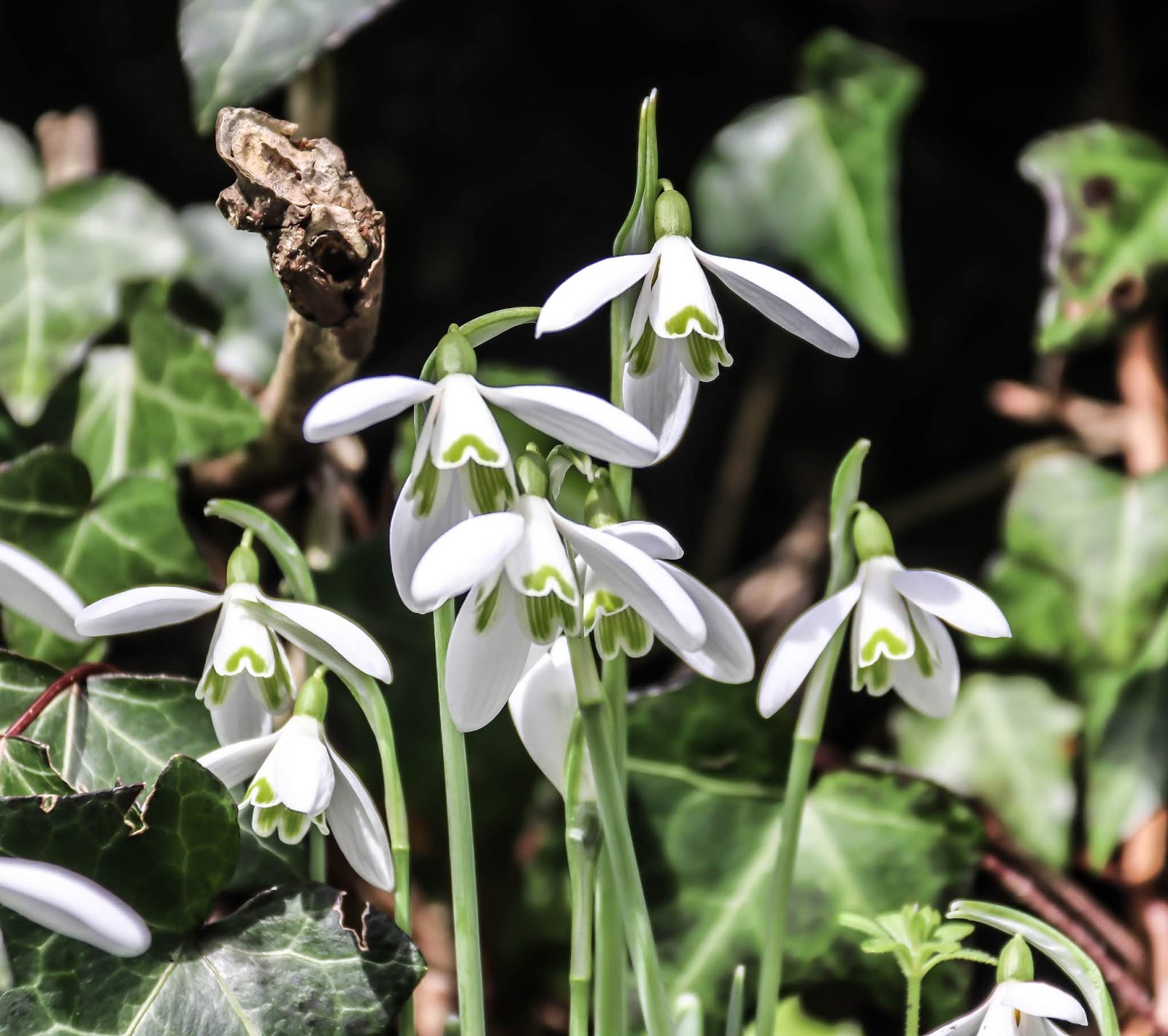
Lots of snowdrops all the way around. They never cease to be a joy.
Sheep, just sheep.
 
St Nicholas's church at Tresmeer. Fifteenth century but extensively restored by the Victorians. It's been closed for several years and is now up for sale for a mere £40,000. No water, electricity or gas and not a lot of land to come with the purchase.
A few photographs of the Tamar bridges, Brunel's original railway bridge of 1859 to the right and the 1960's road bridge to the left. Despite being taken at night, with a hand held camera in a strong wind, they are not too bad.
Looking downstream.
I took this from the site of Silver Street, where Mrs P's great great grandparents once lived. They would have watched as Brunel's bridge was built.
And one more for luck.