Friday, 16 May 2014

Dartmoor in the sun!

It was off to Dartmoor for a 5 mile walk in the sun yesterday. We started at Norsworthy Bridge at the top of Burrator Reservoir and then headed on to the moor. We took in Crazywell Pool and its nearby cross, before walking along the Devonport Leat for a couple of miles. A relatively easy climb took us up onto Sharpitor and from there we walked across the saddle to Leather Tor.  A short sharp descent and a stroll through the woods and we were back at our starting point. A great walk and one that we'll do again.  And there was more: a final pleasure was a stop at the Royal Oak pub in Meavy.
I like the promise that the central finger post to the 'Open Moor' has to offer. And every time we walk the moor, the promise is delivered. In fact, I can't remember ever doing a walk that we haven't thoroughly enjoyed.
Something we haven't seen before. Any ideas?
Our walk will end up on those two tors in the background - Sharpitor to the right and Leather Tor to the left. And look at the blue sky!
Reflections of clouds in the water of Crazywell Pool. Reputed to be bottomless, it is actually about 40' deep and was probably dug out to serve as a water supply for a nearby tin mine.
A stone cross near Crazywell Pool. Nothing definite is known about it except that the top was found near the pool in the late 1800s and was erected on a new shaft at this position. It may have been a marker on the Abbot's Way but then again it may not have been.
The Devonport Leat as it cascades down the hill.......................
...........to the aqueduct over the river. The Devonport Leat was built in the 1790s to supply water to the naval port at Devonport, The aqueduct takes it over the river that supplied, and still partially supplies, water to Plymouth. Heaven forbid that the waters mixed.
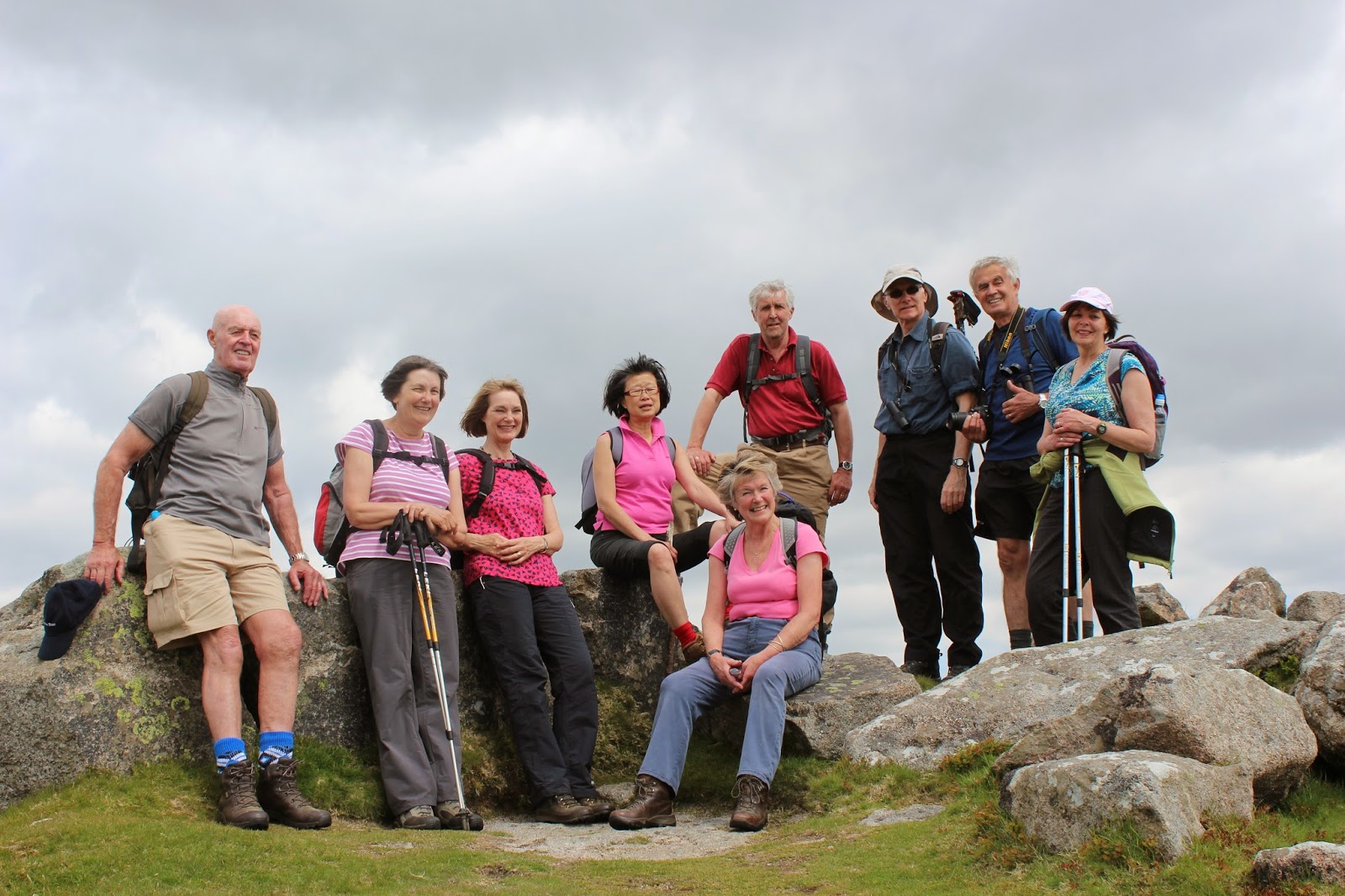
Our merry gang on top of Sharpitor. Oops, just noticed that DC's not there - and me, of course, as I was behind the camera.
Heading up over the granite boulder field to Leather Tor.
Those of us who climbed up to the top of Leather Tor (all three of us) were surprised at how narrow the ridge was. FW can be seen picking his way gingerly along the top.
A great view from the top, extending over Burrator Reservoir in the foreground and those with eagle-eyes will be able to pick out Plymouth Sound and the Breakwater in the distance.

Wednesday, 14 May 2014

Another day, another house and garden.....................

....But very disappointingly, despite a promise of one, no cream tea. However, the fruit cake was very nice. Very nice and very expensive. 

This afternoon we took advantage of the fact that Trematon Castle, near Saltash, had an open garden and guided tour. We've walked past it many times and, as it's rarely open to the public because it's a private residence, we jumped at the chance to visit. The castle has belonged to the Dukes of Cornwall since shortly after the Norman conquest, and is a perfect miniature Norman castle. John Betjeman wrote that it had “one of the most superb views of Cornwall, a Brunel stone viaduct crossing a foreground creek, the Lynher and Tamar estuaries beyond, and the wooded slopes of Anthony”.  Around 1806, a Georgian house was built in the grounds of the castle and it is there that the owners live. The present owners are a husband and wife team of landscape designers and gardeners and their expertise certainly showed in the many borders surrounding the house. We learnt that the Castle is up-for-sale: a snip at just under £900,000. The only problem is that the lease on the property only runs for another 19 years and then it reverts back to the Duchy. A rather feudal arrangement and, as far as I'm concerned, another reason to have a republic!
A view looking up at the central circular keep of the castle. It's a typical motte and bailey design: the motte being the artificial mound upon which it is built and the bailey is the surrounding land. There is good evidence that the castle was erected on the site of a Roman fort.
The Norman gatehouse to the castle. As intact an example as we've seen anywhere.
The gatehouse and part of the curtain wall as we ascended to the castle.
A view from the other side showing the crenulations of the curtain wall.
Inside the castle walls - their circular nature can just about be made out. They are almost completely intact. The space enclosed by the walls would, most probably have been covered by a wooden roof. The corbels taking the weight of this structure can be seen quite clearly just below the crenulations.
A fireplace in the upper floor of the gatehouse. This is where the Black Prince and Sir Francis Drake definitely stayed. Although it's not much to look at now, it is the first of its type in England in having decorative columns on each side of the opening. Before then, decorative features on domestic stonework was not seen. 
A view of the loo! Just imagine, this is where the Black Prince and Sir Francis Drake had a pee ....and more.
And this is the 1806 Georgian house built within the castle grounds. It was built by an admiral, who promptly demolished part of the curtain walls...............
...So that he could get a good view of the naval dockyard at Devonport just down the river. Trematon is in a good strategic position overlooking the navigable waters of the Lynher and Tamar and was probably the reason why the Romans built the original fortification on the site.
Just one of the many herbaceous borders put in by the present owners. Plenty of flowers at the moment and many more to come.
Just one of the many alliums in full bloom. Talking of alliums, the woodland areas were awash with wild garlic and the warm weather really raised its scent. At times, it was like walking through a garlic-smelling mist.
The relationship of the 'new' house with the castle.
 
The gatehouse with the curtain wall to the left. Running down the right hand side of the gatehouse can be seen the place where the demolished curtain wall was keyed in.

Tuesday, 13 May 2014

A pleasant afternoon at Coombe Trenchard

We were invited to be part of a group taking a tour of the house and gardens at Coombe Trenchard just over the border in Devon (Our location was confirmed when the scones of the cream tea came with the jam on top of the cream. The reverse order is the Cornish way). A delightful afternoon in the sun at a very interesting place.
At first glance the house may look Elizabethan but, in actual fact, it's a good example of the Edwardian Arts and Crafts style. It was completed in 1906 and was erected on the spot where a Georgian rectory once stood.
 
An impressive white wisteria was in full bloom at the back of the house.
There were lots of Arts and Crafts touches in the house, such as the wrought iron metal fitments to all of the windows.
And the fitments for the original gas lights. Acetylene was the gas used and this was generated from solid calcium carbide in an outside gas house. Smelly and highly combustible, the use of acetylene was a high risk activity.
 
The risk of using acetylene was recognised and an early sprinkler system had been installed. This used water from this water tower, now converted into bedrooms.
Just two of the very ornate chimney pots. At first glance reminiscent of those seen on Tudor buildings such as Hampton Court.
The gardens and woodlands associated with the house extend for about 100 acres - we did not walk them all. But we did explore an interesting mixture of formal borders and informal woods. Bluebells were coming to an end and wild garlic was taking their place under the trees.
 
I've always wanted a piece of modern sculpture in my garden. A Barbara Hepworth would be nice but way, way, out of my price range. I liked this one and it was a pleasure to feel the cool smoothness of its contours. The right sculpt in the right place and, if my pockets had been big enough, I could have been tempted to walk off with it.
 

Monday, 12 May 2014

Pigs 'Ere Blog Part 7: A little porcine husbandry

A very pleasant interlude in the late afternoon sun checking the pigs.  All looking as happy as pigs can be. Memo to self: lift leg higher when crossing the electric fence.
Eight pigs all present and correct.

Pigs eating pellets.

Pigs eating fruit and vegetables.

Pigs eating my feet.

Saturday, 10 May 2014

The trouble with history.....

The trouble with history is that it is infectious. Contagious. Bloody dangerous (this is not a descent into gratuitous swearing, history is often bloody and frequently dangerous). Like MRSA or Clostridium difficile you can catch history from almost anything. People you meet shed history like dandruff and history leaches out of old stone walls and blackened brickwork by some strange and powerful osmotic force. It will get us all eventually: history will have me and history will have you.

Only the other day I had occasion to visit someone in our church and I brushed against a large slate sarcophagus on my way in. I paused to take a photograph of the offending object, and in that brief moment I must have been infected. By the time I got home, sepsis had set in and I just had to download the photograph and set about transcribing the inscription.

"In memory of Mr Thomas Calvert, late of this parish who, in the year 1746, first introduced into this church four part psalmody and with indefatigable pains and perseverance not only encouraged but in a great measure supported it with great reputation upwards of 30 years. He was an honest man, a kind master, a sincere friend and a good Christian. He departed this life in Plymouth, June 3rd 1781 in the 71st year of his age".

The problem with an inscription like this is that there is enough intrigue in it to keep you blogging for ages. Who was Thomas Calvert? What was his role in the church? What was four part psalmody? What caused him such pain and needed perseverance? The questions become what the microbiologists call systemic. They take over your being and they dominate your life. Like an intellectual tsunami they wash away all other thoughts.

I have begun to gather answers: Thomas did not die in Plymouth but in St Germans; he married Honour Stacey in our church in 1745 and I have an inkling that I may be able to get hold of a copy of his will. But the fever that is history has a long way to go before it burns itself out. In the meantime my hair is unbrushed, my dog is unwashed, my fish are unfed and my next blog post is unwritten. That's what history does to you.

Thursday, 8 May 2014

Election? What election?

We have driven around 260 miles yesterday, crossing Cornwall, Devon, Somerset, Wiltshire, Hampshire, Sussex, Surrey and Kent. On our way we passed just four campaigning posters about the forthcoming EU election. Of these 3 were UKIP and 1 was from the Lib-Dems. Quite honestly, I was expecting to see a lot more and I'm sure that roadsides in past elections were festooned with exhortations to vote. If the political parties are not promoting their causes actively 'on the streets', is it any wonder that there is widespread voter apathy?

Monday, 5 May 2014

Pigs 'Ere Blog Part 6: Checking up

A spot of routine maintenance with the pigs today - before the rains set in for the evening. What a pleasant thing to do.
* Food? - tick
* Water? - tick
* Bedding clean? - tick
* Any coughs or diarrhoea? - tick

* Pigs happy? - tick
* Enclosure and fence secure? - tick

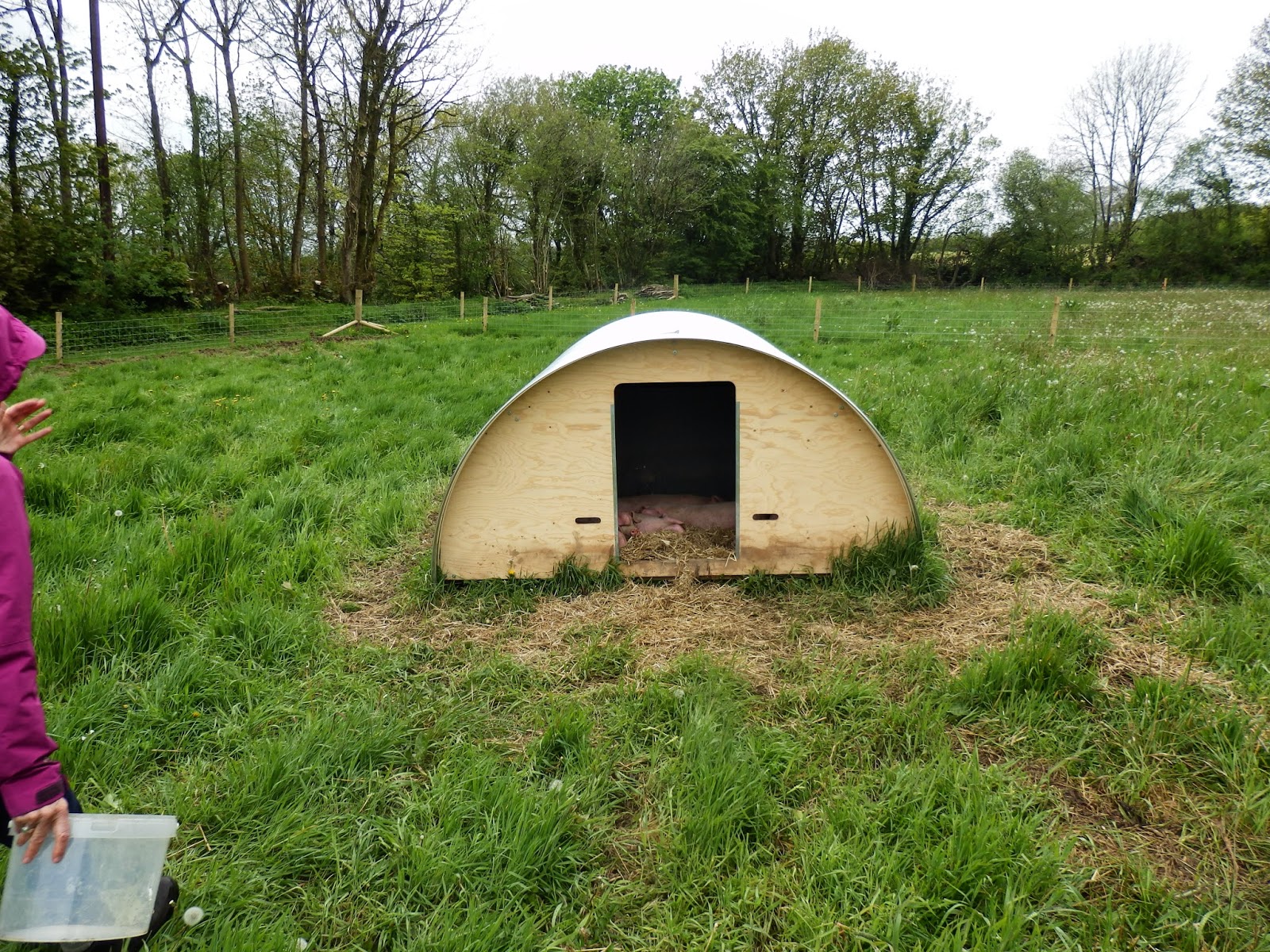
Eight little piggies in their ark having an afternoon snooze.

Someone building a relationship with her future Sunday lunch. Is this a good idea?

The pigs now get their food from an ad lib feeder. It means that they can feed when they like and mealtime squabbles are minimised. Their main food is pelleted but this is supplemented with waste vegetable scraps.

Another view of the feeding station.

A not-very-flattering view from the back.

I mentioned in another posting that the colloquial name for Navelwort is Pig's Bum. I also mentioned that I had never been close enough to the back end of a pig to make a meaningful comparison. Until now, that is..................

Not a bad likeness, eh? Click to enlarge and see if you agree.
All these musings on pigs' bums brought to mind a nonsense rhyme we used to chant when I was very young. It went like this:
Yum, yum, pigs bum
Wrap it up in chewing gum
We used to chant it when we 'dibbed' for who went first in whatever game we were going to play. A Google search turns up a few variants of this but not it exactly. I think it's time the grandchildren learnt how to 'dib' properly.


Sunday, 4 May 2014

Times are hard.................

Ever since I started this blog (on January 6th 2010 if you are asking) I have struggled to ensure that Musings from Higher Downgate and Elsewhere is brought to you free of the commercial distractions of the digital market place. I have turned my back on company sponsors, spurned the advances of product placers and refused to see any sense in Google Adsense. But times are hard here at the Higher Downgate Retirement Home for Confused Bloggers and I have been forced to introduce a series of commercial advertisements. If you enjoy this blog, please feel free to patronise the businesses and products which will feature off and on in the future. I will have tested them all and give them my personal endorsement. Mention my name when you order and a small fee will find its way into my meagre pension pot. Here's the first:


Friday, 2 May 2014

Hebridean Journal April 2014: Part 4 - Harris and Lewis

For our final full day we headed north and took the ferry from Berensay to Leverhulme on Harris/Lewis.  Ideal sailing conditions with a very calm sea and crystal clear weather - again.  A few photographs to give you a flavour of the day.  And that was it for the Outer Hebrides. Where do we go in 2015?
Why do seals always seem to come in pairs around here? They are of the Atlantic Grey variety.


The Hanging Tyres of Leverhulme. Not one of the wonders of the world but nonetheless some interesting verticals.

The Standing Stones of Callanish on Lewis. The main monument is amazing – a cross-shaped setting of stones, centred on a circle of tall stones. At its heart stands a solitary monolith 15 foot high. Lines of smaller stones radiate from the circle to east, west and south. From the north runs an avenue several hundred yards long, formed by two lines of stones that narrow as they approach the circle. And if that's not enough, there's a chambered tomb in the middle. But there's more: there are many other ritual sites lie within a couple of miles. These are mainly more modest rings of standing stones, or single monoliths. Collectively, they form a very impressive site.
The best evidence shows that the main circle was erected 4,500–5,000 years ago, the central chambered tomb a few generations after that, followed by the radiating avenues.  Why did our Stone-Age ancestors build Callanish? The current theory is that it served as a kind of astronomical observatory but, truth be told, no-one really knows. What is clear is that this area had a great significance to those who built the circles.

As well as the overall grandeur of the stones, each one merits closer inspection. Rather than being uniform, their surfaces are a mass of whorls, striations and crystalline inclusions. Apparently this is due to them being of Lewisian Gneiss. Gneiss one! You've guessed - I'm not a geologist. Oh dear, I just can't resist it - gneiss to see you, to see you gneiss.
Is this the only cave in the Hebrides that does not claim to be a hiding place of Bonnie Prince Charlie? I think the local tourist office is missing a trick.

Just down the road from the Callanish Stones was the Broch of Carloway. On Shetland last year we visited the best preserved broch on Mousa (see here) and this one was almost a cut-away version of that one. If they were side-by-side, one would complement the other very well. It's thought this broch is about half the age of the Standing Stones and it is well documented that it was occupied, as a dwelling, until around 1870.

A question we asked ourselves many times as we drove around the Islands.
For those unfamiliar with the history of the Western Isles, can you explain why there are so many derelict houses in the islands? 
There are several reasons, the principal of which would definitely be depopulation of the Outer Hebrides throughout the whole of the 20th century, primarily on account of the lack of economic opportunities. Young people would leave the isles for the mainland, either for work or further education. Many simply did not return. Fathers and mothers would pass on, leaving their crofts to a younger generation who had no desire to live the lives of relative hardship borne by their parents. There is also the topographical truth that many of these houses predate the existence of the road systems in the islands. The homes were originally built near the water’s edge since the main mode of transport would have been by boat. As the roads were built, many of the properties found themselves some distance away, making them unsuitable for the younger generations to stay in after being left the house by their parents. It was often easier, and sometimes more cost effective, to create a new build by the road on the same croft rather than update an older house and create new road access.

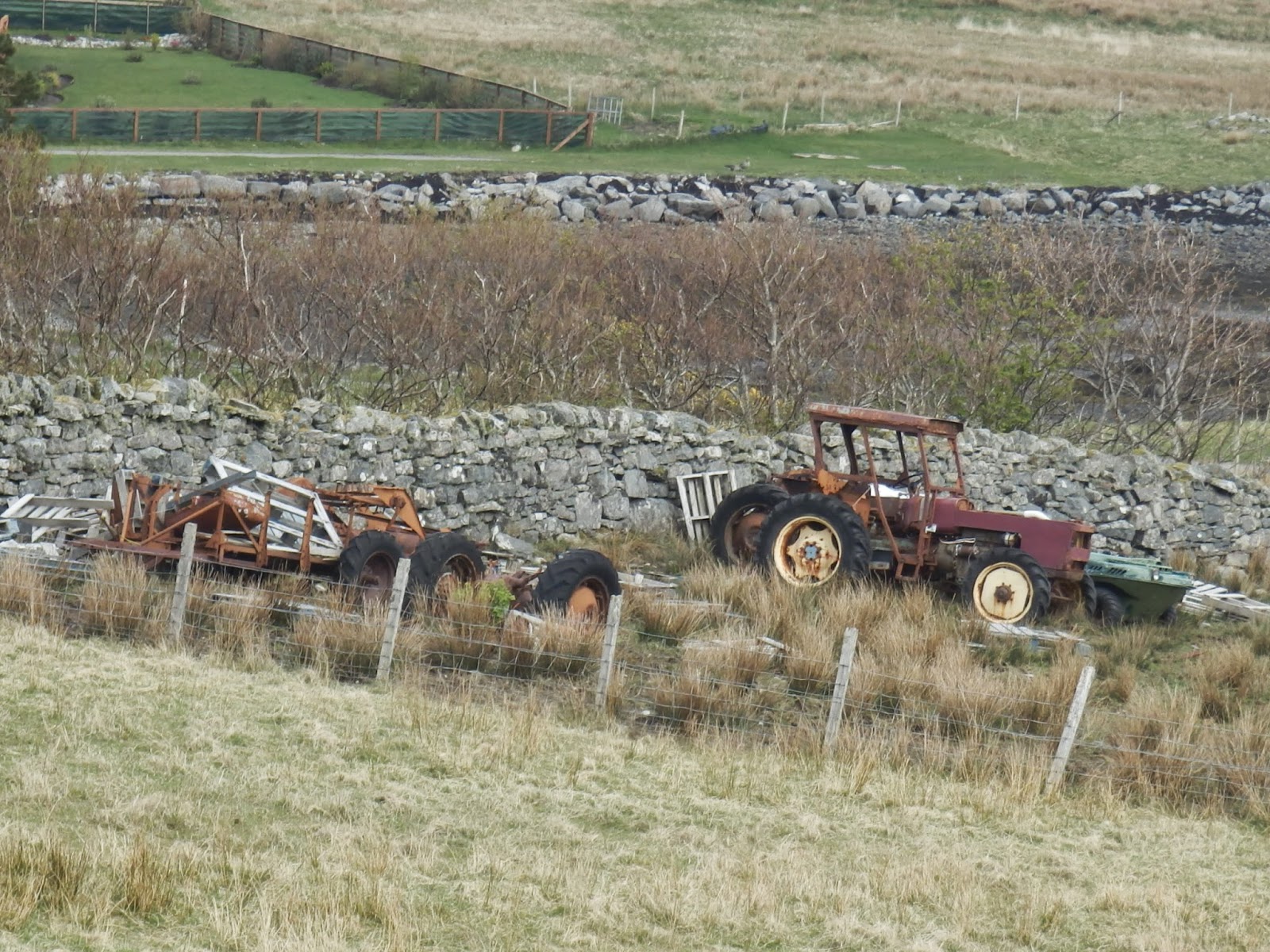
Another question we asked was "why is there so much rusty junk littering the place?". We didn't get an answer but think it's due to a combination of it not being easy to get rid of  and retention just in case some parts can be recycled. Whatever the reason, it doesn't look good in an area heavily dependent on tourism.

Although formally known as the Isle of Harris and the Isle of Lewis, neither are actually islands. They are contiguous land masses, separated in part by a rather insignificant stream. Come on, admit it, you didn't know that either.

Looking down the road in South Harris to the sea in the distance.

The terrain in Harris is rocky and mountainous whereas that in Lewis is more rolling and agricultural.

If you want beaches, make a beeline for Harris. Miles and miles of white sands - and usually completely deserted.
 
And we sail off into the setting sun on our last day in the Outer Hebrides. We will be back.