Wednesday, 1 July 2020

A walk on Southern Dartmoor

The weather is set fair, very fair, so it's off to Dartmoor for a socially-distanced walk with friends. And a good time was had by all.
It's not often that we walk on the southern edges of Dartmoor and this one started on the outskirts of Ivybridge at Stowford Bridge. No, not of the ancient clapper variety but just a bog standard over-a-railway model. Our route took us up onto the moor, skirting Western Beacon and Butterdon Common to take us to a point just past Hangershell Rock. As the elevation profile shows, for just under 4 miles it was a steady ascent but nothing too strenuous, even in the sunshine. From there we dropped down off the moor to Harford and followed the River Erme back to Ivybridge. At 8 miles, this walk was the longest we'd done for a while. 
Looking back down the track we were on some 10 minutes after starting. And so it continued for the next 4 miles.
Looking due west towards the 'alps' of the China Clay workings at Lee Moor. Kaolin has been worked on Dartmoor since the early 1800s. Although production is much lower than in the past, China Clay still plays an important role in the local economy. The streak on the left is the scar of the open-cast Drakelands tungsten mine (which closed in 2018) at Hemerdon.
About 1 mile into the walk, we came across this track, which we followed for another mile or so. It is the bed of the Redlake Tramway, a railway built to carry supplies and workers between Bittaford and the clay workings at Redlake, near the centre of the southern part of the moor. It was built in 1911 to a 3 ft (914 mm) narrow gauge, and ran for a circuitous 8.3 miles. Although it took materials to the workings, it never carried clay in the reverse direction. This actually came down by gravity in a large pipe and ended up being processed at Bittaford.
I rarely feature people in my posts but this is for someone I know will be looking out for this one. I will point out that I'm only in front because I've got the remote control for my camera. Allowing for the perspective, we were all suitably socially distanced, except for those in a 'bubble'. 
Keen eyes are required to make out the line of stones heading up Piles Hill. We didn't venture further to take a closer look at them but this extract from a Dartmoor gazetteer whets my appetite to revisit them: "Stone alignments or stone rows consist of upright stones set in a single line or two or more parallel lines, up to several hundred metres in length. They frequently lead to burial monuments such as small cairns, cists and barrows and are therefore thought to have had a ceremonial function. The 70 or so examples known on Dartmoor were probably constructed in the Late Neolithic period (around 2500 BC). The Butterdon Hill single stone alignment runs for over 2km along the ridge between Butterdon Hill and Piles Hill and is the second longest stone alignment on Dartmoor".
A rather attractive natural collection...………….
A far less attractive unnatural collection. Why, oh why, do people behave so abysmally? It really does p**s me off. A pox upon them and may they be visited by a plague of boils and get suppurating pustules. Serves 'em right.
At this time of year, damp places on the moor are generally bedecked with the seed heads of Cotton Grass, which is neither cotton nor a grass. It's a sedge. If you ever want to distinguish a sedge from a grass or a rush, remember that 'sedges have edges', referring to their triangular shaped stems. Seasoned walkers know that it's best to avoid areas where they are growing in profusion as they are likely to be boggy.And if you want to go a little further into it - grasses are round and rushes are hollow - the stems, that is.
Cotton Grass in its natural state. I don't think the black and white version does it any justice at all. A couple of Cotton Grass facts for you: historically the seed heads would have been used to stuff pillows instead of goose down and were used for wound dressings in the First World War.
What never ceases to amaze me is how you can be ambling along some deserted lane in the middle of deep Cornish or Devonian countryside when a church will spring up from nowhere. The beautiful church of St Petrock’s at Harford is one such church lying in a secluded spot several miles upstream from Ivybridge on the river Erme. Unfortunately, but not unexpectedly, the church was closed but we will return for a visit.
Closed the church might have been but the churchyard was still open for a wander around. This one caught my eye: Captain Michael Farr who was in the infamous German POW camp of Colditz. Mr Google tells us: "Michael (Micky) joined up and was taken prisoner early in the (1939-45) war. He was held in Colditz for virtually the whole war. Afterwards he returned to live with his mother at Whingreen in Ivybridge. I understand they ran a self-sufficient small holding. He stayed there after his mother died and eventually died there himself, unmarried and without children. It is thought that his incarceration in Colditz damaged him considerably. The house has since been pulled down and replaced". I find that very sad.
But here's a more amusing anecdote I came across: "Prisoner Michael Farr, whose family ran Hawker's Gin (the sole purveyors of Sloe gin with a Royal Warrant), managed to make a sparkling wine dubbed "Château Colditz". Some prisoners would get black teeth or even temporary blindness from consuming this beverage — a condition known as "jam-happy" — as it contained many impurities. Although the German guards despised the drunken prisoners, they generally turned a blind eye to the distilling".
This headstone was a rather unexpected finding. I was looking closely at the background of some of the photographs I'd taken of the graveyard and noticed this one. I can't find anything about it via Mr Google but I expect a revisit to the church will give something of its history. 'Died of the awful visitation of cholera'. It resonates with our present time. But Mr Google does have this to say about the 1832 outbreak: "Devon suffered from proximity to ports such as Plymouth and Bideford - places where sailors came ashore already infected with cholera. The railways too, brought people from badly-infected areas such as London and Liverpool. But the true cause was the primitive level of sanitary arrangements throughout the county. In 1832, Devon was second only to London in its casualty rate and the Exeter outbreak in that year was well-documented by Thomas Shapter. The port of Dartmouth suffered badly and deaths spread to other places in the South Hams; at the same time, there was a serious outbreak in Plymouth. Another serious outbreak occurred in 1839 but it was the lengthy outbreak between 1849 and 1852 right across the county which killed local people in thousands, not hundreds".
A verdant lane taking us down towards the river. A very green time of year.
And into the very welcome shade of the mixed deciduous woodlands that run down through the Erme valley.
The Erme itself. Quite quiet here but, if you look at the elevation profile in the route map, you can get a good idea of how much it drops on its way down. We had the occasional glimpses of wagtails and dippers.
The gradient of the Erme increases as it approaches Ivybridge and, in several places, cuts its way through a series of 'gorges' and rockpools. It was obviously a spot where the locals came for a dip. But not for me. Just imagine how cold that water was coming off the moor. The power of the water was used for centuries by the Stowford Mill a little way downstream from here. Nowadays the mill is closed and is being converted into apartments.

Tuesday, 30 June 2020

It's birthday time again

It's that time of year when my birthday looms large and Mrs P starts asking me what I want for a present. Usually my answer is "I don't want anything" but not this year. This year is different. I want a rock tumbler but not just any rock tumbler. I want a National Geographic Variable Speed Professional Rock Tumbler! It is designed to stimulate my curiosity, occupy my stagnant mind, fill the empty hours of lockdown and open my eyes to a world of beauty I had never known was there. Having finished painting the house and planted my way through a lifetime of vegetables, this new hobby - "a fascinating hobby for all the family" - is designed to keep me out of mischief and satiate my curiosity.
As is my custom, Mr Google and I have researched rock tumbling intensively, if not obsessively, and I've learnt a few things. If you are thinking of taking up rock tumbling as a way of coping with the trials and tribulations of modern living, there are a couple of things you need to be aware of before you embark on this enthralling hobby. First, it is by no means a fast-track to instant gratification. As soon as I looked closely at the details on the box, I got a warning of what might lie ahead. There are two dials on the piece of kit, one to adjust the speed and the other to adjust the time of the tumbling cycle. The latter dial deals only in days! Further investigation suggests that a normal cycle would be about five days tumbling with Grit #1, followed by 8 days with Grit #2 .... etc, so by the time all the various grades of grinding grit have been used, you are talking about weeks if not months of constant tumbling. That may not be a problem for everyone, but if, like me, you are advancing in years, you need to ask yourself whether you or the rocks will be ground down the first.

The second potential problem results from the grinding process itself. The rocks, along with the grit and the water, sit in a rubber sealed container which is constantly turning. And this is not going to be silent. It's going to make a considerable amount of noise and if I put it on my desk, as I had intended, it's going to vibrate. Ivy the Dog will hear the din and abandon our garden. Neighbours from up the street will gather - observing appropriate social distancing measures, we are, after all, a law abiding neighbourhood - and discuss the possible source of the noise coming from the bottom end of our lane. Birds will desert our garden, and cows in the fields further down the hill will lie down in the field in the middle of the day. The natural order of things will be disrupted and for what?

On second thoughts, Mrs P, cancel the Rock Tumbler. Get me a box of Allsorts instead. That would be safer.

Wednesday, 24 June 2020

Hello, grappling fans

Most of us respond positively to a challenge. I don't mean serious, grown-up challenges such as woodworm in your rafters or your wife running off with the milkman, but life-enhancing challenges such as climbing a mountain or collecting matchbox labels. For some people it is pedalling a bike backwards up a very steep hill, for others it is skiing blindfolded down a precipice or walking from Lands' End to John O'Groats; but for me the challenge has always been satisfying my curiosity. I find the unknown both fascinating and irritating. I need to know and the pursuit of knowing is a pleasure in itself, even if the topic is of zero interest to anyone else but me. And, let's be honest, some of the topics that grip me are pretty obscure. Here's a good example.

For some reason, as I was looking at a newspaper archive recently for mention of a family member, my attention was caught by a row of posters. The photograph may be of limited artistic interest, but what it lacks in creativity it more than makes up for its mystery. There are dates on the posters, but no years. And this is where curiosity (and a little spare time) kicks in. What was the year?
 
Dates themselves can be a useful tool in pinning down the exact year. The wrestling poster features a contest between Mick McManus* and Mick McMichael, which, in itself, isn't much use, as they seem to have fought each other on a weekly basis for more than a decade. But if they wrestled on a Wednesday 13th August it must have been either in 1963, 1969 or 1975. The first of those dates is just too early in the career of Mick McManus for him to have top-billing, the last is after the introduction of decimal currency, and therefore we are left with August 1969. Back in February 1971 the world changed, and that transition from 12/6 to 62.5p provides nerds like me with endless pleasure. We can be pretty certain that the photograph predates decimalisation and 1969 is the year in question. 

Validation of the date comes from the next poster. It shows that the qualifying round of the British Speedway Northern Riders Championship at the Halifax Stadium was on the 9th August. And that is the clincher: the detailed records held on the Official Website of British Speedway confirm that the event took place that night in Halifax in 1969 (Eric Boocock was the winner, by the by).

So, there we have it. A completely pointless exercise and now that it's settled, I'm ready for another challenge. How about rock tumbling?

* A footnote for those who have no idea who Mick McManus was. He was a big star of Saturday afternoon wrestling on ITV, a programme hosted by Kent Walton, whose catchphrase was "Hello, grappling fans". My dad loved the programme.

Friday, 19 June 2020

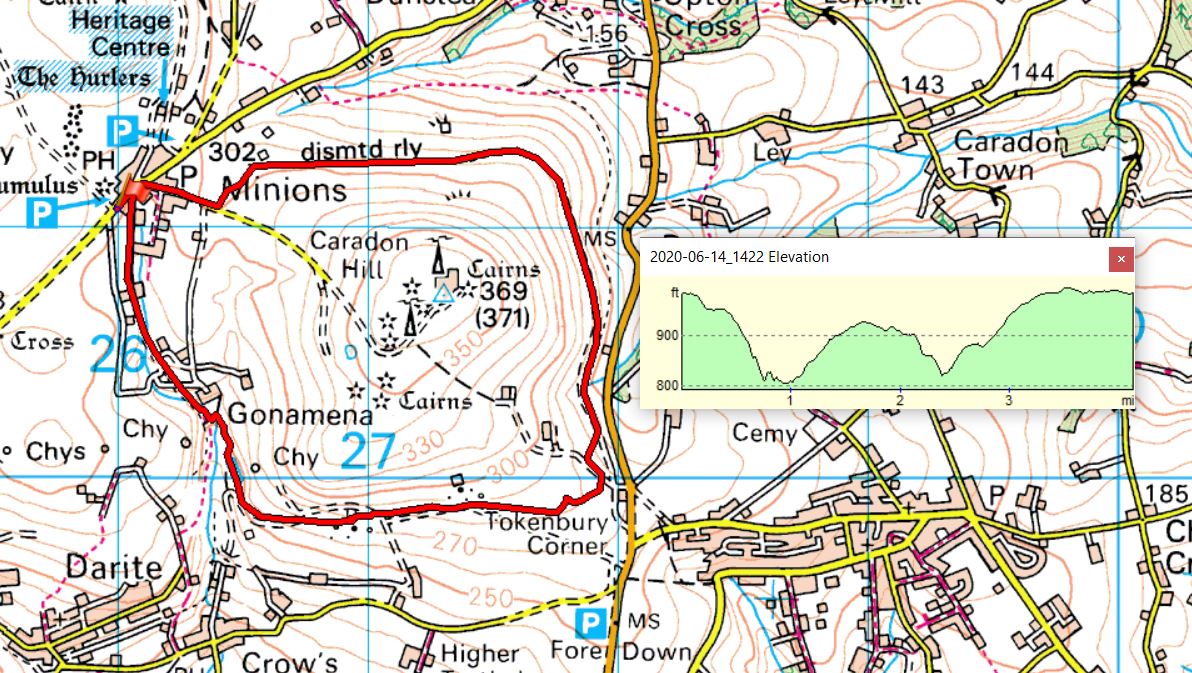
Gonomena, Caradon Hill and Minions

A walk we've done several times before but this time we did it in the reverse direction to normal - anticlockwise rather than clockwise. It's a route for lovers of industrial archaeology and wide ranging views.
We started and ended the walk in Minions, just on the edge of Bodmin moor. The 4 mile route took us down through  the Gonomena Valley and then around Caradon Hill following the old mineral railway track. A relatively easy walk, with lots to see on the way round.
We started off walking along the track of the Liskeard and Caradon Railway which was a mineral railway built to transport granite, copper and tin ore from around Minions to Looe Harbour. The journey from Moorswater to Looe was initially on the Liskeard and Looe Union Canal and later on the Liskeard and Looe Railway which was built alongside the canal. The railway opened in 1844 and was powered initially by gravity and horses. The full wagons ran downhill under gravity with brakes to control their speed. Each wagon was individually piloted by a brakesman. The empty wagons were then hauled uphill the next day by horses. It was later superseded by a steam railway which used an incline around the other side of Caradon Hill.
We have watched the decline of this old house over the years. It was originally associated with the mineral railway and has an impressive number of stables around the back. How much longer will the building survive?
Although each of these mines would have had individual names, latterly they were all subsumed into the South Caradon complex.  Copper and tin were the main ores they mined. All is quiet now and it's quite difficult to reconcile their present appearance with this contemporary description 'On Saturday nights after pay-day, the populous villages of Caradon Town, Pensilva, Minions and Crows Nest were crowded with men, and resembled in character the mining camps of Colorado and the Far West'.
Rarely do we come across a bull on our walks and when we do, we are appropriately cautious. Luckily this Belted Galloway bull was meekness itself and ambled away without paying us too much attention.
I'm not one for anthropomorphising animal expressions but this cow seems to be acting coy to me. Is there a touch of Princess Di in this look? Head held slightly to one side and with fluttering eyelashes?
The remains of Holman's engine house, part of the South Caradon mine complex. I am always aware that, in walking this part of the Caradon mines, we are walking in the footsteps of one of Mrs P's forebears, one of her great great uncles, John Henry Cook, eldest brother of her great grandmother, Ellen Lavinia Cook. Given his very humble origins, it was remarkable what John Henry Cook achieved.
John Henry Cook was born in Doddycross, just outside of Menheniot, in 1858. He started work aged nine in the old Wheal Mary Ann and Trelawny lead Mines. He moved to Pensilva and worked at South and East Caradon mines before he emigrated to Queensland. He moved on to Ballarat Diggings in Victoria and joined the Salvation Army where he eventually rose to rank of Sergeant.Major and Treasurer at Charters Towers. He then moved to the New England district working at the Dorrington Mine near Vegetable Creek before arriving at Cobar copperfields where he married Annie.They travelled to and stayed at Ravenswood for a few months before he became Captain of the New Queen Mine after arriving in Charters Towers finally becoming Manager there. When he became ill, he travelled back to UK to visit his aged mother who was then living in Newport, Wales, with her daughter. It was hoped the sea voyage would help him recover health but it was to no avail and he died Oct. 1910, soon after his arrival home in Charters Towers. His cause of death was given as 'miner's phthisis', a form of silicosis which he must have contracted whilst working down the mines, possibly from his earliest days in the lead mines at Menheniot.
Looking eastwards with the stack of Kit Hill clearly visible. We can see where we are standing now from our back garden.
Not 'Where's Wally?' but 'Spot the Church Tower'. There are two church towers in this panorama - St Melor at Linkinhorne and St Sampson at South Hill.
Walking up the mineral railway in an appropriate social distance. This track took the produce of the nearby mines and quarries down off the moor  and eventually to the port of Looe, about 20 miles away.
And this is where my natural pedantry kicks in...…..Given the proximity of the site of this house to the various industrial activities in Minions, I'd be very surprised if there hadn't been something happening there on September 5th 1782, most probably something to do with mining. I did not have the courage to approach the house-owners to ask them to correct their sign.
Same house, different sign. No quibbles from me on this one. It seems about right.
I've got no idea what the function of this was, neither can I anything about it from Mr Google. I'm assuming that it is something to do with the mineral railway which ran right next to it.
Lots of these Stonechats around. A resident that spends its time flitting from bush to bush.
This was the only Redstart that I saw. A summer migrant from April to September or thereabouts. 

Thursday, 11 June 2020

Another walk around the Parish

What? You are going out for a walk? Hooray! That means you won't be sitting on your chair staring up at us with your great big lens in your hand. Stalking and harassment, we call it. Give us a break and leave us alone why don't you.
 
A fine show of Michealmas Daisies on the verge of the churchyard path.
Dog Roses were in evidence in all the hedgerows we passed. And what's the difference between a Dog Rose and a Briar Rose (Sweet Eglantine)? The easiest way to distinguish them is the colour: the Briar Rose is generally pink. It also has a stronger scent.
How many ladies does it take to close a gate? Two apparently.
An anti-Covid grid. Trust a farmer to come up with a practical solution. It works as, as far as I know, Climson Farm is virus-free.
Shades of green in Rowden Lane.
Socially-distanced walkers heading back into Stoke Climsland.
Buzzard on high. There are definitely fewer of these birds around this year. There are suspicions, unsubstantiated, that they may be targeted by those looking after local pheasant shoots.
At first glance, I thought this was the cocoon of some butterfly but closer inspection shows it to be full of very small spiders. It's the 'nest' of a Nursery Web Spider, who spins the nest around its egg-sac.
And go for a walk, we did. Just over 5 miles, starting in Stoke Climsland and taking in a mixture of quiet lanes and farmland. We encountered no-one else and were passed by only 2 cars on the lanes.
For most of the walk, the church tower was visible. In the distance can be seen the eastern edges of Bodmin Moor. The largest hill on the right is Sharpitor and that to the left is Caradon Hill.
The hamlet of Lidwell. Stoke Climsland parish has several such hamlets, all associated with ancient wells. Lidwell is thought to be a derivation of Lady's Well.