Showing posts with label Croatia 2017. Show all posts

Thursday, 15 June 2017

Croatia June 2017: Part 6 - the last

My final post on Croatia and I thought I'd share my impressions on the country. On the basis of what we saw and experienced in Istria, the most northerly and westerly province, we'd give it 10/10. Friendly people, very pleasant countryside, interesting coastal and inland towns and quiet roads. The cuisine can be described in one word 'Italian', which is not surprising given the history of the country. Definitely a place to revisit.

For our last afternoon at our rental villa, I occupied myself by wandering around and about the immediate vicinity with my camera. I'll close with some of the shots I took.
A view across fields to our nearest town, Visnjan. It had a good bakery, an excellent restaurant, a cafe and a supermarket. What else could we need?
Here and there poppies added a splash of vivid colour to the verges. Quite eye-catching.
I'm not sure what thus plant is but it looks too big to be an ordinary dandelion. Is it an allium of some sort? I'll confess that a little post-editing on the camera has brought out the colours sharply.
One of my favourite insects - the Hummingbird Hawk Moth. I never tire of seeing them and never tire of trying to get the 'definitive' shot. I've not yet achieved that but I'll keep trying. They love lavender and in warmer climes that's the place to head for if you want to see one. I've only seen it once back home but it does appear to be seen regularly around and about our area.
In an earlier post (here) I showed the insect above and questioned what it was. Obviously not a Hummingbird Hawk Moth and it's actually a Bee Fly, a member of the insect family Bombyliidae. Their mimicry of bees gives them a measure of protection against predators that have learnt to avoid the sting of true bees. Things to look out for if you see one: typically large fly eyes, large straight proboscis for getting at nectar, odd angle to the legs and the transparent wings. They are parasitic on solitary bees and their larvae feed on the larvae and pupae of their prey.
Here's a day flying moth not often seen in the UK - the nine-spotted moth, although the exact number of the spots is variable. It doesn't breed in the UK and is a rare immigrant but it's quite common in Southern Europe and that's where I saw it. This one was about 3 cm long. Look closely and you can see the white tips to the antennae.
A Marbled White Butterfly. Common across Europe but restricted to the southern counties of England. Despite its appearance, the Marbled White is more closely related to the subfamily known as the 'browns' rather than the 'whites'.
The Spotted Fritillary is absent from Northern Europe but quite common in Southern regions. A very striking butterfly with very intricate patterning on its upper wings.
And that on the lower surface is just as intricate, with orange/yellow bands with spots.

Oooh, I thought, a little black insect. Nothing much to look at.
That is until it started flying and revealed its large striped abdomen. Thus far I have failed to identify what it is. Can anyone help?
A sight-seeing boat catching the light of the setting sun. What setting sun?
This setting sun. The gull was enjoying looking at it as well.
A metaphor for us saying 'goodbye' to Croatia and sailing off into the sunset to return home.

Monday, 12 June 2017

Croatia June 2017: Part 5

Another sunny day and off we went back to Rovinj. Nothing too strenuous, just a potter around the old streets, enjoying the sun and soaking up the ambience. With the weather the way it is back home at the moment, it's best to take the heat and dry when we can. We thought we might not experience it again for quite a while.
The church of St Euphemia dominates the view over the harbour/marina. A busy place and good for people watching. Was I the only person wearing long trousers and a shirt with 'proper' length sleeves? After all, there are sartorial standards to be maintained, even on holiday.
The clear blue Adriatic, shimmering in the sun.
I just liked the symmetry of this line of boats.
I had a double-take when I saw this. Donkey? A little probing shows that, whilst this is not a common dish, it is traditional and is usually a sort of ragu sauce of donkey mince. A dish with a kick? And, no, we didn't try it.
A good illustration of why pottering around the back streets of a town like Rovinj is so enjoyable. A treat for the eyes, and soul, at every turn. I feel sorry for those who can't take pleasure from doing the simple things in life and just live in the moment. 'Mindfulness' in modern parlance, I believe.
And at the next turn we come across this sunlight courtyard. A place to relax and practice mindfulness, perhaps? Or to just sit there enjoying 'being'. 
Yes, it's true, the statue of St Euphemia does move around with the wind. It was pointing in the opposite direction when we were here at the beginning of the week. Wouldn't it be fun to watch it whizz around in high winds? I wonder how fast it can go?
Perhaps he was wondering what to choose from the selection below?
Allsorts, just allsorts. Croatian allsorts look identical to British allsorts. Maybe they are from the UK and the manufacturer is panicking over losing sales when Brexit arrives? I bet Theresa May hasn't given this a thought.
Watersside buildings on the north side of Rovinj. Mr D and I pondered on the practicalities of having to paint the sides of one of these. I'm not sure we came up with a sensible suggestion. Very long ladders resting on the seabed probably wouldn't work.
A Pied Wagtail contemplating taking a dip in the sea. Or was it practising avian mindfulness?

Sunday, 11 June 2017

Croatia June 2017: Part 4

Another day in the sun and we headed south along the coast to Pula, reknowned for its Roman amphitheatre. And I finish up with a shot of a bee that I'm rather pleased- the shot not the bee, although it's a mighty fine Croatian bee.
Constructed between 27 and 64 AD, the amphitheatre (arena) in Pula is amongst the six largest surviving of its type. By all accounts, it is the best preserved ancient monument in Croatia. It is certainly impressive and, at this time of the year, had the added bonus of being busy but not oppressively so.
What you see now is the third amphitheatre to be built on the site. The first was made of timber, which was replaced by a small stone one, which was subsequently itself replaced by this one. It was built of local limestone, the original colour of which can be seen in the cleaned portion to the left - cleaned not renovated. When new, it must have been a dazzling sight and visible for miles around - a good way of telling the natives who was in command.
The sheer scale and intricacy of amphitheatres always amazes me. Plus the fact that they are built to a pretty standard design.. I routinely ponder on the logistics of building these structures. Someone must have estimated the required number of blocks, for example, and someone else would have ensured that they were supplied and delivered at the right time. I suppose the penalties for making a cock-up were pretty severe and were an incentive to get it right - first time. I wonder if there were Roman project managers who had the 'big' picture (picture maximus?) and controlled everything. There must have been.
There was little to see of what would have been the underground areas that housed the gladiators and animals. The amphitheatre remained in use until the 5th century, when emperor Honorius prohibited gladiatorial combats. It was not until 681 that all combats were forbidden and the amphitheatre ceased to be used. It then gradually fell into decline and stone plundered by the local population for their own pet building projects. One such was the bell tower of the local church shown above. The pilfering continued until an enlightened bishop in the thirteenth/fourteenth century put a stop to it. Hooray for him.
An abundance of amphorae. Why do they always have pointy bottoms? Actually, they don't as there were many different types and some of them are more conventionally shaped. Those with the pointy bottoms are 'transport amphorae'. Apparently this shape makes them easier to store in racks on boats and carts and the big handles are good for moving them. Also, the pointy end makes it easy to plonk them down in sand and earth.
The Temple of Augustus, probably built during the reign of the first Roman emperor, Augustus, which puts it between 2 BC and 14 AD. The best of its type outside of Rome, or so they say. And who am I to gainsay that?
The Triumphal Arch of the Sergii, built around 30BC, honouring the achievements of the Sergius family, a powerful dynasty of colonial officials. Once incorporated into the old city walls, it now lies sandwiched rather incongruously between two restaurants.
Apart from gulls, the bird we saw very commonly was the Jay. Of course we get them in the UK but, more often than not, I always seem to see them as they fly away from me. They really are more colourful than you might think from a rear view.
Let's go with the birds and bees theme and show this shot of a bee nectaring on some blossom on a tree in a courtyard in Pula. Sometimes, just sometimes, I'm rewarded for my patience (and persistence). I like the fact that the pollen sacs are really evident on this one.

Saturday, 10 June 2017

Croatia June 2017: Part 3

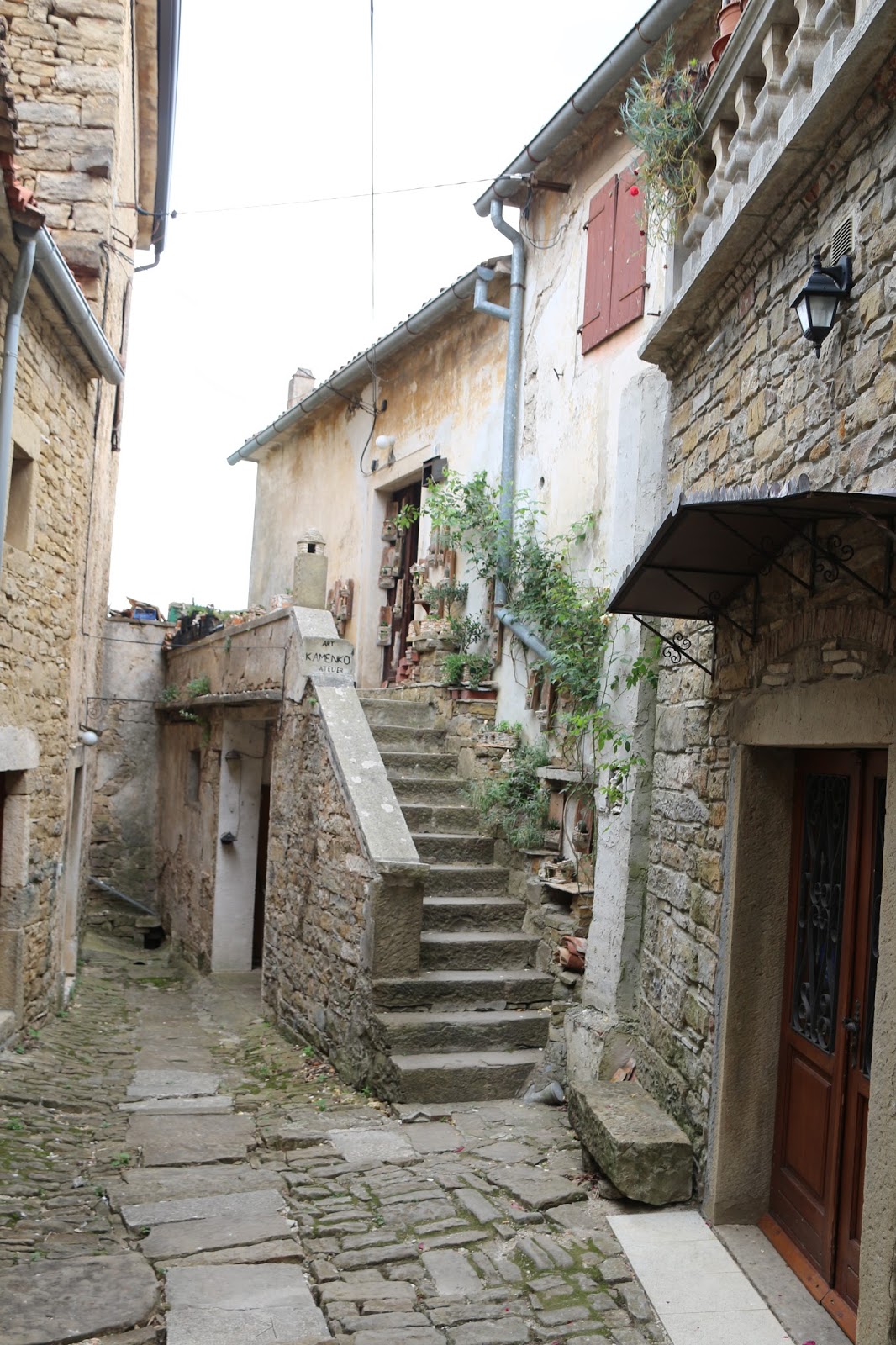
Out and about today for a trip to the hill town of Groznjan. Once a strategically important fortress town, over the centuries it suffered a decline in both its importance and population. However, in the 1960s its fortune was revived and the depopulation reversed when a group of artists began setting up studies in the abandoned buildings. Today there are many craft shops and galleries distributed throughout the disarming jumble of crooked cobbled lanes and leafy squares. A place for wandering around and just enjoying.
The old town gate.
Narrow lanes and stairs everywhere.
The view over the open countryside to the north of Groznjan, definitely not a touristy area.
A courtyard with the evidence of buildings from previous eras. Look closely and you can make out a few artistic additions.
A rather ornate door to a very narrow house.
It always pays to look down and up when walking around old towns. Look down and you'll see some very nice manhole covers, cast in a bronze like metal and engraved with the coat of arms of the region. Perhaps I ought to send this photograph to Jeremy Corbyn? He likes manhole covers by all accounts.
Look up and you'll see unusual objects such as this mask.
I don't know what this is and none of my field guides seem to be able to pin it down. At first glance, I thought it was a Hummingbird Hawk Moth but it obviously isn't. Looking at its head parts (where are the antennae?), I don't think it's a moth. Something to investigate when I get back home.
Another Common Blue Butterfly. I'll confess that getting good images of  butterflies is not easy.  They seldom seem to alight on anything for longer than a few milliseconds and I've got a camera memory card almost full of useless shots.

Thursday, 8 June 2017

Croatia June 2017: Part 2

Being tourists: a few photographs from Porec and a nearby attraction.
The Euphrasian Basilica in Porec is really an episcopal complex, including, apart from the basilica itself, a sacristy, a baptistery and the bell tower of the nearby archbishop's palace. Collectively it's a good example of early Byzantine architecture in this part of the Mediterranean and, because of this, it has World Heritage Site status. The photograph shows the 16th Century bell tower......
... that you can climb up via 200 steep steps to see the bells. Four bells to be exact. Four big bells.
Apart from the bells, you get a good view over the Old Town from up there as well. If I'd said this was in Italy, you've believe me, wouldn't you?
The basilica dates from the 6th Century and even then it was built partially on the site of  a Roman villa, the fine mosaics of which can still be seen. This is the tomb of Bishop Euphrasius, who commissioned the building of the basilica.

The most striking feature of the basilica are its mosaics, dating from the 6th century. These are just a few of them and they really are spectacular up close, especially when the sun hits them and they shimmer in the light.
Looking down the nave of the basilica with the two side aisles separated from it by a series of  marble columns.
A pleasant interlude was spent at the Caves of Baredine, just a few miles from our base. Fairly recently commercialised, they had not yet fallen foul of the trend to give the formations fanciful names that seem obvious only to those on drugs. I don't think I've ever been able to make out any shape that a guide elsewhere has pointed out. A horse's head? Nope. A mysterious figure? Nope.  These caves were about 300 feet deep: getting to the bottom was not a problem but getting back up came as a bit of a shock.
Looking to the 'ceiling' of the largest of the caves we passed through. The main colourant of the columns was iron so the shades were mainly browns and pinks. Actually I'll take back what I just said about not recognising shapes in the formations. Is it my imagination or, if you look very closely with eyes half closed, can you really make out a lot of stalactites hanging down? Isn't nature wonderful?

We've got some 'human fish' for you to see, said the guide. I think we were all a little disappointed to discover that this is the local name given to the cave dwelling salamander, the Olm. It eats, sleeps and breeds entirely underground and in complete darkness. Hence no eyes and no pigmentation in its skin. And this is why they are called 'human fish', being white like Caucasians. If you look carefully, you can make out the pink external gills, larval in origin but retained in the adults.
Not sure that I'd call this an 'underground lake'. Underground pond, yes, but lake? Nevertheless, some very attractive reflections.
A drop of water falling from a stalactite and bouncing off a stalagmite. I wonder how long it had taken to filter down from the earth to reach this point?
We know someone back in Cornwall who might like this number plate.