Showing posts with label Trethomas. Show all posts

Thursday, 30 May 2019

Some of my yesterdays

This is where it all happened - although it wasn't quite as built up when I was doing my thing. Red dots and circles indicate some of the places mentioned.
Having had a far longer past than I will a future (sad but true), it's inevitable that, every now and again, I'll reflect on the seven plus decades I've got behind me. For the most part, the reminiscences of my childhood are still vivid. Like most of us of a certain age, I can probably recollect with far more accuracy that which happened in my early days than the events of more recent times. At least, I think the clarity is still there - or is there a touch of self-delusion? Who can possibly know? But I do not view yesteryear through rose-tinted spectacles: there is nostalgia, of course, but no sentimentality. It was the way it was and that's how we accepted it.

In two previous posts, I've touched on various part-time jobs I had in my youth (here and here) and, just to test my memory, I thought I'd try and jot down all those jobs I could remember. I've surprised myself at the list and it's been fun revisiting the people and places involved. I consider myself extremely lucky to have had all those experiences: I wouldn't have missed a minute of them. Here they are:

Football Argus Paper round The very first Saturday job I can remember was delivering a few Football Argus's in the late afternoon around the streets and pubs of Bedwas. I was 8 or 9 at the time and did get a few 'coppers for sweets'. I'm not sure how long this lasted but, at this distance, I'd guess for the length of the football season. 

Butchers' Boy: Off and on for a couple of years before I left Bedwas Junior Mixed, I had a Saturday job at Morgan's the Butcher in Church Street. As well as taking orders out on an old-fashioned shop bike with a basket, I helped make sausages, faggots and black puddings (getting blood for which in a bucket from the slaughterhouse behind Lewis's). And sweeping up the sawdust from the floor and cleaning down the counters.

Delivery boy/packer: During the summer of 1959, just before I went to Bassaleg Grammar School, I had a job at the Home and Colonial Store in Caerphilly. My Aunty Phyll got me the job and it was a mixture of bike deliveries and helping with packing various goods (dried peas, currants, raisins etc) from tubs into smaller packets. Pushing a heavily laden delivery bike up the Mountain Road in Caerphilly was not an easy thing to do and I can still remember feeling affronted that one customer did not even say "thank you" after I'd obviously struggled up the hill with her groceries. One day I'll tell about the Pea Magnet Saga and the Great Penrheol Delivery Boy Kidnap Incident. I still bear the mental scars from both.
Exactly the type of bike I used for deliveries. No gears, brakes only on the front wheel and a less-than-comfortable leather saddle. And let's not forget the wicker basket at the front.
Various jobs on farms: Like most of my contemporaries, I don't remember ever getting regular pocket money from my parents and, if we wanted some cash, we had to earn it. Hence we offered our services to whoever needed a (cheap) pair of hands. In reality, this meant one of the many small farms around Bedwas and Rudry. We'd do anything if there was a few coppers at the end of it and we laboured in the fields picking vegetables (my worst ever experience was picking potatoes in the cold and wet on Ty Sign Farm), helping with animals, milking, harvesting apples, hay making, picking stones from the fields - anything at all and in all weathers. 

Milk round with Mr Lewis: I've dealt with my time on the milk round with Mr Lewis at length previously (here) and, if you are interested, I will refer you to that post.

Milk round with John Davies: When Mr Lewis sold his round, due to ill-health, it was taken over by David Davies (Dai Dai the Milk) and I briefly worked with him. But I soon moved on to help his son, John, on his round that took in Rudry, Draethen, Lower Machen and Machen proper. I really enjoyed this time as the route was very rural and took us around some fantastic countryside. Sitting on the back of a van in the fresh air and racing around the lanes - what's not to like?  It was during our Sunday break for breakfast that I first encountered the Archers and poached eggs with HP sauce! I still like them both.

Sunday paper round: I did this for about three years when I was in the Sixth Form. It involved an early start (6am, sometimes a killer after a raucous Saturday night out in the pubs and at the Palais in Caerphilly. Confession time: I was an underage drinker, as were all of my 'gang'), picking up a trolley load of papers from Mr Jones' Paper Shop in Bedwas and then delivering them around some streets in Trethomas. I can still remember the route: Pant Glas View, Central Buildings, Bryn-y-Fran Avenue, Birch Grove, Elm Grove, Ash Grove and Hazel Grove. When I 'retired',  my brother and my elder sister inherited the round: the nearest we've ever got to having a family business.

Working on a farm at Cefn Mably: This was a mixed arable/dairy farm called Cefn-llywd, owned by George Huish and run by his son, Roger. I was there for a full summer holiday and some weekends. I enjoyed it as the work was varied - milking the dairy herd of friesans, tending to sheep and pigs, hedging, tractor driving, hay making etc. However, what I didn't like was the fact that it was 10 miles from home and involved negotiating many hills on an antiquated push-bike with only three gears. On the positive side, I can still remember the taste of the wild strawberries I used to pick as I pushed my bike up a hill near the Maenllwyd Inn in Rudry.

Working at the British Legion, Trethomas: For a year or two, around 1964/1965, I worked behind the bar at the British Legion in Trethomas when George and Alma were the stewards. Almost invariably, my good friend, Malcolm from Rhiwderin (who never did get the hang of playing Bingo), was on the same shift so it was never dull. It was the days of pounds, shillings and pence and I was very adept at adding up orders for multiple drinks. I'm not sure I could do that now. Certainly not at the British Legion as it's been demolished for quite a while.

Working on the Bedwas and Machen Urban District Council: When university students living in Bedwas or Trethomas were looking for jobs during the summer holidays, there were a few 'usual' places that took us on. One of these was the 'council' - the now defunct Bedwas and Machen Urban District Council. I spent the summer of 1966 working for them and got to grips with the full panoply of services offered by the council. Some of the things I got involved with were grave digging, laying kerbstones and paving slabs, collecting rubbish, repairing drains, replacing broken window panes, cleaning buses and acting as a labourer for a stone mason. The latter was an old communist called Dick Jones who was a fascinating character. He was part of the Socialist contingent that fought in the Spanish Civil War against Franco and had spend many years in the 1930's travelling around the USA. I really enjoyed both hearing about his exploits and helping him build a bus shelter in Machen, that is still standing after 52 years. I always metaphorically salute Dick every time I pass it.
The old offices of Bedwas and Machen Urban District Council. The yard I worked from was to the right. The JP's courtroom was on the left and that was the scene of the infamous 'Air Gun Trial', where several youthful miscreants were subjected to a mock trial by the then JP, Kenwyn Lewis. But that's a story for another day - possibly, maybe.
Working on the Xmas Post: Another of the 'usual' places for hiring students was the Post Office over the Xmas period, dealing with the 'Xmas rush' of cards. I started doing this in 1966 and continued through 1967 and 1968. We were there for about a week each session. The days started with sorting out the mail into rounds and then going out delivering around Bedwas and Trethomas. For a couple of years, I was assigned what was known as the 'Mountain round' which involved delivering mail to all the farms and houses on Bedwas mountain. It was quite an onerous task, walking, perhaps, 5 - 6 miles with a heavy postbag, sometimes on lanes, sometimes on tracks and sometimes on shortcuts across fields. But it was money and it helped offset the overdraft I had accrued during the previous term. A happy time with a great bunch of regular postmen, all uniformly sarcastic and cynical! 

BOCM, Bassaleg: I'd almost forgotten this one. Labouring at British Oil and Cake Mills near Bassaleg railway station. I was only there filling in for a few weeks and the work entailed watching over milling, rolling and pelleting machines and a bag filler. Nothing too onerous and I can still recall the noise and the dust. The pay was rubbish.

Working up the Plant: Or to give it its formal name British Benzol and Coal Distillation Co. Ltd. At one time, this was THE place for students to work in the summer holidays. The Plant comprised of a series of coking ovens and an associated 'by-products' complex that recovered various chemicals from the gases produced in forming the coke. It was shift work and students helped out wherever a pair of hands was needed. I worked there for two summers (1967 and 1968) and, on one shift or another, was involved in most of the areas. Sometimes I worked on the ovens where the coal was burnt to form the coke. Sometimes I worked over on the by-products, mainly doing quality control checks on some of the processes and bagging chemicals as they were formed. Sometimes I worked hosing red hot coke down with water. Sometimes I worked on routine maintenance - greasing conveyor belts and clearing up spillages. A bit of everything really. I enjoyed working on the ovens more than anything else as it was quite exciting and moderately dangerous, with so much hot coke around. Every now and again, I'd work a 'doubler' - two shifts back to back. In theory, this meant a 16 hour working day but, in practice, the foreman allowed you to slope off early on the second shift. The money was good and I can remember the thrill of getting £20 in my pay packet when I had done a doubler. And it was in a pay packet - a brown envelope that we picked up at the cashiers' office on a Friday lunchtime. It was a great place to work and, someday, I might elaborate on some of the things that happened on some of the shifts.

A couple of photographs taken with my old Zenith E SLR camera and processed by me. The shady figure is me on the top of the ovens when crushed coal was being poured into the open oven from the mobile hoppers. The brush was used to make certain that it all went in. The flames were an occupational hazard.
All the coal is now in the oven and the lids are being pushed back on. It was hot work and we had to wear wooden clogs as ordinary boots tended to melt in the heat! On more than one occasion the bottom of my trousers caught fire - another occupational hazard. Training? Minimal. Health and Safety? Almost non-existent.
Working at the Alcan, Rogerstone: Alcan Industries were based in a large works along the banks of the Ebbw River in Rogerstone and produced aluminium sheets etc from ingots. I worked there for the summer of 1969. Shift work again and students were employed to fill in wherever needed during staff holidays. I remember that, at the students' induction day, we were told not to be 'political' with the regular workers. I got involved in a wide variety of tasks - stretching aluminium sheets on a large machine, 'helping' fitters and turners with lathe work, carrying tools for mechanics as they repaired machines, working with a thermal lance to unblock the doors on the remelt furnaces etc. It was in the days when long hair for men was still a novelty and I have a vivid memory of running the gauntlet of ribald women on a packing line. Men do not have the monopoly on crude remarks or suggestive gestures! I blush as I recall what they shouted at me! It scarred me for life.

Working in the Family Loaf bakery: This was, in fact, the last temporary job I had as an undergraduate student, as after it I moved into the heady world of being a post-graduate. The bakery was on the Wern Estate in Rogerstone and involved working night shifts during September 1969. Forget the artisan baker, this was bread making on an industrial scale using the much-derided Chorleywood Process. I sweated between the proving and baking ovens, knocked cooked loaves out of their tins and operated a slicing machine. It was hot work but well paid. On some shifts, 'proper' bakers made us fruit loaves and other fancies to take home - all 'under the counter', of course, but ignored by the management. A perk of the job.

All these jobs helped me to develop skills that didn’t get taught in school, such as how to fake a smile (useful) or get on with someone difficult (a vital life skill). I learnt about the tedium of menial work and the ghastliness of some people, but also the value of physical labour and the camaraderie of work. I met some amazing people and learnt that wisdom and intelligence were not the preserve of the formally educated. Away from the critical gaze of my family, I got a taste of independence, responsibility and a sense of self-worth that I hadn’t known before. And along the way, I picked up a range of skills that have stood me in good stead over the years. I learnt that a bit of graft and getting your hands dirty won't kill you and how to just get on with it without complaining. Life lessons that I'll always remember with fondness and not just a little pride: I did all that and survived.

Tuesday, 4 August 2015

RIP Red Ray

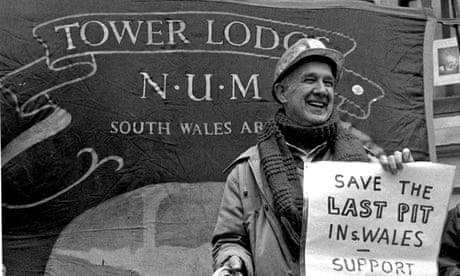
I don't think I've ever seen Trethomas mentioned in the Guardian before today and, as a sad bonus, it came with the name of someone I knew: "Red" Ray Davies. Ray was a member of our local Labour party back in the sixties and, over what were probably my politically formative years, we met at various meetings at the Workman's Hall. They were educational and interesting times. The following obituary by Ray's wife, Wendy, gives the essence of the man. I'm not sure there are that many like him still around and, apart from Jeremy Corbyn, certainly few like him in the upper echelons of the Labour Party now. More's the pity, say I.
'Red' Ray Davies taking part in a protest against the closure of Tower colliery
 
My husband, “Red” Ray Davies, who has died aged 85, was a Caerphilly county councillor and tireless peace activist whose energy and passion for justice were unabated to the end.
Ray was born during the depression in the Welsh mining village of Llanbradach to George Davies, a collier, who was blacklisted for his union activities, and his wife Winifred (nee Bate). Ray experienced hunger and disease during his childhood, including TB and diphtheria. The fire in his belly was ignited by the loss of his mother, who died in childbirth, for lack of a hospital bed or a blood transfusion.
He went to work as a boy miner in 1943, witnessed death at first hand underground, and organised a strike of boy miners after he saw Bevin boys recruited for the war effort receive hard helmets and boots while he had to wear a soft cap and his uncle’s cast-off shoes. After leaving Llanbradach pit at 18 and completing his national service in 1948 in Trieste, he became a labourer and eventually a refractory engineer at Llanwern steelworks in Newport, before being made redundant in 1988.
Ray got his Labour party card in 1958, and although he was often at loggerheads with the leadership, his loyalty to its founding socialist principles never wavered. He won his first local election in 1965, and went on to serve for more than 50 years as a strong advocate on the county borough council for people in the towns of Bedwas, Trethomas and Machen, living his entire life in the area.
Appointed as a magistrate in 1969 in Llanwern, he was relieved of that role after his arrest during the 1980 steelworkers strike for lying down in front of lorries crossing picket lines at the Alpha Steel plant in Newport. Lord Hailsham, then lord chancellor, asked Ray to undertake that he would not go on future demonstrations. Ray refused and a week later his name was struck off the magistrates list. He was also arrested a number of times during the 1984-85 miners’ strike, and served three prison sentences for refusing to pay the poll tax.
Elsewhere, he threw his heart into campaigning for the Palestinian right to self-determination. In Palestine in 2003 he was shot in the head at Balata refugee camp after being caught in crossfire between the Israeli army and Palestinians while escorting ambulances to hospital. At 79 he was knocked unconscious by police during a march in London called to protest against the bombing of Gaza – and received damages.
For more than 60 years he was opposed to nuclear weapons, and in 1991 became vice chair of CND Cymru. He cut the fence at Aldermaston; he broke into Faslane nuclear submarine base, and, aged 85, led the singing at dawn at the blockade of Burghfield atomic weapons establishment in Berkshire.
Ray’s son Mark predeceased him. He is survived by me and our sons Tad and Carwyn; and by his children David, Stephen and Rachael from his first marriage, to Audrey Thomas, which ended in divorce.
Wendy Lewis
The Guardian 4th August 2015


Tuesday, 21 July 2015

A trip down Memory Road

One old image: so many memories. Here's a photograph that came my way recently of Newport Road, Trethomas, dated 1960. That's my home village and the photograph shows the main row of shops always referred to as 'down the road'. It really was 'down the road' as we lived a couple of hundred yards 'up the road'. Thinking about the shops and what they sold is going back into another era and a time completely alien even to our children. If you have the inclination, come with me on a shopping expedition 'down the road' to the shops in Trethomas. I'm sure all those of a certain age would be able to so something similar.
 
1. Davies the Meirig (more formally E.C.Davies Ltd): where we bought a lot of our groceries. What do I remember? Cheese cut from a large round with a wire, butter from a large yellow cube and patted into shape, bacon sliced to the thickness of your choice directly from the side on a hand operated slicer, ham carved off the bone and biscuits picked from large tins - with a separate one for the broken remnants. There were lots of dry goods and things in tins but nothing frozen. And not a plastic bag or shrink wrap in sight. Eco-friendly shopping at its best. 
 
2. Bulgen's: for vegetables and fish. Can't remember that much about them other than the fact that they sold, mmm, vegetables and fish.
 
3. Luis' Cafe: it seemed as if every Welsh Valley village had its own Italian cafe. Many had Bernis, some Servinis: we had Luis Rabiotti. Luis came over from Northern Italy before WWII, had married a local girl and spoke with an interesting Welsh/Italian accent. His cafe was the place to get frothy coffee, hot blackcurrant squash and steamed meat pies. Steamed meat pies? In the absence of an electric heating oven, a meat pie (Thomas of Merthyr Tydfil - accept no alternatives) was put into a paper bag which was then pierced with a nozzle of the coffee machine and given a blast of steam. The result was a watery hot pie with very soggy pastry but a great taste. Before I'd really figured out what was happening, for years I thought the process actually involved injecting the pies with hot gravy - which tells you something about their meat content and how dumb I was.
 
4. Morgan's the Butcher: the only 'out-of-town' branch of Lewis the Butcher from Bedwas (not to be confused with Morgan the Butcher of the same place). Run by Mervyn Morgan (who was a different Morgan the Butcher than the Morgan the Butcher from Bedwas), it mostly supplied meat raised on the farm of the eponymous owner and that of his brother, Lewis the Milk. Food miles? About two! Sausages, faggots, black pudding etc were all made either on the premises or up the road in Bedwas. Mervyn and Luis were great friends and had worked next to each other for many years. As I got older and got to know them better through a weekend job I had with Lewis the Milk (yes, I was known as Deri the Milk for four or five years but I don't put that on my CV. I was also known as Deadly Deri to some of my early friends, but that's another, not particularly edifying, story.), they recounted their adventures during WWII when Luis was briefly interned as an alien and then released to join the local Home Guard. Thank goodness, Hitler never invaded Trethomas as I don't think Luis, Mervyn and their colleagues would have been a match for the Third Reich. Or perhaps I'm doing them a disservice? "Here, take this Thomas of Merthyr gravy pie in the face, Fritz". "And see how you like the feel of a well-aimed faggot, Helmut". "Gott in himmel: ze trackz of mein panzer ist clogged mitt ze string of Welsh sausages". "Donner und blitzen, attacked mit low flying schwartz puddings"....and on and on and on........
 
5. Wolfson's drapery and haberdashery: Mr Wolfson's stock was never ever going to rival Carnaby Street for its up-to-date fashions but it did supply a whole range of 'sensible' items for the working man and his family. I remember buying some Welsh flannel shirts there (collarless, made of thick itchy wool but very hippyish), a supply of collar stiffeners for my school shirts and, on the morning of my wedding, a white shirt to go with my suit (it's a long story but my original choice got the thumbs down from everyone who saw it).
 
6: Worthington's the ironmonger: Glynn Worthington supplied all sorts of nails, screws, wood, paint, spades, shovels etc. Nothing pre-packaged and you could buy exactly the number you required for any particular job - our Trewortha's in nearby Callington reminds me a lot of Worthington's. You could also get paraffin for those heaters that everyone seemed to have around that time: Worthington's sold Esso Blue. Does anyone else remember the Blee Dooler ad?

7. The telephone box: ah, the telephone box. Worthy of a Blue Plaque. This featured prominently in the early days of my courtship of Miss L, later Mrs P. We didn't have a 'phone at home, like the majority of the people in the village, and this was my hotline to the younger daughter of the posh family living in the distant land of Risca. I spent a lot - and I do mean a lot - of time down there and often had to run the gauntlet of good humoured but risqué comments from Luis and Mervyn. I became very adept at dialling Risca 227 for free (and illegally. So arrest me!) using a trick passed down to me by older boys and which could only be done on the old-fashioned analogue contact equipment.

L.P Hartley wrote, in The Go Between, that "the past is a foreign country, they do things differently there". It certainly seems that way but I'm ever so glad that I had the right passport. As I've said before "you can take the boy out of the valleys but you can't take the valleys out of the boy". Happy days.

Wednesday, 27 March 2013

Those boots were made for........spooking.


An earlier post where I mentioned an unexplained encounter at Caerphilly Castle brought to mind the only other similar happening I've had.  We'll call this one 'The Dark Arch Incident'.

Let's set the scene.  When I was growing up the local pit or coal mine (Bedwas Navigation Colliery to give it its full title) was an even bigger playground for us than Caerphilly Castle.  It loomed large over the village and provided employment for most of the men.  We roamed around it and in it as freely as we could get away with and there were few parts of the pit that we weren't familiar with.  The pit buildings were on the mountainside and were separated from the village (and the now contiguous neighbouring village of Trethomas) by the railway line (down to Newport and up to Merthyr Tydfil).  Easy access to the pit  for many of the miners was provided by a narrow tunnel - the Dark Arch - under the railway.  The Dark Arch was around 100 yards long and had a kink in its length so that you could not see all the way through.  It was dank, smelly and, at best, very poorly lit.  For young children it was a rather frightening place.  So much so that, more often than not, we would wait for some miners to go through and then tag along behind them rather than risking it by ourselves.

The infamous Dark Arch. The hut to the left was a relic of the strikes for union recognition in the 30s.  A classic workers vs bosses conflict which the workers won.  Power to the People!

However, when we were feeling brave we used to play a game of dare: who had the nerve to go through the Dark Arch by themselves?  How old were we when we did this?  In my mind, we were a few years younger than 11, certainly before I moved the great distance of a mile to live in Trethomas rather than Bedwas (that would be 1959).  Back to the game: this involved a few of us at each end at the start and the bravest setting off into the Stygian gloom alone.  We did this many times without anything of note happening but one particular time something did.  We were all set up with maybe 3 or 4 of us congregated at each of the two entrances.  All of a sudden, the group I was with heard the sound of hob-nailed boots clattering over the cobbles of the tunnel.  It sounded as if a miner was walking through. This went on for a while and we waited for someone to emerge before we started our game. But the clattering faded away and no-one came out.  We thought that the walker had stopped out of sight so we waited ... and waited and waited .. for them to come out. Nobody did and, after a while, we went in en masse to see what was happening. No-one was there and we met the other group of us coming down doing the same thing.  All of us had heard the sound and, as no-one had gone passed us, we were all convinced that someone had been walking in the tunnel towards the end that we were standing at.  I know what I heard and, again, I have no explanation for it.  Of course, at the time we attributed it to the Dark Arch being haunted, not that I was ever aware of any such myths being associated with it, then or since.  One consequence of this event was that we never played the game again and we made sure that we always went through the Dark Arch with at least one friend or tagged onto an adult.  Another consequence was that, even as an adult, I never felt easy going through the tunnel.  As a student, I spent a few summers working at the coking plant next to the pit and, although the route through the Dark Arch was the shortest, I invariably took the longer path that avoided it.  Daft, eh?  Even dafter is the observation that the hairs at the back of my neck were standing on end as I just recalled the sound of the ghostly hob-nailed boots advancing towards me - over the decades..........


Friday, 29 June 2012

Where my fascination for ovens began?

All this recent talk about baking and ovens brought earlier experiences with 'proper' ovens to mind. I had an inkling that I had some old photographs somewhere and, much to my surprise, I came across them almost as soon as I started looking. They were taken with my first SLR camera sometime in the summer months of '66, '67 or '68, when I had a holiday job as a general dogsbody at a coke/coal-gas producing plant in my home village of Trethomas. Indulge my nostalgia whilst I elaborate.

The operation of the plant is, at its most basic, quite simple. Coal is burnt in large ovens to produce coke (sent to smelters at various steel works), the gas is washed free of contaminants (processed to make a host of coal-tar related products) and then piped to Newport for use. Or that's the way it was: the plant has been long closed - a casualty of the closure of the South Wales coal field (and I still bear a strong grudge against Thatcher for her part in this).

Students were employed in the summer months to cover shift holidays and it was a much sort after job as the wages were very good for the area (a 60 hour week could bring in a magnificent £19!). There was also considerable kudos attached to working in such an industrial environment - it was seen as a man's job and a definate step up from lazing around as a labourer with the erstwhile Bedwas and Machen Urban District Council (I know as I'd served my time there as well!). About ten of us would be taken on and allocated across the four separate shifts. I had a regular place on the ovens themselves and this suited me just fine. There was always something going on and the regular workers were a great bunch to spend time with. In retrospect, I learnt quite a bit about life from them, particularly in the area of politics. To a great extent, the political discussions (and they got quite heated at times) we had helped me shape my own views, the core of which remain largely unchanged from those days.

What about the work? No concessions were made to the fact that we were students and, apart from being given a pair of wooden clogs if you were working on top of the ovens, no protective clothing was issued. These were the days before Health and Safety! There was no training: you were just told to whom you had to report and they showed you what had to be done. Because we were all classed as 'brainy students' we were expected to pick things up quickly, otherwise hoots of derision came our way and, if we did something particularly daft, word quickly spread from shift to shift. But there was never anything malacious behind these comments: if anything there was a collective pride in the fact that some of their own were going to university and 'getting on'.

Here's just a little about what I spent a lot of my time doing: working on top of the ovens and charging them with fresh coal. Every batch of coal (maybe 20 - 30 tons at a time) was burnt in the oven and the resultant coke pushed out (the oven doors were taken off to allow this and then put back on - but I won't go into this just now). When empty each oven was ready to be refilled. This was done through four capped holes on the top. The caps had to be removed to do this and the first photograph shows the burst of flame that shot up as each cap was removed. In case you are wondering, the caps were shifted using a hooked rod, which was not as long as you might expect! Speed and agility were of the essence. Once the caps were off the 'trolley' (a coal hopper on rails) came up and, after some fiddling around, discharged their contents into the oven. This was accompanied by yet more flames and smoke, in the middle of which we had to go to make sure that the coal flowed through quickly. When it was all out, the trolley went back for more and we had to put the caps back on the oven. We did this with a pretty ordinary broom! I haven't seen these photographs for years and I'd forgotten how dramatic they look. Yes, I am that person with the funny hat: it kept my luxuriant locks of hair from being burnt off. And, yes, every now and again the bottoms of our jeans would catch fire. Oh, how we laughed as we hopped around trying to douse the flames! It was certainly not the place to wear anything other than your oldest and most dispensable clothes. Ah, I forgot to mention the clogs. They had soles about 3 inches thick and embedded with two steel strips. They were necessary because the tops of the ovens were hot (we regularly cooked bacon and eggs on a clean-ish patch, I kid you not) and made quick work of melting rubber and burning leather. I know: a prank for new starters was to get them going without giving them their clogs. Oh, how we laughed as we hopped around with burning feet!

Happy days! And that's why I love ovens.


Saturday, 17 April 2010

Yet more drivel!

Britain's Got Talent. More tosh but tosh with a cruel edge to it. Putting no hopers on TV really is the pits. Why I am watching it? 'Cos I'm at my mum's and she has the remote control!

Drivel drivel, drivel!

Have caught a few minutes of an awful programme - Over the Rainbow. What absolute tosh. No more on it from me.

We live in interesting times...........if you support the Lib Dems!

Both the TV news and the paper press are full of the way in which the fortunes of the Lib Dems have changed in the aftermath of the first debate. Nick Clegg is the new political pin-up boy, with poor old Gordon being relegated to third position. The polls are fairly variable but the trend is clear - Lib Dem gain at the expense of Labour. What will it mean for the rest of the campaigning? Clearly both Labour and the Tories will take the Lib Dem threat more seriously and will start shooting at them with whatever ammunition they will be able to trawl up. There's a long time to go to May 6th and if Nick Clegg performs less well in the remaining debates, all of this excitement might very well make no discernible difference when voters are in the booth. Which other party stands to lose the most from the Lib Dem 'bounce'? If I were David Cameron, I'd be concerned that the floating voters might see the Lib Dems as a reasonable home for their votes and cause me problems in the marginals. If I were Gordon Brown, I'd be thinking the same. There's no question that Labour are not popular, but then neither are the Tories. Perhaps those who would have put a peg on their nose Eand voted Tory will now feel that they can vote Lib Dem peg-free!

Friday, 16 April 2010

Election Debate #1

I managed to watch most of the first debate between the leaders of the three main parties last night. Political history was being made, or so we were told. Unfortunately, although it may have met this criterion, it was not a vehicle for incisive presentation of policies or for finding out anything really new. Upon reflection, that is a very personal view and probably does not apply to everyone who watched it. I regard myself as reasonably politically informed and, perhaps, the less informed would have learnt something about Nick Clegg. Given his normally low profile, it may have come as a surprise to many that he was quite sensible. The common wisdom seems to be that Clegg 'won' the debate. I agree with that and, although Gordon didn't do too badly, his seriousness is a definate handicap. It will be interesting to see how he performs in the rest of the series.

Friday, 15 January 2010

Communities at their best

The situation in Haiti goes from worse to worse as a fuller picture emerges of the devastation caused by the earthquake. Today's news concentrates on two aspects; the fact that the Haitian infrastructure, or lack of it, is hampering relief efforts and the great surge of aid donations from around the world. It's the latter aspect I'd like to comment upon.

Common wisdom says that the worst events bring out the best in people. Undoubtedly, there will be many individual acts of humanity between the Haitian people but I'm thinking about the wider community here. It is times like these that people really pull together and help each other out. We act as we should - we are all joined by our common humanity.

To a much lesser extent, we see the same thing happening in the UK when we have adverse weather conditions. Witness how people really came together and acted for the common good during our recent snows.

When we show our collective positive side, it gives me heart that it is possible for us to work together as a community - local in the case of the snow in the UK and internationally in the case of the Haitian earthquake. I wish I knew how this goodwill could be harnessed as our normal way of doing things. Whatever the answer, I'm convinced that the present free-market/consumerist philosophy is not it!