Wednesday, 3 May 2017

Mull April 2017: A visit to Staffa

Our trip to Mull presented the perfect opportunity to visit the geological gem that is Fingal’s Cave on Staffa. This we accomplished by taking a combined boat excursion from Ulva Ferry that also allowed us the chance to spend some time on the largest of the Treshinish Islands, Lungha, to see the puffins and whatever other birdlife was there at the time. The weather was as good as it could be, with blue skies and a calm sea. Could a day out be any better than this?
A seven hour excursion on a custom-built sea cruiser we were promised. This isn't what we had in mind.
Phew! Luckily Captain Hamish came to our rescue with the Salty Haggis, a fine sea-going vessel with plenty of room for the 15 of us.
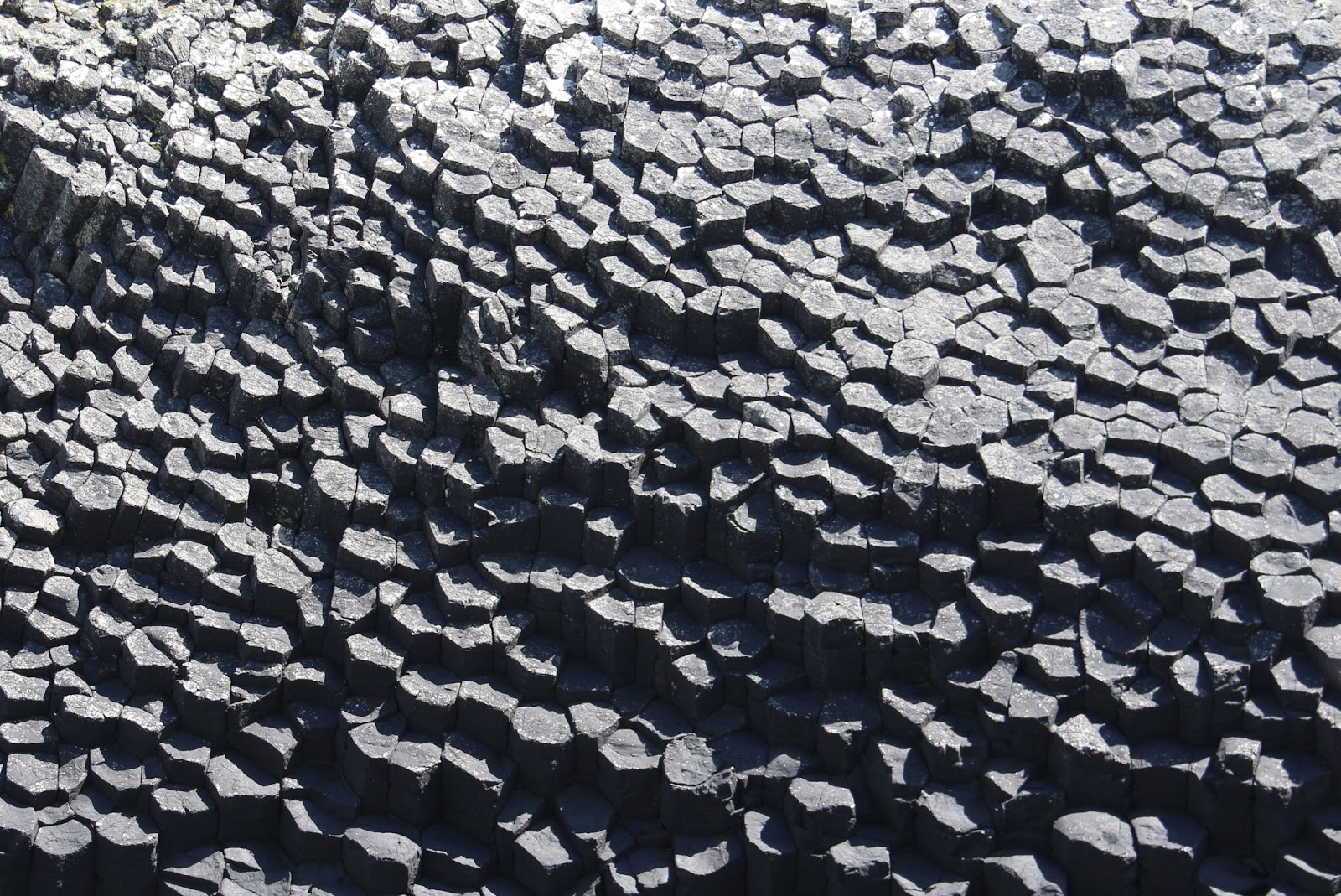
Staffa is a dramatic looking island, with huge columns of hexagonal columnar basalt topped with the compressed ash of volcanic explosions. According to our resident geologist, basalt is an igneous rock, meaning it was formed from lava (or magma). Specifically, it is an extrusive igneous rock, meaning it formed as a lava flow at the surface. As you approach by boat you see this green-topped shape looming out of the sea, and as you come closer its unique structure becomes apparent
Rounding the island, you come upon Fingal’s Cave. Personally I much prefer the Gaelic name An Uamh Bhin, which means ‘the melodious cave’. That would, in fact, have lent itself better to Mendelssohn for his Hebrides Overture. However, it is universally known after the Irish hero Fionn MacCool, hence Fingal’s Cave. It was a bit naff but entirely predictable in a pleasant way that, as we moved closer to the cave, the boat crew fired up the PA system and piped out Mendelssohn's Overture. Hearing it in-situ makes you realise how well the music reflects its origins.
The on-foot approach to the cave is reasonably safe these days, with non-slip surfaces and a handrail to guide you. The tops of the basalt columns make pretty good stepping stones. Walking gives you a much better look at the columns and one of things you’ll notice is that, although they are described as ‘hexagonal’, they don’t all have six sides. This is, apparently, just one of those things. Geologists defaulted to calling them hexagonal long before they were properly studied, but they can have any number of sides (usually between 3 and 7). Once you get your eye in, you find yourself counting the number of sides to find the non-hexagonal ones!
When inside the cave, the sound of the waves breaking and echoing makes the visitor understand why it was originally called the 'melodious cave' and why it inspired Mendelssohn. I was inspired myself, in fact, but I could only manage a tuneless whistle. Look up and you see that the ceiling is studded with a mosaic of the moss-covered remains of broken/eroded columns.
Inside looking out. Blue sky, calm sea.
The columns don’t just go straight up and as the land has been squished (that's a geological term) and stretched and moved about over millions of years, the columns have ended up bent in places and seem like waves of rocks.
It really is an amazing sight and is in the 'see if you can' category. The alignments reminded me of the patterns produced by iron filings and a magnet.
A solitary Shag drying its wings in the sun. The silhouette clearly shows the distinctive tuft of feathers above the forehead which is present in its breeding plumage.
Looking back to Mull, with Ben More in the distance and the island of Ulva to the right.
Sitting near the highest point on Staffa, and just above Fingal's Cave, is a trig point. But not any old trig point. It's a circular trig point and one of the relatively few of the Vanessa design. Only seen north of the border, these are the gold medallists of the trig point spotting world - and this is the first Vanessa I've seen. Imagine my joy - it was a very quiet joy because I thought that jumping up and down in glee was not appropriate under the circumstances. So, you ask, what's so special about Vanessas? A little context will help you appreciate my joy.
When the OS triangulation had progressed to the Highlands of Scotland, it was necessary to design a new and lighter pillar, cylindrical in shape, in order to avoid excessive transport costs. These round pillars, usually called 'Vanessas', or sometimes 'Branders' or 'Kelsey Columns', were considered "less aesthetically satisfying" than the standard pillar, so they were only placed in inaccessible locations to "reduce the risk of criticism from the more sensitive element of the population to an acceptable level." Vanessa pillars weigh around 6½ cwt (330kg), less than half of a typical and more common Hotine pillar (14 cwt, or 711kg), and did not require such a large foundation, making them ideal for the rocky outcrops of the Scottish Highlands.
'Vanessas' are so-called because the name is derived from 'Venesta', the name of the company which produced the cardboard tubes that the concrete was poured into. And this is the bit of the story I really love, Venesta was chosen because of their expertise in making other cardboard tubes - the centres of toilet rolls. I can imagine the lateral thinking in operation here. "You know what we need is something like a giant toilet roll tube to mould these things. Now who makes 'em?".
When I get engrossed in something like this, I start to think that I'm losing the plot. I need help!
Ah, there's someone who can do just that. But she seems otherwise engaged..
And then it was back down the ladders to the boat and the rest of our trip. Next stop Lungha to see the puffins. But were they there? Stay tuned for the next exciting episode to find out.

Tuesday, 2 May 2017

Mull April 2017: Some textures of Mull and Iona

Being surrounded by bold landscapes and wild seascapes, it's easy to ignore some of the detail closer by. Quite often the textures and patterns under your nose are just as interesting. Here are a few that caught my eye on Mull.
Barnacles and seaweed by the pontoon at Ulva Ferry.
I'm not a Geologist but we were travelling with one and John was able to explain the morphology and origin of the rocks we were seeing. The area of Mull around Fionnphort is characterised by pink Ross of Mull Granite and this gave the cliffs a rosy glow when the sun was on them. Rocks on the beach had some interesting grey striations caused by a darker mineral cutting across the pink granite.
I call them grey striations but to geologists they are a secondary  intrusive rock which rejoices in the wonderful name of “porphyritic microgranodiorite”. Of course, how could you mistake it for anything else?

Here are some of the many pebbles that make up the shingle beach on the southern tip of Iona where St Columba supposedly landed after sailing from Ireland. Search the mosaic and see if you can find any of the yellow-green serpentine marble stones that are common here. But whatever you do, don't confuse them with the much more common epidote-green pebbles which are much more common. The Iona marble is yellowish; the epidote is pistachio green. Got it? Good. And I don't know why we've got yellow print and dots on this bit. Strange.

A nice collection of lichens covering pink Ross of Mull granite.
Basaltic columns on Staffa. More on their origins in another post - possibly.
The columns are not all vertical. Movement after their formation 'squished' them into various shapes.
Neither are they all hexagonal. Count the varying number of sides in this photograph if you'd like something to do.
Light and wave patterns on the Sound of Iona
No, not more basalt from Staffa but the breast feathers of a Shag. You might think that Shags are all black but, as the photo shows, there is a green undertone to their colour.
And now for something completely different? Any guesses as to what it is?
It's a detail of a wire statue of St Columba in Iona Abbey. A total contrast to its surroundings and I wasn't sure about it the first time I saw it. I went back to it a couple of times and, I'm afraid, it just doesn't work for me there. Maybe if it were somewhere else more modern? To me it adds a discordant note, without adding anything. Having said that, I did like the intricate tracery of the wires and can appreciate the skill and artistry behind it. I'm sure every home has something like this: a gift that you aren't too keen on that you need to put on display somewhere out of the way.

Monday, 1 May 2017

Mull April 2017: To begin at the beginning

Every year the Gang of Five (or maybe Four or Three or even Two) head north and visit the Scottish Islands. We've given Orkney, Shetland and the Outer Hebrides a good go and this year we turned our attention to Mull in the Inner Hebrides. Getting there is an adventure in itself: my sat nav tells me that Fionnphort, the place we stayed on Mull, is 637 miles from home. What it doesn't say is that it's not a direct route and it takes about 15 hours lapsed time to travel there: car to Exeter airport, flight to Glasgow via Manchester, hire car from Glasgow Airport to Oban, Caledonian MacBrayne ferry to Craignure and finally a drive through spectacular scenery to Fionnphort (pronounced approximately as Finafort). There's not a lot in Fionnphort but with an excellent B and B, a decent pub/restaurant next door and the ferry to Iona just 5 minutes away, it was a good place to be based for our stay.

And how did we spend our six nights on Mull? Walking on Iona and seeing its sights and sites, visiting a sea eagle location, having a day's cruise to Staffa and the Treshinish Isles and generally taking in the views and atmosphere wherever we went. The next couple of posts will give some idea of how we filled our time. Here are few random shots to get things started. 
The view from our B and B (appropriately called Seaview - highly recommended for location, comfort, welcoming hosts and magnificent breakfasts) across the Iona Sound to, mmmm, Iona.
A view down the Tiororan Glen where we spent some time at an RSPB Eagle Watch site. The eagle in question is the White Tailed Sea Eagle. Re-introduced to the Islands a few years ago with birds brought from Norway, there are now about 20 breeding pairs on Mull and the programme is judged to have been a great success. Did we see any Sea Eagles here? Ah, you'll have to wait for another post to find out.
Looking up the Sound of Ulva towards Ben More, at 996 metres the highest mountain on Mull and the only Munro on the island. Unfortunately (ha, ha) we did not have time to climb it.
Duart Castle, dating from the thirteenth century, and the ancestral home of the Clan MacLean. Yet we another thing didn't have time for.
If you like a beach with white sands and clear blue water, Mull and Iona are the places to head for. But these are beaches to walk along rather than to swim from. Some say the Gulf Stream warms the sea in these parts: I say they are wrong. It's damn cold and only nutters would dip their toes into the briny up here.
A view taken from the top of the island of Staffa looking back towards Iona and Mull over a relatively benign sea. More of Staffa in another post.
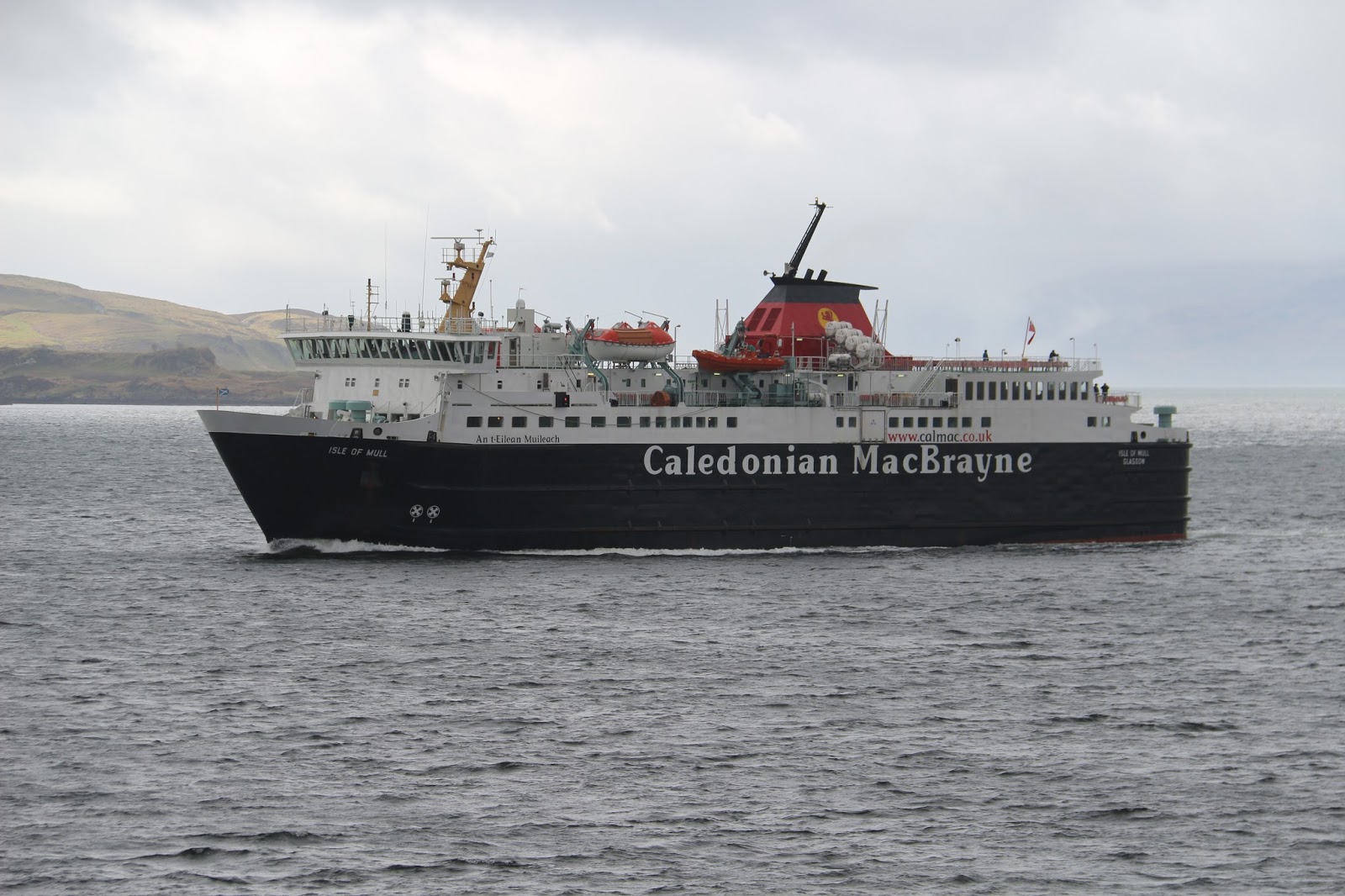
The 'workhorse' of the islands - the Caledonian MacBrayne ferry. What I like about these is the calm professionalism with which they operate and the no-fuss way they go about providing their service. And now that the Scottish Government has started subsidising them, the prices are almost a bargain.
We liked this notice we came across on our way to Ulva Ferry. We saw a few cats lurking in the vicinity but they looked anything but uncertain: rather over confident I'd say. Of the frail old woman, there was no sign.
Coming into the hamlet from the opposite direction, there was a variant of the above. Doddery OAP? Again, no sign - apart from those in the car.

Tobermory - 'capital' of Mull. Our brief visit there coincided with some sort of music festival and the place was filled with male bikers and loud punk music. I don't think Miss Hooley of Balamory fame would have been amused.

Saturday, 29 April 2017

A walk with an Oil Beetle, noisy sheep and a rare water valve

A few photographs from a walk this week in our locality. A complete contrast to the scenery on our recent trip to Mull, posts for which will follow once I pull my finger out and get the SD card out of my camera. In the meantime, enjoy some West Country scenery.
The circular walk started and ended in the nearby village of Luckett, just 2 miles from where we live. A not-too-challenging 5.6 miles in glorious weather and equally glorious countryside.
A lovely find by one of our group. It's a quite rare Black Oil Beetle. This group of insects (there are several different types in the UK) have a unique and fascinating life cycle. The eggs hatch and a larval form known as a triungulin emerges. This climbs into a neighbouring flower and hitches a ride on a visiting bee. It is taken back to the hive and lives there on bee eggs, honey and nectar until it is an adult, which leaves the hive and starts the life cycle all over. I find that amazing, and you should, too. And if you are lucky enough to spot an Oil Beetle, do take a photograph (showing the thorax, if possible, as this aids the type identification), make a note of where you saw it and send details to the Cornwall Wildlife Trust, who will add the details to their database.
Looking south-ish towards Kit Hill with its iconic stack on top. In the foreground is a field recently sown with a crop and covered with permeable plastic, which acts as a cloche and aids germination. There's obviously been a change in farming practice this year as we seem to be seeing more and more fields covered in this stuff. It doesn't look good but does get better when the crop gets going and breaks through the plastic to cover it in green.
Lady's Smock (Cardamine pratensis) or Cuckoo Flower, so called as it was thought to flower when cuckoos made their first appearance each year. Across the country these plants are becoming rarer as meadows disappear but around here there seems to be plenty of them.
Is there any flower more vivid than the Bluebell? It seems to be a good year for them. But the Spanish variety continues its challenge of our native species. Will Brexit halt them in their tracks? It's definitely one immigrant I'd like to keep out.
Curious calves coming to take a look at our motley band of walkers. I've been around animals long enough to take them in my stride but I recognise that, to the uninitiated, a group like this trotting towards you at speed can be quite alarming.
Ah, that's better. Kit Hill towering over 'normal' fields without the plastic. It looks tranquil, and it is, but this belies the mining and quarrying activity that would have set the area buzzing 150 years or so ago. At least 4 mines and 2 quarries would have been obvious then, with a few more down in the valley bottom where the tree belt is now.
The mining heritage of the area is gradually becoming less visible as sites are absorbed back into the landscape. But there are a few buildings that are being restored and converted into dwellings. Here is the engine house at Broadgate and it is in about Year 5 of the renovation project. It must be a labour of love and I've enjoyed watching the new building rise out of the former ruin. 
Let joy be unbounded. It's not often we come across one of these. It's a granite trough with, and you'll never believe this, a Prewett and Sprong Mark III Overhead Ball Valve Dispenser. These are so rare, they have almost mythological status in the world of Ball Valve Spotters. Wow, to me at least. Whilst I enjoy paroxysms of pleasure, Mrs P usually sighs, rolls her eyes and walks quickly on her way, shaking her head.
Finally, a video clip of sheep. Just sheep, doing what sheep do in a very noisy way. We couldn't work out why they were making such a din but they were clearly spooked about something. Was it the colour of my socks or my daft headgear? Or, perhaps, they were getting excited about the forthcoming General Election? After all, a lot of people will be voting like sheep but let's leave that to another day.

Sunday, 16 April 2017

Pigs 2017: An ending and a beginning

"Pigs again this year?" came the question. And the answer is "yes".  Coincidentally we've just completed a collective homage to last year's group with a special Pig Lunch at Langman's Restaurant in Callington. The chef, Anton Buttery, devised a one-off menu for us using parts of the pig that we would not normally eat and parts that had been in the freezer since the slaughter. A copy of the menu is shown below and featured such delicacies (?) as crispy ears, crispy head, 'quaver' skin, cheeks, sweetbreads, black pudding made with a hint of snout and some crackling. All that plus some 'standard' belly and tenderloin. It was a delicious meal and a fitting tribute to both Anton's culinary skills and our expertise at pig raising.
The menu, unique in the true sense of the word.
Just the one photograph as my camera-phone was playing up. This is the black pudding course.
A couple of days after the meal and a working party spent a few hours getting the pig field ready for the next set of occupants - eleven of the beauties due to be picked up from Penzance on May 3rd. We are going with the same breed and the same supplier. Why change a winning combination?
I'll give the pigs about two weeks to root their way through all this new grass.

Sunday, 9 April 2017

Keep an eye out for this one.

Writing a review of a play for our local parish magazine is always a little daunting. What if I don't like it? When this happens, I always try to focus on the positives, however elusive they may be. But those who know me can see through my damning with faint praise and can decipher the code. And so we come to last night's one-man show at the Old School: The Odyssey (Greek Stuff). Luckily no need for coded language, it was great. If you have a chance of seeing it as it does the rounds, do. You won't regret it. Here's what I've written for next month's Old School News.
The mythical tales of the Greek gods of ancient times are, by their very definition, epic, heroic and magical. Translating them into a one-man show is, on the face of it, a hiding to nothing in the making. How can you depict storms at sea, enchanting creatures of the deep and sorcerous sirens on an almost bare stage with just a scrap of cloth as a costume? All concerns were quickly forgotten the moment David Mynne stepped onto the Old School ‘stage’ and launched into his hilarious retelling of the classic tale. Utilising a piece of blue material, a stack of wooden crates and virtually no other props, David morphed into a legion of characters: as the story unfolded he brought to life opposing armies and their ensuing battles, the sacking of Troy and the subsequent struggle by Odysseus to return home to his wife and son.

The journey home after victory at Troy took 10 years, during which time Odysseus and his crew (lead by his faithful first mate, Pilates) meet obstacles at every turn. They take on a Cyclops, are lured by Sirens, drugged by Lotus Eaters and Odysseus has a wild love affair with a witch goddess, Circe, who wreaks further havoc by turning his men into pigs. More drama follows as they are drawn into the depths of hell when Poseidon sends a storm to wreck the ship in retaliation for the death of the Cyclops who just happened to be Poseidon’s son. Eventually the hapless Odysseus finally arrives home, only to find that his wife, Penelope, has a queue of suitors trying to convince her of his demise and pestering to marry her. The final moments of this grand piece deliver an unexpectedly brilliant feminist sting in the tail.

Liberally sprinkled amongst the traditional narrative are numerous surreal detours and side adventures casually thrown in to raise a laugh and move the story along. David produced teeny tiny models, created voices and threw the cloth around to suggest costumes. Maybe it’s my age but I’m sure I detected more than a hint of Michael Bentine's Potty Time as David conjured up images with words and sounds.


Sunday, 2 April 2017

On this day in 1917, Private Thomas Murley was killed.


Private 45628
THOMAS STANLEY MURLEY
8th Battalion Devonshire Regiment
Died age 25
2nd April 1917
Thomas Stanley Murley was born in 1892 in Lynton, Devon. He was one of the four sons and two daughters of Thomas and Elizabeth Murley. His mother, Elizabeth, was a daughter of Edmund Gill, a well known Victorian fern grower who took advantage of the mild climate in North Devon to establish a nursery. His house in Lynton was called The Fernery and still bears that name today. Thomas Murley Senior joined his father-in-law in this business.


Thomas’s aunty, Annie, had married Edmund Dingle from Venterdon and it was here that Thomas Stanley lived and it is here that he is mentioned in the 1901, where he appears with his mother, and 1911 censuses. It is likely that he joined the family engineering business as his occupation is given as a ‘student engineer’ in the 1911 census. His father died in 1906.


At some point, he enlisted in the Devonshire Regiment in Exeter and entered the France and Flanders Theatre of War as part of the 8th Battalion. His service thereafter is unknown but we do know that on April 2nd 1917, during the Battle of Arras, his battalion attacked the village of Ecoust, just south east of Arras. One description of this engagement describes it as a ‘great success and light casualties’. This description is at odds with the official version in the Battalion War Diary which details an advance under cover of a creeping barrage of artillery firepower, meeting a hail of machine gun and rifle fire and ending up with hand-to-hand combat.
It was in this battle that Thomas was killed and his body was one of those never recovered. He is commemorated on the Arras Memorial and is also remember on memorials in his birthplace, Lynton. He left few effects and his mother received his estate of £2 19s 6p, which is worth around £80 today.

Sadly Thomas's younger brother, Percy Douglas Murley, also of the 8th Battalion, the Devonshire Regiment, was killed on 1st July 1916 aged 20.
Arras Memorial

Detail of the Lynton war memorial

Lynton war memorial
Notification of Thomas Murley's effects.