Wednesday, 7 January 2015

January at Poldhu Cove: Part 6

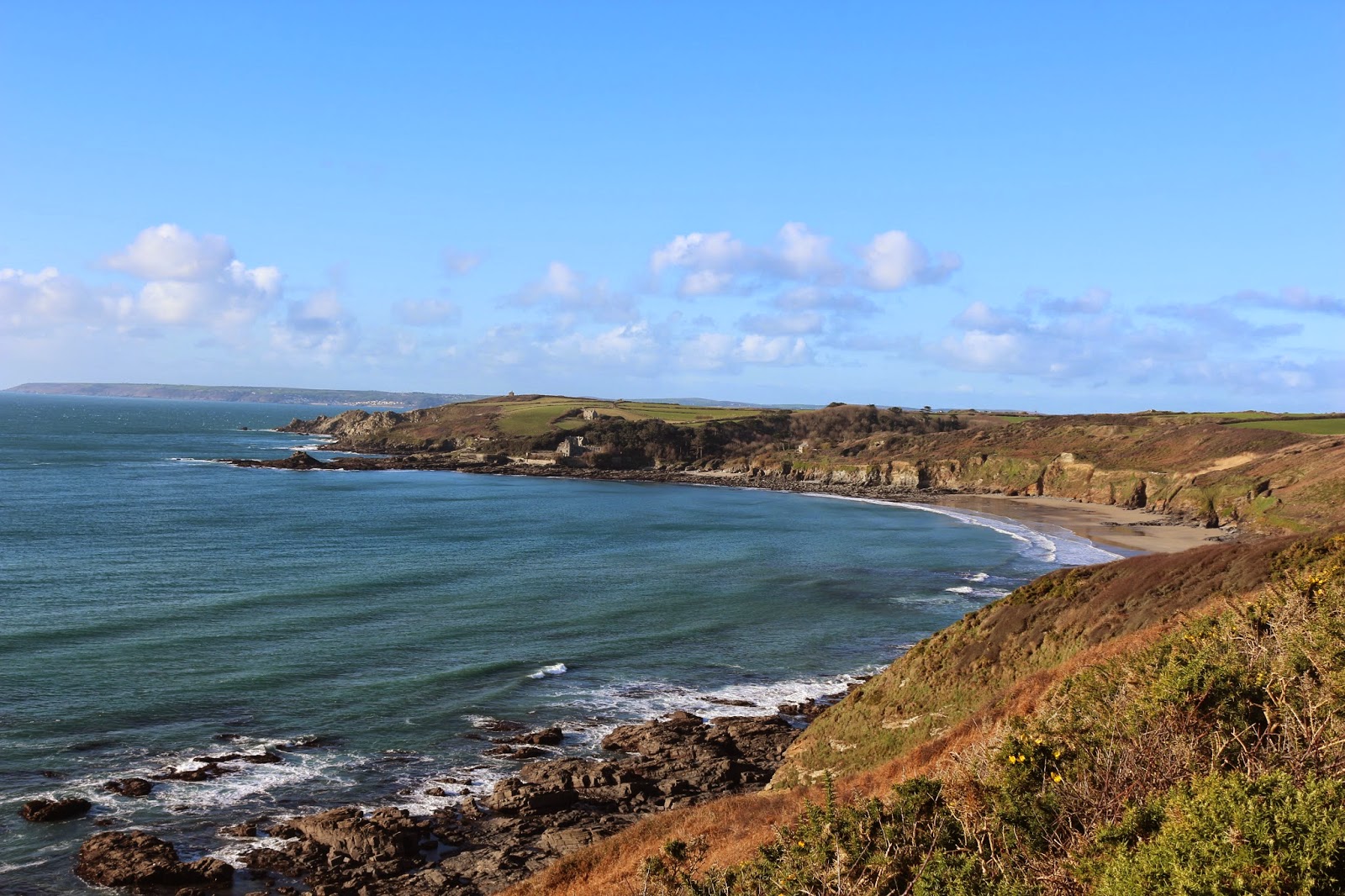
As per the forecast, the weather today was pretty awful so we pottered around the Lizard rather than risk being blown off a cliff. Teashop, church, pub, church and pub was the order of the day. Just a few photographs for the record.
Our first church to visit was St Breac's at Breage (pronounced 'breeg'). What is unusual about this largely 15th century building are the original wall paintings. These are the two largest: St Christopher to the left and the Christ of all Trades to the left.
There are three aisles in the church and a Victorian rood screen. It was a cold building and, in terms of kneelers, not as good as the two churches we've visited previously on this break.
During the Civil War, Charles I thanked his loyal subjects in Cornwall for their fidelity by sending a proclamation to each church in the county. Many of them are still on display, as this one is in St Breac's. Perhaps it was a case of too little, too late as he was defeated in 1645 and executed in 1649.
Shipwright's Arms at Helford Passage - an ideal spot for many things, including a drink and a bowl of smoked haddock chowder.
Our second church was St Anthony's in Meneage, on the Gillan Creek. Another largely 15th century structure, tucked away in a very attractive location close to the creek.
We were intrigued at the number of chandeliers in the church and then the penny dropped - no electric lights but lots and lots of candles. Overall a very compact and warm church, but no prizes for the kneelers.
But it did have the royal coat of arms that accompanied the proclamation mentioned previously at St Breac's. I wonder where we'd be today if royalty hadn't been reinstated?
A 'delicacy' down this part of Cornwall is Heavy Cake and, although it's not heart-friendly, it does go well with a cup of tea and a handful of Simvastatin. Here's how it is described in one guide:
Heavy cake or Hevva cake (Cornish: Hevva) is a cake made from flour, lard, butter, milk, sugar and raisins. Its name is derived from the Pilchard industry in Cornwall prior to the 20th century when a 'huer' (cliff top lookout) helped locate shoals of fish. The huer would shout 'Hevva!, Hevva!' to alert the boats to the location of the pilchard shoals. Cornish tradition states that Hevva cake was baked by the huers on their return to their homes, the cake being ready by the time the crews returned to land. It is made by crumbling all of the dry mixture together, then adding the raisins and mixing to a dough with milk. It is then rolled to a thickness of about 1/2", and a criss-cross pattern is scored across the top. This pattern represents the nets used by the fishermen.

Tuesday, 6 January 2015

January at Poldhu Cove: Part 5

A momentary "will we, won't we" start to the day but common-sense prevailed and we did spend another day walking the Coastal Footpath. And we were glad we did as it was an 8 mile cracker. We started at Marazion, opposite St Michael's Mount, took a bus to Praa (pronounced Pray) Sands and then walked back along the coast. We chose this direction as we'd be heading towards the Mount and would have it in our sights for a large part of the way. We passed by Prussia Cove, Bessy's Cove, Piskie's Cove, Perran Sands and Perranuthnoe, all of which were completely new to us and all of which showed us a hidden part of the Cornish coast. A delightful day out. And the weather? Sunny and dry all the way around.
A bacon bap, a cup of tea and a view. A great way to start the walk. Actually, we didn't start walking here as we had to catch a bus first.
A cheerful male robin singing his little heart out. We could just make out his song: "It's your lucky day, girls. Here I am. Come and take advantage of me. You know you want to". Or something like that. My IWC rather unkindly said "typical male".
Getting into our stride and looking back on the beach at  Praa Sands
Now looking forward to Prussia Cove. The complex of buildings in the distance nowadays comprise the Prussia Cove International Music Seminar. These started in the early 1970s and provide s learning retreat for accomplished musicians. It has an international reputation but is way, way, way out of my league. More in my league is the Judie Dench film, Ladies in Lavender, which was made here.
Prussia Cove actually describes an area of a number of coves (Kings, Bessy's, Piskie's) all of which have a  colourful past related to smuggling activities in the late 1700s/early 1800s.. In fact, the name 'Prussia Cove, derives from one particularly notorious smuggler, John Carter. He seemed to have had a long-standing fascination with the King of Prussia and this sobriquet got passed on to the area of his adventures.
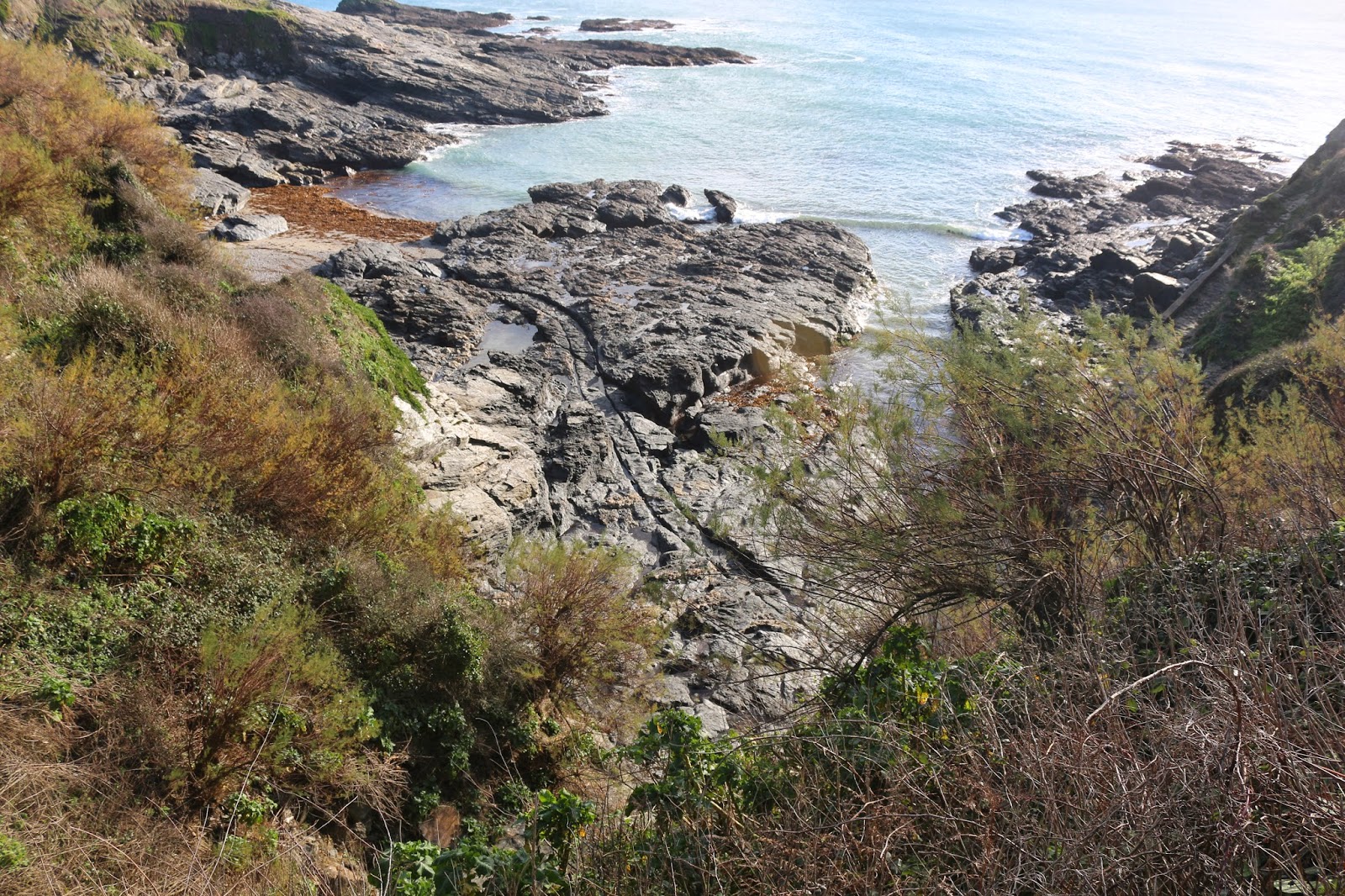
Bessy's Cove (named after one of John Carter's associates who ran a nearby pub) is reputed to have been heavily involved in smuggling and the cart ruts cut into the rock are suggested to have resulted from loading contraband onto wagons for rapid dispersal. Nice idea but they are more likely to have come from the long-standing practice of gathering seaweed as fertiliser for nearby farms. 
 
Just past Bessy's Cove we came across this sturdy wooden pole with holes and a set of pretty hefty chains cemented into nearby rocks. Curiosity piqued, I rooted around for an explanation when we got back and here's what I came up with: 'it is one of the moorings for HMS Warspite, a Queen Elizabeth class destroyer constructed in Devonport docks in 1912. After many campaigns, including the Battle of Jutland and extensive service during the Second World War, she was finally sold for scrap in 1947. En route to the breakers she broke away from the tug and ran aground in Prussia Cove. When she was refloated she was towed into Mounts Bay to be broken up for scrap.'
At the crest of the hill at Cudden Point and St Michael's Mount first comes into view. It was with us for the rest of the walk.
St Piran and St Michael's Church at Perranuthnoe, on a hill overlooking the village and the sea. The first building was Saxon and the present one is mainly 13th century with a few Norman bits still remaining.

An interesting interior with a rood screen still in place. As for St Wynwallow's in Church Cove, there was a profusion of colourful kneelers on the pews. Upon close and considered inspection, the D Parsons Prize for Best Embroided Kneelers was awarded to St Wynwallow's - by a mile.

Perran Sands or Perranuthnoe Beach. Safe swimming and surfing, all within sandwich-throwing distance of an excellent beach-side café.
Strange Things found on a Walk Part 34: a blond wig hanging in a tree. Fascinating and we spent the rest of the walk looking for a bald headed person.
Walking back along the road into Marazion we noticed this unusual plaque high up on a building being used as a studio. It was obviously military in origin but what? Good old Google came up with the answer. It dates from the 1880s and was a drill hall originally used by No. 8 Company 1st Cornwall (Duke of Cornwall’s) Volunteer Artillery. Fascinating, eh? Or is it just me? 
And down on the shoreline at Marazion there were many dunlins and turnstones (with the red legs), picking over what the rising tide was bringing in.
And back at the place where we started for a drink to celebrate the end of a great walk. Try it - you'll enjoy it.
And on this day - 6th January - in 2010, I made my very first blog posting, just 10 miles from where I'm sitting now. Just thought I'd mention it.

Monday, 5 January 2015

January at Poldhu Cove: Part 4

Another walk preceded by a free bus ride. This time we bussed from Lizard village to Kuggar and then dropped down to follow the Coastal Footpath west to Church Cove and thence back to our starting point, a distance of 5 miles. A good day for being out, although the temperature was a little cooler than yesterday. Up and downy and fairly rigorous in parts: overall I'd class it as 'moderate'. Great seascapes, as per usual, but this walk had a few extra items to pique our interest.
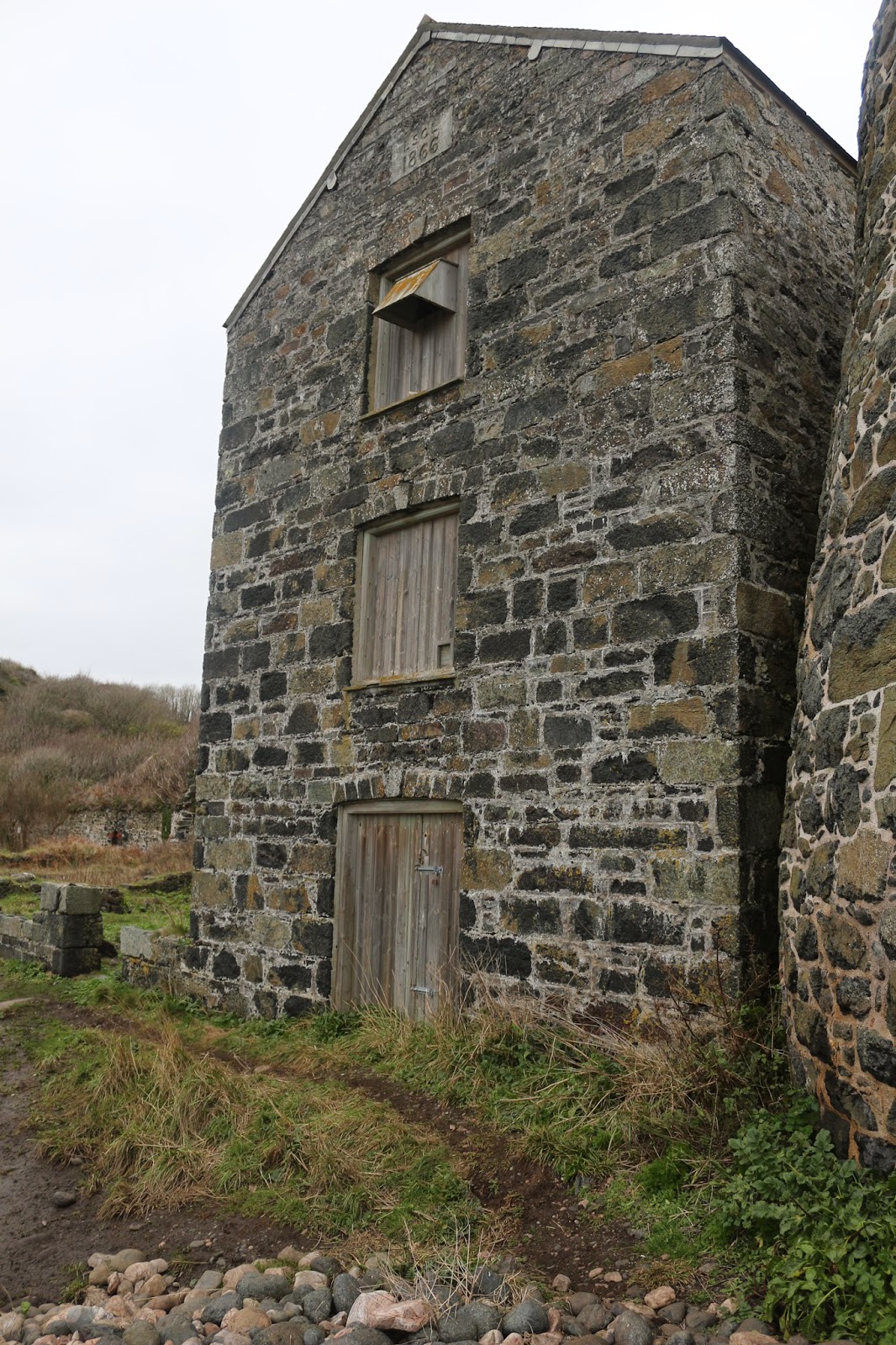
A short way into our walk, at Poltesco, we came across the ruins of what had been a large industrial site. Attached to the wall of one of the remaining walls was this interpretive plaque. It was the site of a Victorian factory built to cut, process and polish the local serpentine into jewellery, vases etc. Queen Victoria was a big fan apparently. The wheel pit to the left of the schematic is still clearly visible, as are the two buildings to the right. 
Two things struck me as unusual about this building. Firstly, the bit sticking out of the top door, which I reckoned was a nesting box for a barn owl. Secondly, the little 'door' on the bottom right of the middle door. I think this was a high level cat flap. If the cat could get up there, it was more than welcome to go in. And if you look carefully, right at the top you may be able to make out the initials LSC - Lizard Serpentine Company.
One of the most aesthetically pleasing footpath bridges that we've come across. Each upright was topped with a lump of serpentine. So, well done to the National Trust for using a little imagination and making good use of our annual subscription.
The fishing village of Cadgwith Cove where we'd hoped to grab a drink and a snack. We were out of luck - Cadgwith Cove was shut!
Cadgwith Cove is still a working fishing village, specialising in crabs and lobsters. Sadly, no opportunities to sample the fare. Oooh, I do like a pot of fresh white crab meat. No need for any lemon or vinegar, the taste of the sea is enough. A treat for another day, methinks.
This is the Lizard lifeboat at sea. A few minutes before I took this photograph, I was looking at the life boat station and thinking that it would be great if I could get a shot of it coming down the ramp. Too much of a coincidence, I thought, and dismissed the idea. One loud bang later and the life boat was out and on the waves. An opportunity lost but hooray for the RNLI.
St Wynwallow's church at yet another Church Cove. You can see bands of local serpentine in the construction of the tower. Yes, it's the same St Winwalloe that gave his name to the church at the other Church Cove. And he's also known as St Winwallow. For someone who was a hermit, he certainly got around.
We both love rooting around graveyards because you get a real glimpse of community life. One headstone that stood out was this military one dedicated to: A sailor of the Second World War. SS Gairpossa. 16th February 1941 What was the story behind this? Back at the cottage, I was able to find out the fascinating truth. I quote at length below from a number of sources.
The SS Gairsoppa was a British steam merchant ship built in Jarrow and launched in 1919. After a long civilian career, she saw service during the Second World War. She was named in honour of the town of Gersoppa on the banks of river Sharavathi in Karnataka, India.
She sailed with several convoys, before joining Convoy SL 64 in February 1941. Gairsoppa left the convoy when she exhausted the majority of her fuel and was making her way to Galway, Ireland, when a German U-boat fired a torpedo that sank her and sent 85 people to their deaths. It was thought that three lifeboats launched, but only one in the charge of the second officer, R. H. Ayres, with four Europeans and two Lascars on board, made it away; the rest of the crew was lost. By the 13th day only the second officer, the radio officer, and one seaman gunner remained alive. Ayres and his boat reached the Cornish coast two weeks later at Caerthillian Cove. The boat capsized before the Lizard lifeboat could reach them, and only the second officer was pulled from the sea alive. Two of the men aboard, Robert Frederick Hampshire (Radio Officer), and an unnamed Indian seaman, died trying to get ashore. They are buried at St Wynwallow's. Ayres was appointed a Member of the Order of the British Empire (MBE) for his attempts to rescue his fellow sailors; he lived until 1992.
The wreck of the Gairsoppa was discovered in 2011, and it was announced that an operation to recover its cargo of silver bullion, with an estimated value of £150 million, would begin in 2012. On 18 July 2012 Odyssey Marine Exploration, of Tampa, Florida, reported that it had recovered 48 tons of silver, making this probably "the deepest, largest precious metal recovery in history" (as the Gairsoppa rests in 4,700 metres (15,400 ft) of water).
The interior of St Wynwallow's. We both felt it was a very warm feeling church. One of its claims to fame is the fact that it was the last in which a sermon was preached in the old Cornish language (in the 1690s).
It also has an amazing collection of embroidered kneelers. Each place in the pews had a uniquely designed kneeler, the themes of which were many and various, ranging from poppies to GWR steam engines and, of course, many relating to the sea. The one I most liked is this one of a lighthouse in a storm. Such skill.
 

Sunday, 4 January 2015

January at Poldhu Cove: Part 3

A straightforward day: bus from just down the road to Porthleven (change at Helston) and then walk back along the coastal footpath to the cottage. We clocked up 6 miles but it didn't seem like that as, although it was a bit up and downy, it was relatively gentle. The weather was reasonable: a little mizzle every now and again although the visibility was good all the way and we enjoyed the seascapes that only Cornwall can offer. Hooray, another few miles of the Cornish Coastal Footpath completed and probably only 100 more to go before we've done it all.
Unusual sign for the toilet at Poldhu Cove, apparently reserved for ladies and babies with disarticulated hips. Maybe they get a lot of them down these parts? They also get a lot of dogs: so much so that we wondered whether we were holidaying at the same time as the UK Dog Walkers Convocation.
Let's give a cheer for the free travel on buses for people over a certain age. Long may it continue - but it probably won't.
 
The destruction of the harbour at Porthleven afforded some dramatic TV images during the storms we had early last year. They still haven't completed all of the reconstruction.
And lest we think that storms are a recent happening, here's a sober reminder of an event in 1979.
A couple of miles along the coast and we come to Gunwalloe fishing cove.
We were last here in January 2010 but the weather was a little different then!
And who is this, do I hear you say? This is St Winwaloe, who came to Cornwall in the 6th century from Brittany and whose statue is right next to the entrance of his patronymic church..........


.......St Winwaloe's in Church Cove, also known as the Church of the Storms. Its position is unique, being right on the beach and separated from the sea by wall and a relatively narrow strip of pebbles. An interesting interior but we couldn't really poke around as they were just about to hold a service - all two of them, including the priest.


And what better place to end a walk than a café on the beach?


And watching the ever-changing sea and sky?
 

Saturday, 3 January 2015

January at Poldhu Cove: Part 2

After a wild and woolly night, followed by early morning rain, we decided that it would be prudent not the walk the cliffs today. The alternative was the more sheltered walk around Loe Pool, the largest stretch of fresh water in Cornwall. It's not somewhere we'd been before and it was a very pleasant surprise, reminding us of Bosherton Ponds near Tenby in Pembrokeshire. At just over 7 miles, it was a good stretch of the legs. The Loe is separated from the sea by a shingle beach some 200 yards wide and is reknowned for the many over-wintering water fowl to be seen. We were out of luck and the ducks we did see were in a park on the outskirts of Helston.
The Loe with the sea to the right and the Pool to the left. In the mid distance you may be able to make out the white cross memorial to the 100 sailors lost when HMS Anson run aground in 1810. Lots of legends associated wit h how the Loe was formed, the most popular of which is that it was formed by a giant storm in the 1300s, forming a barrier and cutting off Helston up-stream. Unfortunately for this story, there really isn't any good documentary evidence for Helston ever being a port. Shame really, as the prosaic view of the geomorphologists is much less romantic. They say that the Loe was formed by rising sea levels during the last Ice Age - boring, boring, boring.
Taken on the Loe, looking back into the Pool. And here's another legend for you: Loe Pool was the place where Sir Bedivere threw the sword Excalibur to the Lady of the Lake. Not true, of course, as it springs from the pen of Tennyson in one of his epic poems.
 
Apart from all this, enjoy!
Although the size and ferocity of the waves shows the sense of the warning signs. This is not a beach for watersports. We reckon the waves had more power than ones we'd seen in Hawaii.
A coot, just one of many, bobbing in the water.
A juvenile Cormorant (because of its light breast) drying its wings.
Lots of these little Tufted Ducks around.
The beady eye of a female Mallard Duck keeping a watch on the passers-by.