Monday, 16 June 2014

Walk: Yelverton to Clearbrook and return

Lest I forget, a few photographs from a 5 mile walk last week. This one started in Yelverton on the western fringes of Dartmoor and took a circular route to Clearbrook and back. Brilliant weather and a walk with interesting aspects of the industrial past of the area.
A young wren waiting patiently for its parents to bring it some food.
A robin on a post - just at the limits of my lens.
A cuckoo - just passed the limits of my lens! It's not often that you catch sight of these birds.
Sheepstor in the distance between the trees. About 5 miles away.
The Devonport Leat built around 1800 to take water from the moor to the expanding dockyard town of Devonport.
Granite sleeper beds of the old mineral tramway. Of similar vintage to the Devonport Leat.


Friday, 13 June 2014

Pigs 'Ere Blog Part 8: Ever expanding piggies

Just another day at the Pig Farm!  All is going well.

Still eating their way through an enormous amount of pig feed - but gaining yummy weight in the process.
Feet continue to be regarded as fine substitutes for feeder pellets.
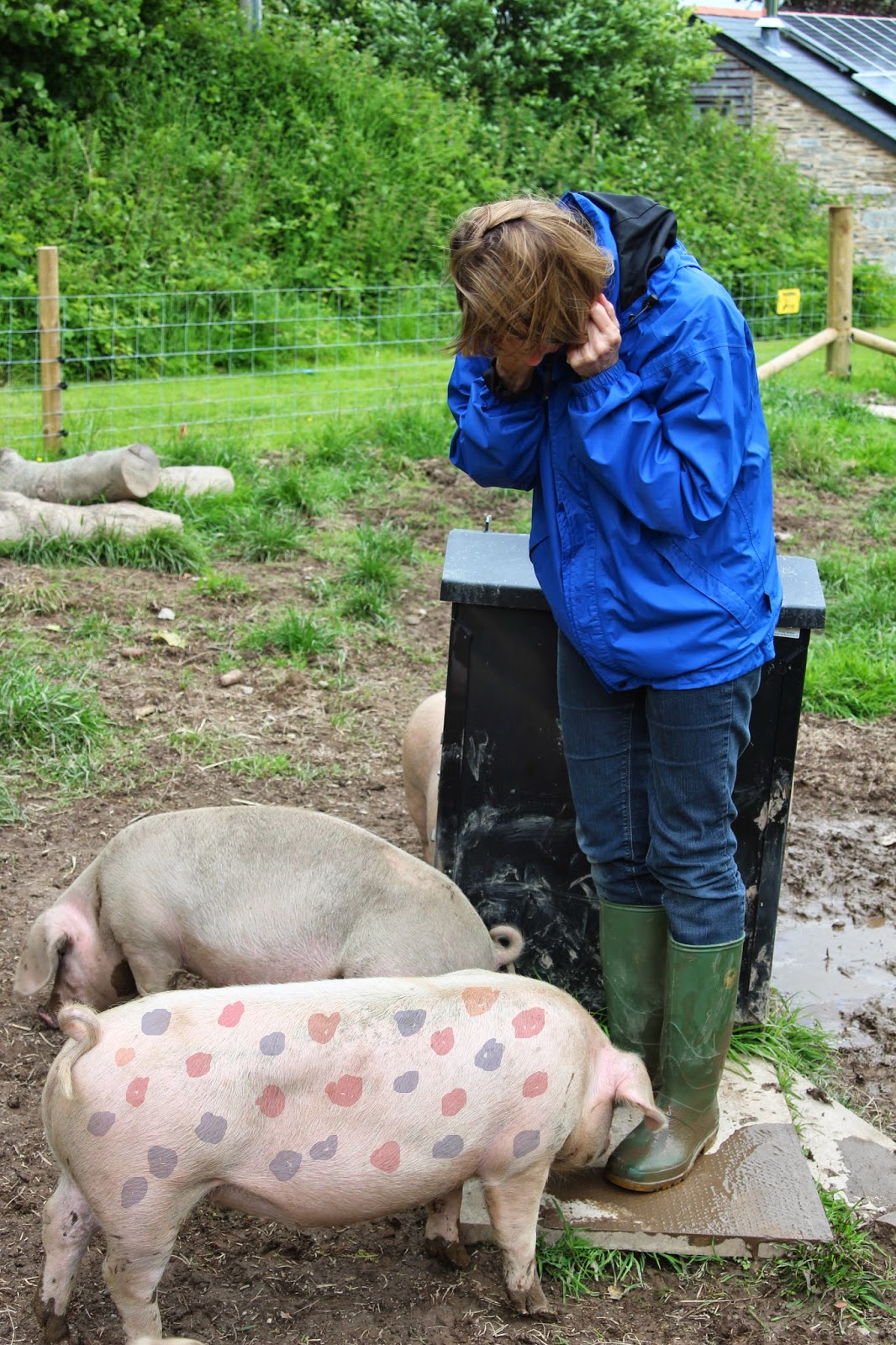
Something the pigs and I have in common - we all like being tickled behind the ears by this lady.
Mmmm - is this one supposed to be spotted?
There's something about wallowing in mud as a prelude to having a feed.
Man in his natural environment.

Scarlet sentinels........

Foxgloves, you want foxgloves? We got them! Carrying on with the "it's been a good year for primroses/bluebells/may blossom" theme, we can now add "it's been a good year for foxgloves". As these few photographs show, there are a lot of them around - on the hedgerows, in the fields and in the woods. The ones below were taken on the edge of the Duchy Woodlands overlooking the village. They are definitely more profuse than we've seen in previous years, perhaps due to the weather when it mattered for flower production but, in this area, perhaps due to the larch clearance and the associated seed dispersal when the ground was disturbed. Whatever the cause, the effect is both colourful and stunning.


Tuesday, 10 June 2014

An ornithogical first.

It's that time of year when all of my bird-watching friends talk about the exotic species feeding at their bird tables. For example, recently I've been assailed with tales of Tartan Mac-Caws, Chocolate Oreos, Sky Bluebirds and the occasional Rainbow Trout: all of which tend to put my asthmatic sparrows and expectorating magpies to shame. But then, this morning, as I welcomed a new day from my lounge window, I spotted an unusual visitor to my patch. I rushed to the bird books to help me identify the avian interloper and I am pleased to announce to the world the first sighting of Adobius Photoshopii var.Technicolourificus in Cornwall.

Sunday, 8 June 2014

So many words

According to the Oxford English Dictionary there are between 2,500 and 3,000 new words added to the English language each year. Have you ever stopped to wonder where on earth they come from? Who designs and manufactures them? Where is the word factory? Whilst heavily engaged in the process of living recently I've had plenty of opportunity to let my mind wander, and I think I may have come up with the answer to this important question. The mine from which most of these new words are hewn is none other than our old friend the Word Verification system.
 
Just think about it. You decide to leave comments on some page, carefully compose a paragraph of Shakespearian quality prose and then it is lost to posterity because you type in "brutlok" instead of "brutlik". How many of those verification words have you ever seen before? Precisely. Absolutely none. They are fresh off the production line. Google has reached an agreement whereby it gets these new words for word verification purposes before they are allocated meanings and sent out into general circulation.
 
Armed with this insight, I have invented a new game for us to play. The next time you are confronted with a word verification request, make a note of the word. Then invent a meaning for it and show its use in a sample sentence. Here are my entries based on word verifications I have encountered recently.
1. Slyma: a small dribble of saliva (often secreted from the corner of the mouth) as in "Brian threw off his heavy coat and wiped the slyma from his grizzled chin".
2. Kersim: a minute part of a larger object (mainly used in relation to food) as in "Whilst in the past Brian would settle down for the evening with a large pie he now contents himself with just a kersim of pasty".
3. Deriesse: the final statement in an argument as in "With a look of fury Brian spat out a perfect deriesse as he walked out of the door".
 
Play along if you want but I am afraid you will not find any word verifications on my blog. You will need to go somewhere else for your fix. With that deriesse I will leave you for today.

(I should add that the Brian referred to is a figment of my imagination and is not based on any Brian in the vicinity. No, honestly, the Sage of Pempwell was a million miles from my thoughts when I was composing this).

Friday, 6 June 2014

On this day, 6th June, 1944............

.... my father went on a trip to Sword Beach in Normandy with some of his friends in the Royal Marine Commandos. He was 20 years old at the time. A proud and poignant time for all in his family as the 70th Anniversary of the D-Day Landings is remembered.
Aerial view of Sword Beach
RM Commandos coming ashore
The berets of the RM Commandos in the thick of it. There's one face there that looks suspiciously like my dad but that would be too much of a coincidence to be true.

Wednesday, 4 June 2014

An evening walk in the Dartmoor mist

We've just enjoyed an evening walk around Sharpitor and Peek Hill with the Plymouth and District Archaeological Society. Misty and damp but we did see a lot of Bronze Age remains and, to bring us almost up-to-date, the remnants of a WW2/Cold War RAF listening post. Not the best of conditions for taking panoramic shots.

The mist is obscuring the ancient trackway that was used before the existing road was constructed under the Turnpike Act in the early 1800s.
These tombs are generally referred to as cists although on Dartmoor there is often mention of kistvaens or kists. It is thought that the word kistvaen has derived from the Celtic cist (chest) and maen (stone) aptly meaning 'stone chest'. The accepted description of a 'typical' Dartmoor kist is that it comprises of a four-sided stone chest with a covering slab and occasionally a paved floor. They were constructed of stone, quite often granite. There were two main methods of interring the deceased, either the body was placed into the stone chamber in a crouched foetal position or the remains were cremated and the ashes placed in an urn and interred in the floor of the pit. Many of these finds are dateable to the Early Bronze Age which ran from about 2300 - 1400BC.
Looking up to the top of Sharpitor.
And this is what it looked like when we walked here a couple of weeks ago. Photographs not taken from exactly the same spot but near enough. Lots of clitter formed from the freeze/thawing effects of the last Ice Age.
Imagine a thicker mist; imagine the damp silence accompanying it; imagine being alone; imagine some unknown shapes; imagine some strange and unknown noises. Now you have the stuff of the legends of the 'Beast of Dartmoor' and the 'Beast of Bodmin Moor'. I'm convinced that most, but not all, sightings can be explained by sheep or ponies. The rest? Who knows but I do like to think that the moors do not reveal all of their secrets.
And in the distance can just be made out a red light. Not sure what it was due to. It was on the road but brake lights would come as a pair? Spooky!
A Bronze Age hut circle. Larger than the norm and with an unusual cross wall in the centre. Lots of speculation about this but it was unlikely to be an original feature. It may have been added as a result of the hut being reused at some stage, possibly by tinners.

Friday, 30 May 2014

They come over here - using our NHS

In the aftermath of the EU elections, it is not surprising that immigration and immigrants are featuring prominently in the news - ad nauseum. Also rearing its ugly head again is that hoary old chestnut - access to the NHS by all these 'foreigners coming over here and using our medical services'. Out of interest I've reread what the architect of the NHS, Aneurin Bevan, had to say about this very issue in his book 'In Place of Fear' and I've copied the relevant passages below. Obviously the numbers have changed since he wrote this in the early 1950s but I think his philosophy is still valid. I particularly like his phrase 'rejoicing at the opportunity to practice a civilised principle'. Increasingly we seem, as a society, to be incapable of taking this stance on anything. We are all the poorer for not being able to do so.

One of the consequences of the universality of the British Health Service is the free treatment of foreign visitors. This has given rise to a great deal of criticism, most of it ill-informed and some of it deliberately mischievous. Why should people come to Britain and enjoy the benefits of the free Health Service when they do not subscribe to the national revenues? So the argument goes. No doubt a little of this objection is still based on the confusion about contributions to which I have referred. The fact is, of course, that visitors to Britain subscribe to the national revenues as soon as they start consuming certain commodities, drink and tobacco for example, and entertainment. They make no direct contribution to the cost of the Health Service any more than does a British citizen.

However, there are a number of more potent reasons why it would be unwise as well as mean to withhold the free service from the visitor to Britain. How do we distinguish a visitor from anybody else? Are British citizens to carry means of identification everywhere to prove that they are not visitors? For if the sheep are to be separated from the goats both must be classified. What began as an attempt to keep the Health Service for ourselves would end by being a nuisance to everybody. Happily, this is one of those occasions when generosity and convenience march together. The cost of looking after the visitor who falls ill cannot amount to more than a negligible fraction of £399,000,000, the total cost of the Health Service. It is not difficult to arrive at an approximate estimate. All we have to do is look up the number of visitors to Great Britain during one year and assume they would make the same use of the Health Service as a similar number of Britishers. Divide the total cost of the Service by the population and you get the answer. I had the estimate taken out and it amounted to about £200,000 a year.Obviously this is an overestimate because people who go for holidays are not likely to need a doctor’s attention as much as others. However, there it is. for what it is worth and you will see it does not justify the fuss that has been made about it.

The whole agitation has a nasty taste. Instead of rejoicing at the opportunity to practice a civilized principle, Conservatives have tried to exploit the most disreputable emotions in this among many other attempts to discredit socialized medicine.

Naturally when Britons go abroad they are incensed because they are not similarly treated if they need the attention of a doctor. But that also I am convinced will come when other nations follow our example and have health services of their own. When that happens we shall be able to work out schemes of reciprocity, and yet one more amenity will have been added to social intercourse. In the meantime let us keep in mind that, here, example is better than precept.

Wednesday, 28 May 2014

Now you see me, now you don't.

Josh and his nanny have difficulty with the basic premise of the hide part of 'Hide and Seek'.

Tuesday, 27 May 2014

The truth is out..........

Isn't it strange the way that daughters can wheedle secrets out of their fathers? Remember my mentioning a while back that I'd taken to product endorsement to earn a little money to help me run my blog? Well, I've gone a little further than that and have done some male modelling. I normally hide my well-sculptured pectoral 6-pack and rippling biceps under a rather shapeless jumper in order not to attract attention to my finely chiselled physique. But hard times demand drastic actions and I soon got in deeper than I had intended. Read on...

They said "Get your shirt off for the Korean version of Men's Health" and "It won't be available in the UK". Such naivety and trust on my part: such duplicity on theirs. I understand now that the UK edition comes out soon so, as a pre-emptive measure, I thought I'd better get it out first to minimise the shock. Hence my paternal confession. You know, I really don't think the hassle has been worth the 2 kgs of Kimchi I got as my fee. Fermented garlicky cabbage anyone?

Monday, 26 May 2014

The EU results are in.

The results for the South West EU constituency are in and I'm pleased to say that the Green Party were successful in winning one of the six seats being contested. This is good news as the candidate, Molly Cato, will be an excellent advocate for us in Brussels. I've met her just the once and she impressed me with her energy and enthusiasm. She is definitely not a single-issue politician and it will be interesting following her progress.

The turn-out of 36.9% is surprisingly low given the publicity that these elections have had. It is still a fact that the majority of the electorate cannot be motivated to get out and vote and that should be a concern to all with an interest in politics. For the record, here are the results:


Sunday, 25 May 2014

One man went to mow, went to mow the graveyard.

Every so often I take my turn on a volunteer rota to mow the grass in the graveyard of our village church. I like doing it for a number of reasons: I get to become a 'boy racer' for a couple of hours speeding around on a ride-on mower and, in the process, I get to enjoy some fantastic views. I've been doing this for a few years now and, in that time, I've got to know the headstones 'on my patch' quite well. I always so 'hello' to those I actually knew in life and I regularly talk to total strangers.  I always find something to ponder upon as I whizz around. What was the deceased like? How did they die? What was their story? Here's a taste of just some I come across.
There are a few things about this headstone that intrigue me. Firstly, why the differing surnames for husband and wife? Secondly, what was Archibald Buller doing in the USA? Thirdly, the story of Hamilton Buller, of which I know a little. Hamilton was born locally, emigrated to Canada in 1913, joined the Canadian army in 1915, spent 3 years fighting in France, was invalided out due to being gassed and finally died in Stoke Climsland in 1919 of tuberculosis.
 
And here's a photograph of Hamilton Buller and one of his younger sisters, taken around 1908. I know exactly where they were standing when the photograph was taken and the backdrop is no longer one of industrial dereliction. The mine has long been closed and is now totally overgrown.
 
The Nathaniel Lobb named on this one also features on our WW1 memorial. He was awarded the Military Medal for some act of bravery but I've not been able to find out exactly for what. The Lobb family lived almost next door to where we live now and it is highly probable that Nathaniel visited our house. He may even have stood where I'm typing this.
 
Nathaniel Lobb was a career soldier and had served as a sapper in the Second Boer War. Here is his medal from that campaign - the Queen's South Africa Medal plus battle clasps - as they are displayed in the museum of the Royal Engineers at Chatham. In WW1 he was part of the Special Squad responsible for the introduction of gas warfare.......but that's another story.
 
One of the Pennington family of bell founders. They made the bells in the church and many for other churches in this part of the world. One of their foundries (they built temporary casting pits close to where the finished product was going to be hung) was just over the road, apparently, but no-one knows exactly where.
A breach of Health and Safety regulations?
Sacred
to the memory of

William Sampson
of the Parish of Phillack
in the County
He was killed in Redmoor Engine
Shaft thro' his comrades leaving a
piece of timber slip
thro' the lashings
April 7th 1835. Aged 31 years.
Not that those responsible for the wording on the headstone bore a grudge! The accusatory tone still resonates after 175 years. Who were his careless comrades? Do their bones squirm in contrition and remorse?
The inscription reads:
Sacred
to the Memory of
Edward Weekes
(Late of Venterdon in this Parish)
Yeoman
Whose death was occasioned by a
fall from a horse April 29th 1833
Aged 30 Years
ALSO
Hannah Edward Weekes (His daughter)
Died November 2 1838

Age 5 3/4 YearsA quick calculation of the dates suggests that Edward Weekes' wife was in the final stages of pregnancy when her husband died. Presumably as the wife of a yeoman she was not left in dire straits but, nonetheless, it must have been very hard for her and even harder when her daughter died.
I've always felt for poor William Wilton, who died aged 80 in 1906. Within one month in 1870, he lost his wife Eliza on the 1st February and two children on 20th February, William aged 17 and Ellen, an infant. I can come up with a scenario for Eliza and Ellen as birth related deaths but why did William die on the same day as his sister? Perhaps all three had contracted some disease? Three deaths so close together cannot be coincidental
 

Thursday, 22 May 2014

The deed is done.

My vote has been cast at what must be one of the smallest polling stations in the UK. A sobering thought that, in an elective democracy, it is at places like this that the ultimate political power is exercised. Let's hope that those going in throughout the day make the right choice.
 

Wednesday, 21 May 2014

Voting in the European Elections

I've thought long and hard about who I am going to vote for in the European election tomorrow and here are my thoughts on the choices available to me as a voter in the South West England European Parliament constituency. Just in case you've forgotten (I had), this constituency consists of the counties of Bristol, Cornwall, Devon, Dorset, Gloucestershire, Somerset and Wiltshire. And, believe it or not, it also includes Gibraltar. You know, that rock at the southernmost tip of Spain.

Why am I voting?
Voting in the European election is important for four reasons. Firstly, it is contested on a proportional basis, meaning that those who vote for alternative parties are not just "wasting their vote" as is the case in the unrepresentative and apathy inducing Westminster system. Secondly, the turnout for Euro elections is embarrassingly low (33% in 2009) and I don't want to be counted amongst those who don't vote. Thirdly, whilst recognising all of the faults and the need for wholesale reform, I am still a strong believer in our links with Europe and want to maintain them. And, fourthly, I hold the old fashioned view that voting is a civic duty.
 
Who am I not going to vote for?

1 The Lib-Lab-Con establishment
The archaic electoral system used in our general elections has allowed the three Westminster establishment parties (the Lib-Lab-Cons) to run, what is in effect, a closed-shop. Time after time they have lied to and openly defied the wishes of the electorate, safe in the knowledge that alternative parties have virtually no chance of overturning their oligopoly  (ooh, I do like that word) on political power. The European election is an excellent opportunity for people to protest against the out-of-touch establishment, because under the Proportional Representation voting system every vote counts. In my opinion, voting for any of the 'big three' in these (and, to be frank, in any) elections is voting for the continuation of the establishment orthodoxy - and that's what got us where we are today.
 
2 UKIP
It looks as if UKIP stands a good chance of winning the most seats in the European Parliament, riding on a tide of political illiterates (I'm sorry if this sounds harsh but they are) who consider them some kind of "alternative" to the establishment orthodoxy. What these people fail to realise is that UKIP is even more fanatical about the right-wing Thatcherite economic orthodoxy of neoliberalism than the Lib-Lab-Con establishment, and that they are financed by a pack of former Tory party donors. One of the saddest indicators of the lack of political nonce of most UKIP supporters is that, as opinion polls consistently show, the vast majority of them actually favour the explicitly socialist policies of the NHS and of renationalising the rail network and energy companies. Despite this they are going to march off to the ballots in order to vote for a blatantly Thatcherite party with a burning ideological hatred of the public sector. Unbelievable!
 
 And let's not forget that the main reason for the rise of UKIP is that nobody in the Lib-Lab-Con Trio can offer a credible alternative that articulates public rage without playing on popular hatred. For that, you need vision, hope and real respect for the electorate. For that, you need politicians of stature. And those are things the Big 3 have yet to provide. In fact, I have grave doubts that they are capable of providing them.
 
3 An Independence from Europe Party
A party recently formed by a UKIP reject and with a single objective - let's get out of Europe. A sort of UKIP-lite party and not one that will get a vote from me.
 
4 The fascist fringe
It is incontestable that UKIP occupies the extreme-right authoritarian territory you would expect from a "Thatcherism on steroids" party. However they do tend to regularly expel people from the party when they express totally outrageous and openly fascist sentiments (mandatory abortions for disabled foetuses, suggesting black actors go to live in black countries, blaming gay marriage for the Somerset floods, referring to female party members as sluts...). That they attract so many of these lunatics in the first place should be deeply concerning.
People who are genuine fascists (rather than just politically illiterate/hopelessly confused little-Englanders) have a couple of parties to choose from:
 
There's the laughing stock that is the British National Party, which is led by Nick Griffin (a man who is now as financially bankrupt as he is morally bankrupt) and there are the English Democrats, who are pretty much the political wing of the English Defence League. Neither are for me and, I presume, few people in this constituency.
 
All that leads to the single Genuine Alternative for me - The Green Party

One of the most amusing sounds in modern British politics is the sound of political drones trying to dismiss the Greens as a "single issue party". The Green party have a detailed manifesto covering a huge range of issues, unlike UKIP, for example, whose party manifesto had to be dropped after Nigel Farage dismissed it as 'drivel', meaning that they go into the 2014 European elections with the most absurdly childish party 'manifesto' I've ever read (a 12 page document, five pages of which are taken up by pictures, and the rest containing nothing more than a few unsubstantiated bullet points and pro-UKIP quotations - download a copy and see if you agree with me).

Anyone who actually bothers to check out the Green Party manifesto, and then takes a look at the ludicrous UKIP 'manifesto' will be left in absolutely no doubt about which is a serious political party with actual policies, and which is a bunch of absolute charlatans pretending to be a political party.
Everyone will be more-or-less familiar with the Green party position the environment, so here is a comparison of some of their more important policies on non-environmental issues with the other main parties.
 
 
Ticks in all of the Green boxes for the areas I consider important. Let's face it, in social and economic terms, the Green Party occupies the traditional territory of Old Labour. That's where my heart lies and voting Green tomorrow is my best option.

If just one in every hundred people who didn't bother to vote in the last European elections decided to vote Green, they would easily force the Liberal Democrats into the embarrassment of a fifth place finish. And that's something worth aiming for!

Sunday, 18 May 2014

Dartmoor in the sun! Addendum

In my last post, I mentioned that we were puzzled by these objects just off our path. Intrigued, I e-mailed those that should know. And they did. Here's their reply. Sorted!
From: Princetown Visitor Centre [mailto:princetown@dartmoor.gov.uk] Sent: 17 May 2014 10:22 To: 'Derrick Parsons' Subject: RE: Spotted on a walk yesterday
Derrick,
This is a ‘control flag’ for an orienteering course put out for an organised event by a local group. It is usually associated with a stamp with pins on so that a route card can be suitably marked to prove the objective has been reached.
Regards
Neil Handley
Information Adviser
Dartmoor National Park Authority
National Park Visitor Centre, Princetown
Princetown
Devon PL20 6QF