| Apparently all this lot can be put together by two people in around 30 minutes. I do hope someone sets a stopwatch tomorrow when the 'erection team' gets busy. |
Quid me anxius sum? (Alfred E Neuman, Mad Magazine circa 1956). Facio, ita.
Wednesday, 16 April 2014
Pigs 'Ere Blog Part 3: Arrival Day minus one
Oooh, the excitement is palpable. Will I be able to sleep tonight? Tomorrow promises to be a day to remember: a walk along the Walkham River to its confluence with the Tavy and, as if that's not enough, we pick up our weaners in the late afternoon from their home at Trevaskis Farm. The final selection hasn't been made yet but the breeder, Giles Eustice, sent me this photograph of the group from which ours will come. Lovely looking, aren't they? I think I'm in love!
Tuesday, 15 April 2014
They didn't write books like this in my day............what a pity!
Not your typical bedtime story to read to young ones but, if you are not already familiar with it, it's one I'd recommend. The plot is simple: read on but I'd better give you a spoiler alert in advance.
A terrible catastrophe befalls the little mole one bright, sunny morning. It looks a little like a sausage, and the worst thing is that it lands right on his head. So our plucky little hero sets out to find out who has left their business on his head. He approaches various animals--birds, cows, rabbits, horses, pigs--and asks them if they poohed on his head. To prove their innocence, the animals pooh so that the mole will see that their pooh looks different! A horsey example follows:
Finally, after some help from two manure eating flies, he comes across a dog and realises he has found his culprit. He then poohs on the dog's head in a fitting act of revenge. That's it! Simple but funny. And YouTube has an animated version for all to enjoy.
A terrible catastrophe befalls the little mole one bright, sunny morning. It looks a little like a sausage, and the worst thing is that it lands right on his head. So our plucky little hero sets out to find out who has left their business on his head. He approaches various animals--birds, cows, rabbits, horses, pigs--and asks them if they poohed on his head. To prove their innocence, the animals pooh so that the mole will see that their pooh looks different! A horsey example follows:
Finally, after some help from two manure eating flies, he comes across a dog and realises he has found his culprit. He then poohs on the dog's head in a fitting act of revenge. That's it! Simple but funny. And YouTube has an animated version for all to enjoy.
Sunday, 13 April 2014
A circumnavigation of Caradon Hill in the sunshine
A sunny Sunday afternoon and where better to be than walking around Caradon Hill on the south-eastern edge of Bodmin Moor? It's a walk that we've done several times but it never disappoints. About 4 - 5 miles taking in far reaching panoramas and a 300 year industrial heritage of mining and quarrying. We started in Minions (highest village in Cornwall), followed an old mineral railway and then skirted the hill to come back up through the Gonamena Valley to our starting point. An afternoon to savour - and look forward to repeating. Allow me to share some of it with you.
| A view commonly held in Cornwall. I only partially subscribe to it. |
| That lump in the centre is Kit Hill, about 8 miles away. We live half way up it, sort of leftish. Dartmoor is just about visible in the hazy background. |
| Things found by the wayside Part 302: I've no idea what it is. All (polite) suggestions welcomed. |
| A newly 'consolidated' chimney stack. Eventually all of them will have had this treatment. It's an attempt to conserve them without doing too much to spoil them by making the repairs too obvious. |
| And this is what some of them look like before they are 'conserved'. It won't take long for the ivy to really degrade this stack. |
| Are these the highest alpacas in Cornwall? |
| Goodies for sale! Their website tells an interesting tale of the owners, who are living the 'good life' and getting back to the basics. No alpaca steaks though. |
Friday, 11 April 2014
I've gorn and done it - again
I've gone and done it again. I keep saying I have stopped, I keep putting an end to that extravagant habit that seems to have blighted most of my life. I keep making those resolutions to overcome temptation and yet, and yet, like the recidivist I am, I have gone and done it again - I have bought another book. And let me point out at this stage, by book I mean one of those things printed on paper and sandwiched between cardboard covers. One of those things that consumes a forest of trees, which takes a tanker full of scarce fuel to transport around the country and which occupies precious shelf-space in shops that could be better given over to useful products such as ornamental toilet-roll holders or fluffy rabbit shaped cushion covers. One of those old-fashioned book things that can't be acquired in a wi-fi microsecond at a single press of a button. They can't remember how far you have read, they can't look up the meaning of "recidivist" for you, and they can't put themselves to sleep ten minutes after you have re-read that final paragraph a third time. If that's what you want, then you'll need an e-Book: a magical walking, talking, library that can accommodate all the accumulated knowledge of mankind in a thin tablet the size of a cigarette packet. Whenever I fall off the e-Book wagon I quickly finish up with a fatal mix of wrist ache and confusion (try propping one of those real books against a pillow and tapping it to turn the page). I vow to stick to e-Books in future but then temptation creeps up on me - either in the bath or in a "bookshop". In the bath I live in fear of dropping my Kindle in the water in case it somehow electrifies the entire bathtub and me with it. And in the bookshop I am driven wild by those temptresses (why do I think of books as feminine?), stacked seductively on shelves, displaying on their lurid covers all the joys one might find inside if you were to simply pay the going fee.
And just in case you were interested, the book I bought was the highly recommended (by that little gem, the Liskeard Bookshop) 'Tenth of September' by George Saunders. It's a collection of short stories around a theme of 'dark, disturbing and satirical'. It's the next one of my reading list. Currently I'm enjoying 'Toast', the excellently poignant autobiography of the TV chef and food writer Nigel Slater, but that's a topic for a future blog - possibly..... or possibly not.
Yet another gadget and a treasonable act avoided.........
What's that picture, I hear you ask? Why it's a 'Black Mini Powerful USB Vacuum Keyboard Dust Cleaner--- Ideal for PC Laptop Computer --- Powered Directly from any USB Port or by an AAA battery'. A few weeks ago I bought this little beauty of a hand-held vacuum cleaner (a snip at 50p) and I have become quite addicted to it. I have been known to hover over people eating high tea with the machine already running to catch any crumbs they might create.
Early this morning I was using it to pick some bits (actually it was ash from my joss sticks) up off my desk when I just managed to avoid sucking up the British monarchy. The monarch in question was King George VI, and more specifically a Canadian 1 cent green
postage stamp dating back to the 1940s and featuring the King's image. How on earth this old stamp came to be on my desk, I initially had no idea and then I remembered that it had probably dropped off an old postcard from a family album. Being a tightwad I, of course, did a quick Google to see if the stamp was worth anything, only to discover that it was as common as - well as common as the ash on my keyboard. But scan it, enlarge the scan and it becomes a kind of graphic maze in which you can wander around the King's face in search of the prize you would win by finding your way into his left nostril. When I've got nothing better to do, I might well spend an afternoon hand-colouring all the little blocks in the enlarged version in different shades of red, white and blue. It would be a patriotic activity and it might serve to make amends for nearly sucking HRH into oblivion. But then again, it might just confirm to some people that I am finally losing it totally.Thursday, 3 April 2014
Their very own theme park............
I have been distracted for the past few days over the construction of Bampiland or, perhaps, Grumpyland. It is now open for business with the formal opening awaiting the next visit of the target users. Who will be cutting the red ribbon?
Saturday, 29 March 2014
Mint and Tea Tea Shower Gel: Counting the leaves in the bottle
I've always liked Mint and Tea Tree Shower Gel. Come to think of it – I can remember the first time I used it. It was that exciting. The amazing thing about this shower gel, for those who haven’t tried it before, is the feeling you get as it foams copiously in your hands, hair and on your skin. Some people describe it as a cool, tingly sensation. Others liken it to being stung very gently by nettles. While others, namely me, will recommend you don’t place it too generously on delicate areas! Surely I can't be the only one who finds its tingle mildly erotic (which may be the reason I shower fifteen times a day).
As you can see on the front of the bottle, they say there are 7,927 mint leaves in every bottle which, if you think about it, is a lot! I did think about it and, taking the note on the bottle label at face value, I contacted the manufacturers' Customer Relations office to find out how they know that it's 7,927. The e-mail thread goes:
I use your Mint and Tea Tree Shower gel regularly.
I've been intrigued to read on your label that 'you've crammed 7,927 real mint leaves' into each bottle. What is the basis of your calculation? I'm curious.
Derrick Parsons
Hi, thanks for your email
It takes 7,927 mint leaves to produce the quantity of mint essential oil used in each bottle of shower gel. That's how we arrive at that figure.
Regards
Nina
Derrick Parsons
Regards
Nina
Thank you, Nina.
Formula based on....?
Derrick
Hi, thanks for your email
Based on an estimation of the number of leaves used at the start of the process.
Regards
Nina
Thank you, Nina.
So, no-one actually counts the number of leaves?
Derrick
Hi, thanks for your email.
Correct. But we believe that the optical scanning equipment used for quality control gives an acceptable estimate of the number of leaves passing into this process.
Regards
Nina
Thank you, Nina.
Given the way the number is derived, don't you think that citing a figure like 7,927 implies a misleading accuracy in the calculation? Wouldn't it be better to quote something like 7,927 +/- SD where n = the number of determinations? Or 'approximately 8000'?
Derrick
Hi, thanks for your email.
I have consulted with my scientific colleagues and they are of the opinion that, as the Advertising Standards Bureau have not filed any complaints, we have taken reasonable steps to answer your query. There is nothing more they would want to add.
Regards
Nina
Thank you, Nina.
Not an entirely satisfactory set of answers, I'm afraid. What about your claims of 157 lavender flowers in every bottle of Lavender and Tea Tree Shower Gel and 8,899 real mint leaves in Extra Strong Black Mint Shower Gel? Not to mention 40 real zingy limes in your Lime Shower Gel?
Derrick
Hi, thanks for your email.
I would refer you to our previous correspondence on Mint and Tea Tree Shower Gel.
Regards
Nina
Thank you, Nina.
I appreciate your patience and time. I admit defeat and I'm off for a shower.
Derrick
Hi, thanks for your email.
No comment.
Regards
Nina
As you can see on the front of the bottle, they say there are 7,927 mint leaves in every bottle which, if you think about it, is a lot! I did think about it and, taking the note on the bottle label at face value, I contacted the manufacturers' Customer Relations office to find out how they know that it's 7,927. The e-mail thread goes:
I use your Mint and Tea Tree Shower gel regularly.
I've been intrigued to read on your label that 'you've crammed 7,927 real mint leaves' into each bottle. What is the basis of your calculation? I'm curious.
Derrick Parsons
It takes 7,927 mint leaves to produce the quantity of mint essential oil used in each bottle of shower gel. That's how we arrive at that figure.
Regards
Nina
Dear Nina,
Many thanks for your reply. A supplementary question from me: does that mean that someone actually counted the number of leaves? I'm intrigued at the process.Derrick Parsons
Hi, thanks for your email
In answer to your question, it's a formula calculation.Regards
Nina
Thank you, Nina.
Formula based on....?
Hi, thanks for your email
Based on an estimation of the number of leaves used at the start of the process.
Regards
Nina
Thank you, Nina.
So, no-one actually counts the number of leaves?
Derrick
Hi, thanks for your email.
Correct. But we believe that the optical scanning equipment used for quality control gives an acceptable estimate of the number of leaves passing into this process.
Regards
Nina
Thank you, Nina.
Given the way the number is derived, don't you think that citing a figure like 7,927 implies a misleading accuracy in the calculation? Wouldn't it be better to quote something like 7,927 +/- SD where n = the number of determinations? Or 'approximately 8000'?
Derrick
Hi, thanks for your email.
I have consulted with my scientific colleagues and they are of the opinion that, as the Advertising Standards Bureau have not filed any complaints, we have taken reasonable steps to answer your query. There is nothing more they would want to add.
Regards
Nina
Thank you, Nina.
Not an entirely satisfactory set of answers, I'm afraid. What about your claims of 157 lavender flowers in every bottle of Lavender and Tea Tree Shower Gel and 8,899 real mint leaves in Extra Strong Black Mint Shower Gel? Not to mention 40 real zingy limes in your Lime Shower Gel?
Derrick
Hi, thanks for your email.
I would refer you to our previous correspondence on Mint and Tea Tree Shower Gel.
Regards
Nina
Thank you, Nina.
I appreciate your patience and time. I admit defeat and I'm off for a shower.
Derrick
Hi, thanks for your email.
No comment.
Regards
Nina
Wednesday, 26 March 2014
In praise of: Tennessee Ernie Ford
Not a name we come across that often nowadays but, in his time, Tennessee Ernie Ford was big, big, big. Everyone of a certain vintage will be able to sing along to his classic '16 Tons' but how many in the UK will remember his rabbit-friendly 'Shotgun Boogie'? They certainly don't write lyrics like that nowadays! Listen and enjoy the simplicity of the former and the catchiness of the latter. And what about the piano and guitar playing?
Sadly Tennessee Ernie, and his wife, developed a fondness for the bottle and this had a deleterious effect on his career and his body. This is evident in the short cut-a-ways to him in the YouTube clip of '16 Tons'. He died in 1991 of alcohol-related liver disease. I think his musical legacy deserves to be remembered.
Tuesday, 25 March 2014
Pigs' 'Ere Blog Part 2: The choice is made......
Tangible progress has been made on the Pig Project in the past few days and here's a quick summary.
1. We have an 'official' name necessary for managing our finances. We progress under the banner of Pigs' 'Ere - hence the change to the title of the blog.
2. We have selected the breed we are going for. Because of the taste of the finished product, their robust and docile nature and the fact that we'd be helping with the sustainability of a rare breed, we'll be buying in some British Lop weaners.
3. We have a local supplier: Giles Eustice of Trevaskis Farm near Hayle, further west in Cornwall. Giles' family has been farming in that area for several hundred years and it's great to feel that we are tapping into that provenance.
The seven weaners we'll be buying will be arriving in the middle of April so over the next few weeks we'll be finishing the preparations for their arrival. We've got arks, feeding troughs, drinking points, bedding material and food to get. Looks like we'll be busy but it is exciting to be this close to realising a dream. And off I trot to do some research on pork recipes in anticipation of our Autumnal feasting. Yum.
Thursday, 20 March 2014
If it has to a choice between Celine Dion or a Tibetan sky burial.............
Life is full of strange coincidences, isn't it? No sooner had I posted yesterday's blog on funeral songs than a poem called Sky Burial pinged into my in-box as my Poem of the Day. It's in free verse and comes from US poet, Ron Koertge. I've never heard of him either. Should I? I ought to look him up on Google sometime, but not right now. Anyway, here's his poem:
Q: You're such a disciplined writer. Were you always that way?
A: When I was in graduate school, I worked part-time in a local library.
I ran the used bookstore in the basement. The money came in handy. There was plenty of time to study.
I learned to know the regulars who talked about living with pain and waiting for bland meals to be delivered.
One sweltering afternoon I read about Tibetan body breakers who dismember corpses with their hatchets and flaying knives so the vultures will have an easier time.
I imagined my own body and the monks asking, "What did this one do?". And the answer would be, "Not much." As the hand I could have written with flew away from the wrist.
The poem came with this quote from the author: "It is absolutely autobiographical. It just took me thirty-five years to write it." Not a rush job, then but it does one of the things I like poems to do for me: it made me think. Think about Tibetan body breakers as I'd never heard of them before. And think about the response if the question "what did this one do?" were directed to my remains. But I'm not going to dwell on the latter as the former piqued my interest enough for me to find out more. Read on but be warned that what comes is rather close to the bone, in more ways than one.
There are two forms of sky burial (jhator) practised in Tibet. The first, and the one that immediately crossed my mind, is where the deceased is simply placed on a high rock
where the body decomposes or is eaten by birds and animals. This is the method adopted by remote villagers, nomads and those who cannot afford the more elaborate, ritualised form of sky burial.
In this, the second of the two types of sky burial, family members make offerings at a monastery and prayers are said for the dead. The body is blessed, cleaned and wrapped in white cloth. Then the corpse's spine is broken (ouch!). This allows the body to be folded into a smaller bundle, as it will be carried to the sacred burial site, or dürtro, on the back of a close friend or family member. The journey to the dürtro begins at dawn and can be quite a trek as they're usually situated at high altitudes far from residential areas. Family members may follow along on this journey, chanting and playing double-sided hand drums, but they keep their distance during the physical breaking of the body.
The work of disassembling the body may be done by a monk but, more commonly, by rogyapas ("body-breakers"). With the body positioned face down on stones, the rogyapa burns juniper incense to attract the vultures and sets to work with an axe or ritual flaying knife. He cuts off the hair first and then begins slicing up the body, eviscerating it and chopping off the limbs. As he flays meat from bone, he tosses it to the swarm of vultures gathered for the feast (I'm never going to look at our bird table in quite the same way from now on). The rogyapa then pulverizes the remaining bones with a hammer, mixing them with tsampa, or barley flour, for easier consumption by the birds. Eyewitness accounts have remarked on the fact that the rogyapas did not perform their task with any gravity or ceremony, but rather talked and laughed as during any other type of physical labour. According to Buddhist teaching, this makes it easier for the soul of the deceased to move on from the uncertain plane between life and death onto the next life.
For Tibetan Buddhists, the sky burial is part of the teaching of the impermanence of life. Jhator is considered an act of generosity on the part of the deceased, since they are providing food to sustain other living beings. Such generosity and compassion for all beings are important virtues in Buddhism.
So, there you have it: the Tibetan sky burial. Is this the ultimate in eco-friendly body disposal? What could be more carbon friendly than this? However, I don't think it's for me, it's not the British way, is it? And we don't have vultures in the UK. Just think how long a flock of house sparrows would take to get through 85 kg of me!
Q: You're such a disciplined writer. Were you always that way?
A: When I was in graduate school, I worked part-time in a local library.
I ran the used bookstore in the basement. The money came in handy. There was plenty of time to study.
I learned to know the regulars who talked about living with pain and waiting for bland meals to be delivered.
One sweltering afternoon I read about Tibetan body breakers who dismember corpses with their hatchets and flaying knives so the vultures will have an easier time.
I imagined my own body and the monks asking, "What did this one do?". And the answer would be, "Not much." As the hand I could have written with flew away from the wrist.
The poem came with this quote from the author: "It is absolutely autobiographical. It just took me thirty-five years to write it." Not a rush job, then but it does one of the things I like poems to do for me: it made me think. Think about Tibetan body breakers as I'd never heard of them before. And think about the response if the question "what did this one do?" were directed to my remains. But I'm not going to dwell on the latter as the former piqued my interest enough for me to find out more. Read on but be warned that what comes is rather close to the bone, in more ways than one.
![]() |
| A rather gruesome photograph showing a bone-breaker at his grizzly task. Searching via Google under 'Tibetan Sky Burials' pulls up some very graphic images - not for the squeamish or faint-hearted. |
In this, the second of the two types of sky burial, family members make offerings at a monastery and prayers are said for the dead. The body is blessed, cleaned and wrapped in white cloth. Then the corpse's spine is broken (ouch!). This allows the body to be folded into a smaller bundle, as it will be carried to the sacred burial site, or dürtro, on the back of a close friend or family member. The journey to the dürtro begins at dawn and can be quite a trek as they're usually situated at high altitudes far from residential areas. Family members may follow along on this journey, chanting and playing double-sided hand drums, but they keep their distance during the physical breaking of the body.
The work of disassembling the body may be done by a monk but, more commonly, by rogyapas ("body-breakers"). With the body positioned face down on stones, the rogyapa burns juniper incense to attract the vultures and sets to work with an axe or ritual flaying knife. He cuts off the hair first and then begins slicing up the body, eviscerating it and chopping off the limbs. As he flays meat from bone, he tosses it to the swarm of vultures gathered for the feast (I'm never going to look at our bird table in quite the same way from now on). The rogyapa then pulverizes the remaining bones with a hammer, mixing them with tsampa, or barley flour, for easier consumption by the birds. Eyewitness accounts have remarked on the fact that the rogyapas did not perform their task with any gravity or ceremony, but rather talked and laughed as during any other type of physical labour. According to Buddhist teaching, this makes it easier for the soul of the deceased to move on from the uncertain plane between life and death onto the next life.
For Tibetan Buddhists, the sky burial is part of the teaching of the impermanence of life. Jhator is considered an act of generosity on the part of the deceased, since they are providing food to sustain other living beings. Such generosity and compassion for all beings are important virtues in Buddhism.
So, there you have it: the Tibetan sky burial. Is this the ultimate in eco-friendly body disposal? What could be more carbon friendly than this? However, I don't think it's for me, it's not the British way, is it? And we don't have vultures in the UK. Just think how long a flock of house sparrows would take to get through 85 kg of me!
Wednesday, 19 March 2014
On this day, 19th March 2014, I do solemnly vow...............
.........That no person present at my funeral service will be forced to listen to any of the top 20 songs cited as being currently requested at funerals:
1. Frank Sinatra – 'My Way'
2. Sarah Brightman/Andrea Bocelli – 'Time To Say Goodbye'
3. Bette Midler – 'Wind Beneath My Wings'
4. Eva Cassidy – 'Over the Rainbow'
5. Robbie Williams – 'Angels'
6. Westlife – 'You Raise Me Up'
7. Gerry and the Pacemakers – 'You'll Never Walk Alone'
8. Vera Lynn – 'We'll Meet Again'
9. Celine Dion – 'My Heart Will Go On'
10. Nat King Cole – 'Unforgettable'
11. Tina Turner – 'The Best'
12. Whitney Houston/Dolly Parton – 'I Will Always Love You'
13. Monty Python – 'Always Look on the Bright Side of Life'
14. Luther Vandross – 'Dance With My Father'
15. Louis Armstrong – 'Wonderful World'
16. Daniel O'Donnell – 'Danny Boy'
17. Eva Cassidy – 'Fields of Gold'
18. Righteous Brothers – 'Unchained Melody'
19. Westlife – 'Flying Without Wings'
20. Eva Cassidy – 'Songbird'
I'd rather be dead than let my friends and family sit through any of these. The data come from a recent poll of UK funeral directors reported on a news feed I get. News? They think it's news? Notwithstanding that, the poll also showed a decline in hymns in favour of pop music at two-thirds of British services. Apparently, and surprisingly, only 4% of services feature classical music in one form or another.
So, what music would I want played at my funeral? It's not something that I've yet given any serious thought to but, when I do, I know one hymn that will take pride of place: 'For those in peril of the sea'. An odd choice, perhaps, but it's my choice. And if I can't have what I want at my own funeral, when can I? Why do I want it? Because I like it and, as my dear old nan Florrie B, used to say "worse things happen at sea". I wonder how she'd rationalise this one.
And here's a rather endearingly ragged version of the said hymn - with words if you want to sing along. I did but kept lapsing into a rather sepulchral pitch - as if singing from inside a box.......
1. Frank Sinatra – 'My Way'
2. Sarah Brightman/Andrea Bocelli – 'Time To Say Goodbye'
3. Bette Midler – 'Wind Beneath My Wings'
4. Eva Cassidy – 'Over the Rainbow'
5. Robbie Williams – 'Angels'
6. Westlife – 'You Raise Me Up'
7. Gerry and the Pacemakers – 'You'll Never Walk Alone'
8. Vera Lynn – 'We'll Meet Again'
9. Celine Dion – 'My Heart Will Go On'
10. Nat King Cole – 'Unforgettable'
11. Tina Turner – 'The Best'
12. Whitney Houston/Dolly Parton – 'I Will Always Love You'
13. Monty Python – 'Always Look on the Bright Side of Life'
14. Luther Vandross – 'Dance With My Father'
15. Louis Armstrong – 'Wonderful World'
16. Daniel O'Donnell – 'Danny Boy'
17. Eva Cassidy – 'Fields of Gold'
18. Righteous Brothers – 'Unchained Melody'
19. Westlife – 'Flying Without Wings'
20. Eva Cassidy – 'Songbird'
I'd rather be dead than let my friends and family sit through any of these. The data come from a recent poll of UK funeral directors reported on a news feed I get. News? They think it's news? Notwithstanding that, the poll also showed a decline in hymns in favour of pop music at two-thirds of British services. Apparently, and surprisingly, only 4% of services feature classical music in one form or another.
So, what music would I want played at my funeral? It's not something that I've yet given any serious thought to but, when I do, I know one hymn that will take pride of place: 'For those in peril of the sea'. An odd choice, perhaps, but it's my choice. And if I can't have what I want at my own funeral, when can I? Why do I want it? Because I like it and, as my dear old nan Florrie B, used to say "worse things happen at sea". I wonder how she'd rationalise this one.
And here's a rather endearingly ragged version of the said hymn - with words if you want to sing along. I did but kept lapsing into a rather sepulchral pitch - as if singing from inside a box.......
Sunday, 16 March 2014
Bluebelliferous times ahead....
Ours is definitely a Spring garden and, although we are lamenting the disappearance of the snowdrops, our hearts are lifted by our daffodils, primroses and hellebores really getting into their stride.
With such a visual joy outside the window, it seems a little perverse to be looking forward a couple of months to when bluebells will be with us. To explain, this leap to late April was prompted by a Facebook link to a #lovecornwall ad posted by a friend (thank you, JP, the Sage of Bray Shop). I was intrigued by the title 'If you hear a bluebell ring' and really enjoyed the accompanying video clip. If a bluebell rang, I wonder what it would sound like? Whatever the sound, I think 'tintabulation' would be an apt word to use for it. Enjoy the video and imagine the scent of a thousand bluebells wafting over you.
I might not have known that almost half of the global population of our Common bluebell (Hyacinthoides non-scripta) is found in the British Isles but I did know that hybridisation with the Spanish Bluebell (Hyacinthoides hispanica) is a big problem in some areas, although quite how and when these aliens got into the British countryside remains a bit of a mystery (no doubt some UKIP supporters will be saying "These damn EU migrants coming over here pinching our woodlands etcr).
Something else I didn't know about bluebells is where the non-scripta term came from. It's Latin, of course, and means 'not marked or not written'. It refers to a Greek myth in which, when Hyacinthus died, a flower sprang up from his grave. The tears of his lover, the god Apollo, falling on the plant, left markings on the petals which read “Alas!” There are no markings on Hyacinthoides non-scripta and their absence distinguishes bluebells from the flower of the mythological Hyacinth.
And here are some bluebell facts that we all really need to know:
* In the Bronze Age, people used bluebell glue to attach feathers to their arrows
* The Victorians used the starch from crushed bluebells to stiffen the ruffs of their collars and sleeves
* Bluebell sap was used to bind pages to the spines of books
* According to folklore, hearing a bluebell ring is a sign of impending death. Fairies appear to be spared this fate.
* Bees can 'steal' nectar from bluebells by biting a hole in the bottom of the bell, reaching the nectar without pollinating the flower.
* The ability to turn a bluebell flower inside out is the sign of a great lover. Guess what I can do?
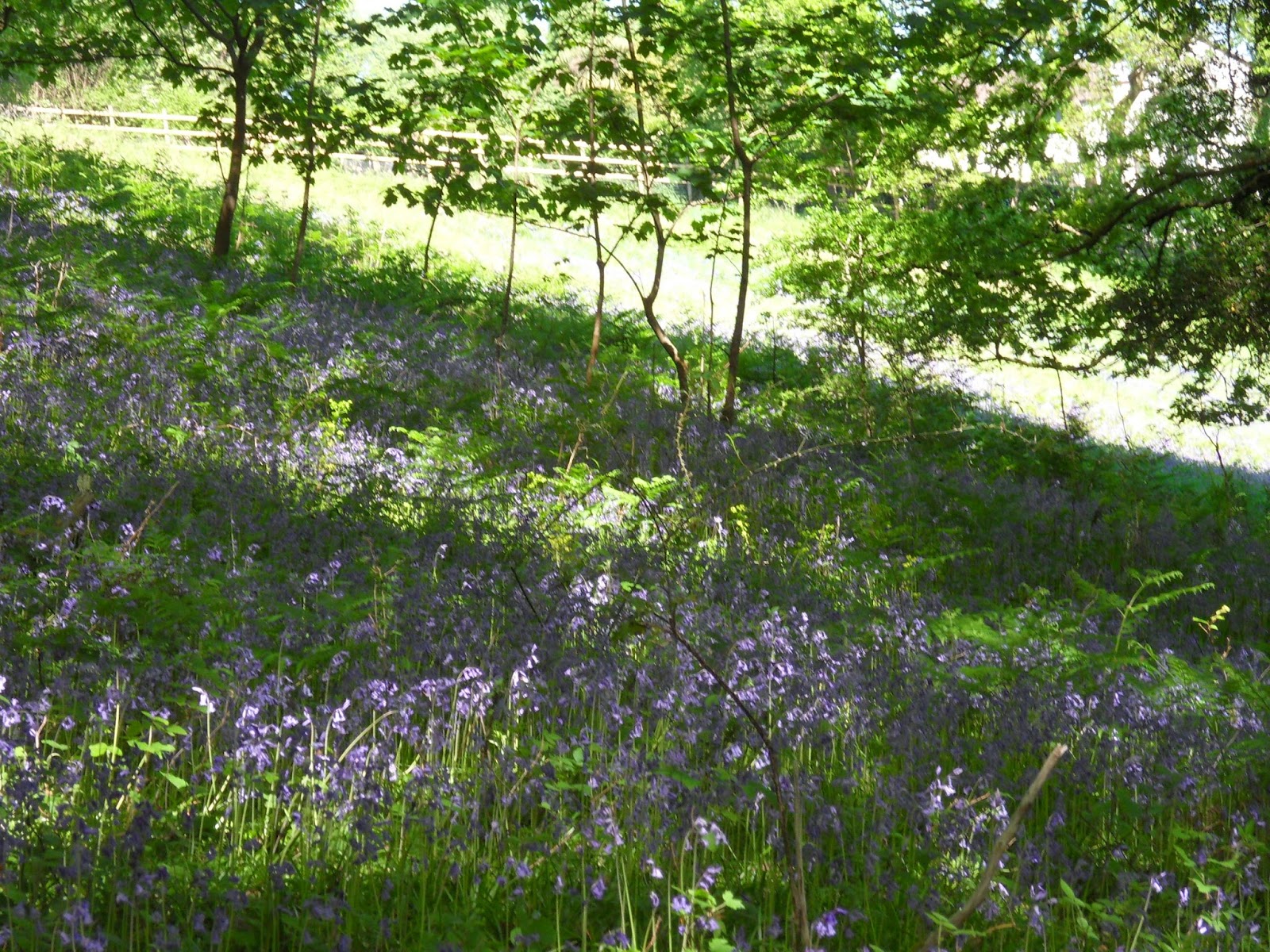
No doubt we'll be visiting some of our local bluebell woods at the appropriate time. Here are just two we have walked through in the past couple of years.
With such a visual joy outside the window, it seems a little perverse to be looking forward a couple of months to when bluebells will be with us. To explain, this leap to late April was prompted by a Facebook link to a #lovecornwall ad posted by a friend (thank you, JP, the Sage of Bray Shop). I was intrigued by the title 'If you hear a bluebell ring' and really enjoyed the accompanying video clip. If a bluebell rang, I wonder what it would sound like? Whatever the sound, I think 'tintabulation' would be an apt word to use for it. Enjoy the video and imagine the scent of a thousand bluebells wafting over you.
I might not have known that almost half of the global population of our Common bluebell (Hyacinthoides non-scripta) is found in the British Isles but I did know that hybridisation with the Spanish Bluebell (Hyacinthoides hispanica) is a big problem in some areas, although quite how and when these aliens got into the British countryside remains a bit of a mystery (no doubt some UKIP supporters will be saying "These damn EU migrants coming over here pinching our woodlands etcr).
Something else I didn't know about bluebells is where the non-scripta term came from. It's Latin, of course, and means 'not marked or not written'. It refers to a Greek myth in which, when Hyacinthus died, a flower sprang up from his grave. The tears of his lover, the god Apollo, falling on the plant, left markings on the petals which read “Alas!” There are no markings on Hyacinthoides non-scripta and their absence distinguishes bluebells from the flower of the mythological Hyacinth.
And here are some bluebell facts that we all really need to know:
* In the Bronze Age, people used bluebell glue to attach feathers to their arrows
* The Victorians used the starch from crushed bluebells to stiffen the ruffs of their collars and sleeves
* Bluebell sap was used to bind pages to the spines of books
* According to folklore, hearing a bluebell ring is a sign of impending death. Fairies appear to be spared this fate.
* Bees can 'steal' nectar from bluebells by biting a hole in the bottom of the bell, reaching the nectar without pollinating the flower.
* The ability to turn a bluebell flower inside out is the sign of a great lover. Guess what I can do?
No doubt we'll be visiting some of our local bluebell woods at the appropriate time. Here are just two we have walked through in the past couple of years.
![]() |
| Alongside the old Plym Valley railway line, now a rather nice walking trail. |
| Burrator Woods on the western fringes of Dartmoor, possibly one of the best places to see bluebells? |
Friday, 14 March 2014
A little daft science..............
Actually it's flatter - or so this article in the Journal of Improbable Research would have us believe. I like this sort of science: it's daft, I can understand it and it makes me laugh. Here's the article almost in its entirety. Perhaps it will amuse you as well. Perhaps it will inspire someone to replicate the study to find out how flat Norfolk is? Perhaps I should take some pills and lie down.
PS: Like the Jumbo saga, this one has a while to run yet. You have been warned.
PPS: For my more insular readers, Kansas is a state in the USA somewhere near the top. It sounds a bit like Holland but with less water, fewer tulips and more crops.
******************************************************
******************************************************
Kansas Is
Flatter Than a Pancake (Mark Fonstad,
William Pugatch, and Brandon Vogt).
In this report, we apply basic scientific techniques to answer the question “Is Kansas as flat as a pancake?” While driving across the American Midwest, it is common to hear travellers remark, “This state is as flat as a pancake.” To the authors, this adage seems to qualitatively capture some characteristic of a topographic geodetic survey 2. This obvious question “how flat is a pancake” spurned our analytical interest, and we set out to find the ‘flatness’ of both a pancake and one particular state: Kansas.
A Technical
Approach to Pancakes and KansasIn this report, we apply basic scientific techniques to answer the question “Is Kansas as flat as a pancake?” While driving across the American Midwest, it is common to hear travellers remark, “This state is as flat as a pancake.” To the authors, this adage seems to qualitatively capture some characteristic of a topographic geodetic survey 2. This obvious question “how flat is a pancake” spurned our analytical interest, and we set out to find the ‘flatness’ of both a pancake and one particular state: Kansas.
Barring the acquisition
of either a Kansas-sized pancake or a pancake-sized Kansas, mathematical
techniques are needed to do a proper comparison. Some readers may find the
comparing of a pancake and Kansas to be analogous to the comparing of apples
and oranges; we refer those readers to a 1995 publication by NASA’s Scott
Sandford 3, who used spectrographic techniques to do a comparison of
apples and oranges.
One common method of quantifying ‘flatness’ in
geodesy is the ‘flattening’ ratio. The length of an ellipse’s (or arc’s)
semi-major axis a is compared with its measured semi-minor axis b using the
formula for flattening, f = (a – b) / a. A
perfectly flat surface will have a flattening f of one, whereas an ellipsoid
with equal axis lengths will have no flattening, and f will equal zero. For
example, the earth is slightly flattened at the poles due to the earth’s
rotation, making its semi-major axis slightly longer than its semi-minor axis,
giving a global f of 0.00335. For both Kansas and the pancake, we approximated
the local ellipsoid with a second-order polynomial line fit to the
cross-sections. These polynomial equations allowed us to estimate the local ellipsoid’s
semi-major and semi-minor axes and thus we can calculate the flattening measure
f.
![]() |
| Figure 1. (a) A well-cooked pancake and (b) Kansas. |
Materials
and Methods
![]() |
| Figure 2. Pancake cross-sectional surface being digitized. |
![]() |
| Figure 3. When viewed at a scale of 50 mm, a pancake appears more rugged than the Grand Canyon |
Results
The topographic transects of both Kansas and a pancake at millimeter scale are both quite flat, but this first analysis showed that Kansas is clearly flatter (see Figure 4).
Mathematically, a value of 1.000 would indicate perfect, platonic flatness. The calculated flatness of the pancake transect from the digital image is approximately 0.957, which is pretty flat, but far from perfectly flat. The confocal laser scan showed the pancake surface to be slightly rougher, still. Measuring the flatness of Kansas presented us with a greater challenge than measuring the flatness of the pancake. The state is so flat that the off-the-shelf software produced a flatness value for it of 1. This value was, as they say, too good to be true, so we did a more complex analysis, and after many hours of programming work, we were able to estimate that Kansas’s flatness is approximately 0.9997. That degree of flatness might be described, mathematically, as “damn flat.”
Conclusion
Simply put, our results show that Kansas is considerably flatter than a pancake.
Notes
1. The photograph of Kansas is of an area near Wichita, Kansas. It may be of significance that the town of Liberal, Kansas hosts the annual ‘International Pancake Day’ festival.
2. To pump up our cross-disciplinary name-dropping, we should also mention that recently some quick-thinking cosmologists also described the universe as being “flatter than a pancake” after making detailed measurements of the cosmic background radiation.
3. “Comparing Apples and Oranges,” S.A. Sandford, Annals of Improbable Research, vol. 1, no. 3, May/June 1995.
1. The photograph of Kansas is of an area near Wichita, Kansas. It may be of significance that the town of Liberal, Kansas hosts the annual ‘International Pancake Day’ festival.
2. To pump up our cross-disciplinary name-dropping, we should also mention that recently some quick-thinking cosmologists also described the universe as being “flatter than a pancake” after making detailed measurements of the cosmic background radiation.
3. “Comparing Apples and Oranges,” S.A. Sandford, Annals of Improbable Research, vol. 1, no. 3, May/June 1995.
Wednesday, 12 March 2014
Short break at Boscundle Manor near St Austell
We've just enjoyed a short break at Boscundle Manor, just outside of St Austell. St Austell? Why St Austell of all places? Because we got a good deal and the place came highly recommended by some discerning friends (yes, we do have some). In the event they were spot on and we'd recommend the place as well.
Just two nights but we managed to wander around the old china clay port at Charlestown, walked a 6.5 mile stretch of the Coastal Footpath from Fowey west to Porthmear and spend a morning at the Lost Gardens of Heligan and Mevagissey. All-in-all, an extremely pleasurable way of spending 48 hours. Can't wait for the next time.
| Sailing ships in the harbour at Charlestown. No longer a working port but making a good living as an attraction for tourists and film makers. |
| Looking east back up the estuary to whence we started our walk. Fowey to the left and Polruan to the right. |
| Looking west to where we are heading. In the far distance is the outline of Dodman's Point. |
| Odd things by the wayside Part 1: a surfing doggy thing, carefully placed by the side of the path. |
| Here the boardwalk had been shifted several feet inland by the recent storms. |
| I spy a tea shop over there! |
| Looking back - and down - on Polkerris. Quite a small place but with a decent pub and café on the beach. |
| Odd things by the wayside Part 2: a small hairbrush stuck into a gatepost. |
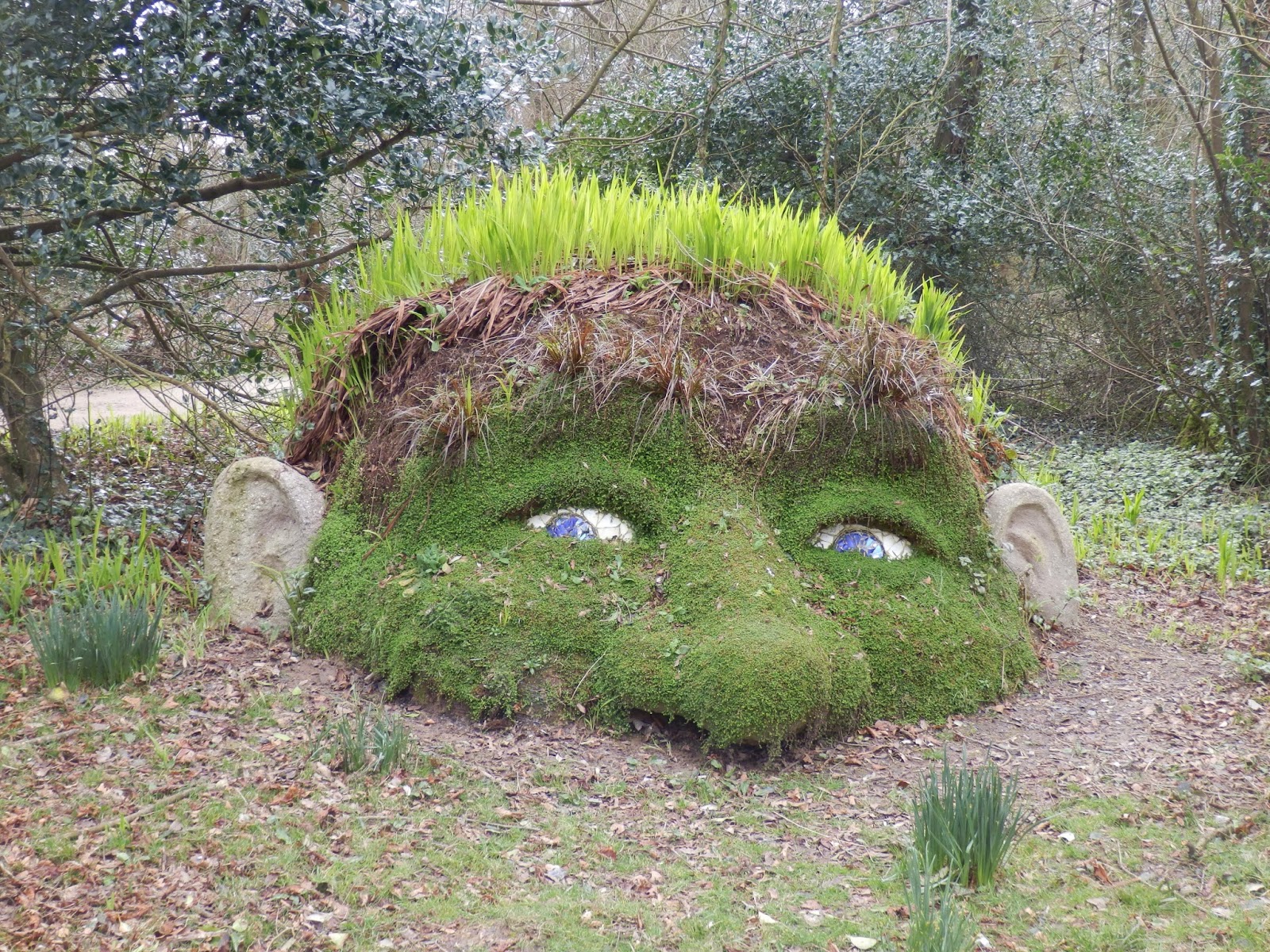
| The Giant's Head sculpture at the Lost Gardens of Heligan. Not at its best this time of year but you do get a good idea of its shape before the growth really takes over. |
| Heligan looking, mmm, green. |
| Just one of the many batches of chestnut mushrooms growing in the mushroom shed. All destined for the on-site restaurant. |
Labels:
Boscundle,
Coastal footpath,
Heligan,
St Austell
Subscribe to:
Posts (Atom)